Green
The green, the common before it was a party colour.
- Origin
- South East, England
- Famous bearer
- Graham Greene (1904–1991), novelist; The Power and the Glory, Brighton Rock, The Quiet American
- Register
- English family
The Green arms and country

Coat of armsEscutcheon of the Green baronets of Marass (1786)Borne by the Marass line, one branch of the name rather than all of it.Charles Matthews · CC BY-SA 4.0 
Coat of armsEscutcheon of the Green baronets of Milnrow (1805)Borne by the Milnrow line, one branch of the name rather than all of it.Charles Matthews · CC BY-SA 4.0
.svg)
.svg)
- Coat of arms: Granted to an individual and inherited down that one documented line. These are the arms of particular families of the name, not of everyone who shares the surname.
CoreHistoric reach
The seat of Green
Seat vacantChief
No one leads the Green community yet. When the movement opens, you can stand for its leadership, or help elect whoever does.
Current mission
No shared goal set yet. Once Green has leadership, it sets the public focus: a restoration, a gathering, a real-world project that helps its own.
The Green clan is being rebuilt. Join the waiting list for the movement today, and you help decide who leads it and what it does.
Help rebuild the Green clan →What does the Green name mean?
Descriptive or locative, the green, the one who wore green at May games.
The history of Green
The village green, the clerk, and a tax people fought
A four-year study led by the University of the West of England, concluded in 2016 and published as the Oxford English Dictionary of Family Names in Britain and Ireland, read sources from the eleventh century to the nineteenth and found that more than ninety per cent of its 45,602 surnames were native to Britain and Ireland. Its project leader, Richard Coates, singled Green out by name as one of the surnames that records a place rather than a trade or a father: it relates, he said, to a village green. The machinery that produced such names arrived with the Norman administration, hereditary surnames in England being generally traced to the preparation of the Domesday Book in 1086, taken up first among the feudal nobility and gentry and spreading downward so slowly that only by the fourteenth century did most people in England and Scotland carry one. They were not welcomed. In late medieval England compulsory surnames were resisted, because everyone understood what they were for: taxation. The clerks doing the recording worked in a conquered country's second language, the language of official documents having shifted from Old English to Latin after 1066 and Norman given names such as William, Robert and Richard having displaced the Anglo-Saxon ones; an English descriptive byname like Green survived that whole apparatus because it described something a Latin-writing clerk could still see out of the door.
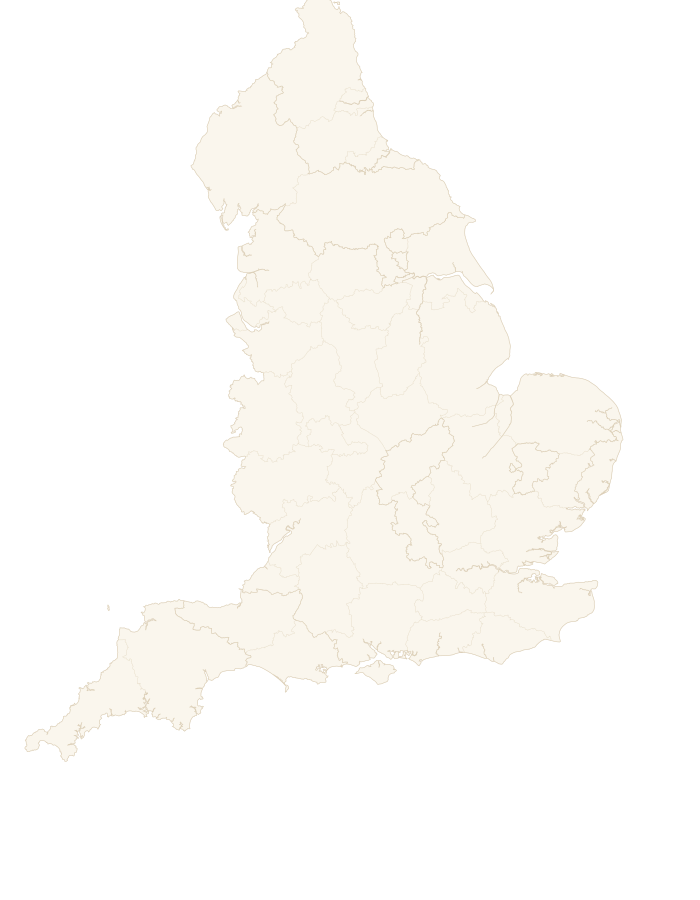
The families carrying the name today sit thickest across Kent, Surrey, both Sussexes, Hampshire, Berkshire and Oxfordshire, Buckinghamshire, Essex, Hertfordshire and Bedfordshire, Norfolk, Suffolk and the Cambridgeshire fens, over an older spine through London, the West Country, Gloucestershire, Staffordshire, Warwickshire, Shropshire, the Black Country and every riding of Yorkshire.
The baker's boy in the mill on Belvoir Hill
George Green was born on the fourteenth of July 1793 at Sneinton, then a village on the eastern edge of Nottingham, the only son of George Green the elder, a master baker who in 1807 built the brick-tower windmill on Belvoir Hill that still stands as Green's Windmill. The boy went to school for a year and a half, between the ages of eight and nine, to Robert Goodacre's Academy in Upper Parliament Street, the best school in Nottingham. That was the whole of his formal education before Cambridge. He worked in his father's bakery from boyhood and in the mill from his early teens, and the arithmetic of grain and grinding was the only mathematics anyone expected of him.
What he learned beyond Goodacre's he taught himself out of borrowed books. In 1823, at the age of thirty, he was admitted a member of the Bromley House Subscription Library in Nottingham, and Bromley House had on its shelves the leading French mathematical literature of the day: Lagrange, Laplace, Lacroix, Poisson, Cauchy. The intellectual world of Sneinton in the 1820s was a small one, and it was sufficient. Everything Green afterwards did to European physics he built out of that reading, done in whatever hours a working miller had left, under the sails his father had raised over Sneinton in 1807.
An essay printed at Bridlesmith Gate, 1828
In March 1828, working in a small room at the top of the mill, Green finished a treatise he called An Essay on the Application of Mathematical Analysis to the Theories of Electricity and Magnetism. He was thirty-five. There was no learned society to carry it, so he published it by private subscription in Nottingham, printed by T. Wheelhouse of Bridlesmith Gate, with fifty-one subscribers found for him by his patron, the local squire Sir Edward Bromhead. The press run was small, and for almost twenty years the work was effectively unknown to the wider scientific community.
It was nevertheless one of the most original pieces of mathematics produced in nineteenth-century England. The Essay introduced what Green named the potential function, the scalar function whose gradient is the force. It stated and proved the integral identity now universally called Green's theorem, which relates an integral taken over a region to an integral taken over that region's boundary. And it set out the integral representation now called the Green's function, the response of a linear system to a point source, from which the response to any distribution of sources can be assembled by superposition. That last device became one of the central working instruments of every mathematical physics that followed it, from electrostatics through acoustics to quantum field theory.
The forty-year-old undergraduate of Gonville and Caius
Bromhead, who understood what his miller had done, pressed Green to read for a degree. He went up to Gonville and Caius College in October 1833 at the age of forty, took his Bachelor of Arts as Fourth Wrangler in the mathematical tripos of January 1837, and was elected a fellow of Caius in October 1839. In the four years between the degree and his death he produced six further mathematical papers, on the reflection and refraction of light, on the equilibrium of fluids, on wave motion in canals, and on the propagation of sound in tubes; each is a permanent contribution to its field.
He fell ill in the winter of 1840 and went home to Sneinton, where he died on the thirty-first of May 1841 in his forty-eighth year and was buried in the churchyard of St Stephen, fifty yards from the mill. The Essay was rediscovered in 1845 by William Thomson, the future Lord Kelvin, then a twenty-one-year-old Cambridge undergraduate who came upon a copy in the library of his coach William Hopkins, and who had it reissued through the Journal für die reine und angewandte Mathematik. From that reissue Green's work entered the mainstream of European mathematical physics and has never left it. The name in modern science begins above a Nottingham windmill.
A short history, a borrowed name and the Greene spelling
The name's second great line is written rather than calculated. J. R. Green (1837–1883) published A Short History of the English People in 1874, the foundational work of popular English historiography. Graham Greene (1904–1991) carried the variant spelling that survives alongside Grene, and wrote Brighton Rock, The Power and the Glory and The Quiet American. Henry Green (1905–1973) was not born to the name at all: Green was the pen name under which Henry Yorke published Living, Party Going and Loving.
Around those three the name has carried an unusual weight of authorship. F. L. Green (1902–1953) and G. F. Green (1911–1977) were both British authors; Candida Lycett Green (1942–2014) a British writer and Marian Green (born 1944) an English one; Geoffrey Green (1911–1990) a British sports writer; Yvonne Green (1957–2024) an English poet, translator and barrister. The historians repeat the pattern that J. R. Green began: E. H. H. Green (1958–2006), Oliver Green (born 1951) and Jeffrey Green (born 1944) were all British historians, and Nile Green (born 1972) an American one.
Grün, the ordinances of 1790 and 1808
A second European route into the name runs through law rather than landscape. In 1790 Prussia enacted the Hoym Ordinance at Breslau, requiring Jewish families to take fixed hereditary surnames; Napoleon issued a decree to the same effect in 1808, binding across the territories governed under his code. Families with no trade name and no village name to fall back on took ornamental surnames instead, names chosen for what they meant rather than for what the bearer did, a practice common among the Eastern Ashkenazi communities of Germany and Austria. Grün (green) belongs to that class of chosen names, and it travelled westward with the families who carried it. The same administrative impulse ran through Europe under the Napoleonic Code, which required that a person be known by a family name that would not change between generations, and through the Netherlands between 1795 and 1811.
The route out of Europe rewrote the spelling again. European Jews arriving in the United States, and particularly those fleeing Nazi persecution, sometimes anglicised their surnames to avoid discrimination, and Grün became Green. Bearers of the modern name in Israel and in Jewish America include Yossi Green (born 1955), the Jewish American composer; Yehuda Green (born 1959), the Israeli singer and composer; Dror Green (born 1954), the Israeli psychotherapist; and Yaniv Green (born 1980), the Israeli basketball player.
Engravers, architects and readers of rock and sun
The name attaches itself repeatedly to people who made or measured things. Amos Green (1735–1807) was an English painter and Valentine Green (1739–1813) a British engraver; William Green (1775–1860) played the Northumbrian smallpipes; Alexander Henry Green (1832–1896) was an English geologist. Leslie Green (1875–1908) and William Curtis Green (1875–1960) were both English architects, and Cecil Howard Green (1900–2003) an English-American geophysicist and businessman.
The scholarly bearers run to the present. Dennis Howard Green (1922–2008) was an English philologist, Celia Green (born 1935) a British philosopher, Lucie Green (born 1975) a British astrophysicist. Zechariah Green (1817–1897) was an English philanthropist and healer, and Bryan Green (1901–1993) an English priest and author. On stage and screen it runs from Martyn Green (1899–1975), the English actor and singer, through Nigel Green (1924–1972), the British actor, Hughie Green (1920–1997), the British television host, and Pamela Green (1929–2010), the English model and actress, to Robson Green (born 1964). Nor is the name confined to Britain: Eva Green (born 1980) is a French actress, Marika Green (born 1943) a French-Swedish one, Lennart Green (born 1941) a Swedish magician, and Åke Green (born 1941) a Swedish Pentecostal pastor.
The resistance, the flying aces and six wins at Badminton
Sigrid Augusta Green (1920–2012) served in the Norwegian resistance. William Edward Green (1898–1940) was a British flying ace of the First World War and Wilfred Green (1898–1947) a British flying ace and Royal Air Force officer; Wilfrith Green (1872–1937) rose to brigadier-general in the British Army and Everard Green (1844–1926) served as a British army officer, while Percurt Green (1939–2025) reached lieutenant general in the Swedish army. Florence Green (1901–2012) was a British supercentenarian and veteran.
In sport the name's clearest achievement belongs to Lucinda Green (born 1953), the British equestrian who won the Badminton Horse Trials six times. Will Green (born 1973) played rugby union for England, Wally Green (1918–2007) rode speedway, Kay Green (1927–1997) played English cricket, Ellis Green (1880–1936) and Haydn Green (1887–1957) played English football, and Josie Green (born 1993) and Colin Green (born 1942) played it for Wales. In public life the name reaches from Beatrice Green (1894–1927), the Welsh labour activist, to the British politicians Walford Davis Green (1869–1941), Walter Green (1878–1958), Pauline Green (born 1948), Damian Green (born 1956) and Kate Green (born 1960).
Champions of the Green name
The bearers whose lives are inseparable from this surname. Each has their own page, biography, achievements, geography, connection to the family.
Historic Places, Rebuilt
Explore the streets and seats the Green name knew, rebuilt with AI as they stood in history.
The castles of the homeland
The great strongholds of the homeland, look one up, see what it looked like in its prime, and recreate it to explore.
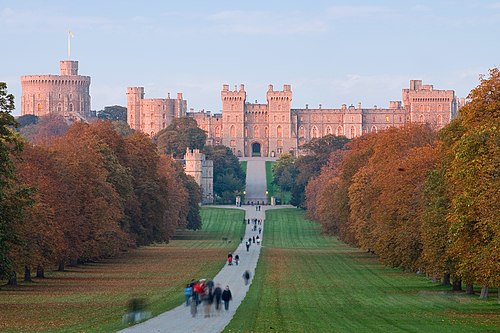 Windsor CastleRestored · prime 1820
 Tower of LondonRestored · prime 1285
 Bamburgh CastleRestored · prime 1904
All castles in England → · Strongest castles in England → · Castles of Europe
Play As Your Clan
Hold a real castle against whatever you choose to send at it, take a ship out in her own service years, or stand at the shoulder of someone the record remembers. The chronicler sets the scene; the deeds are yours.
Notable bearers of the Green name
- Graham Greene (1904–1991), novelist; The Power and the Glory, Brighton Rock, The Quiet American
- Henry Green (1905–1973), novelist (pen name of Henry Yorke); Loving, Living, Party Going
- J. R. Green (1837–1883), historian; A Short History of the English People (1874), foundational popular English historiography
- George Green (1793–1841), mathematician; Green's theorem and Green's functions in mathematical physics
- Lucinda Green (b. 1953), British equestrian, six-time Badminton Horse Trials winner