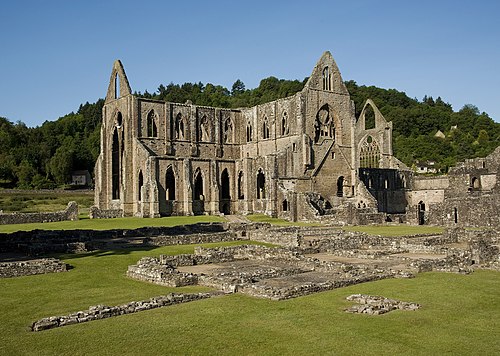
Wales · Ruin
White Castle
Y Castell Gwyn
White Castle (Castell Gwyn) is a medieval ruined castle near Llantilio Crossenny in Monmouthshire, Wales, built by the Normans and substantially rebuilt in the 13th century as a concentric stone fortification. It comprises an inner ward set in a deep, water-filled revetted moat, an outer ward with curtain wall and mural towers, and a crescent-shaped southern hornwork. The site is today a scheduled monument managed by Cadw.
First raised
1130
Its prime
1260
Today
Ruin
As it stood in 1260
What White Castle looked like in its prime.
At its prime the castle presented white-rendered external stonework over red sandstone, with a compact inner ward surrounded by a deep, revetted, water-filled moat and four tall, circular, four-storey mural towers. The inner gatehouse, flanked by two round towers, led eastwards to the hall, constable’s lodgings and a chapel partly contained within a tower; domestic ranges and a kitchen lay against the inner curtain. To the north an outer ward with a stone curtain, four mural towers and an eastern gatehouse (with drawbridge and portcullis) faced a dry ditch, while a crescent hornwork defended the southern approach, originally linked by a timber bridge.
Its story
The story of White Castle.
A Norman Frontier Castle, 1066–1135
White Castle was established in the wake of the Norman invasion of England in 1066, as the Normans pushed into the Welsh Marches and William the Conqueror made William fitz Osbern Earl of Hereford; fitz Osbern went on to capture Monmouth and Chepstow. Possibly commissioned by fitz Osbern himself, the castle, originally called Llantilio Castle, was one of three fortifications built in the Monnow valley alongside Grosmont and Skenfrith to protect the route from Wales to Hereford, overlooking the manor of Llantilio Crossenny and the River Monnow. The first castle was built from earth and timber, with three large earthworks forming an inner and outer ward and a hornwork guarding the main entrance to the south; a mill was built at Great Trerhew to grind corn for the garrison.
The earldom's landholdings were broken up after fitz Osbern's son, Roger de Breteuil, rebelled against the Crown in 1075. Following a major Welsh revolt in 1135, King Stephen restructured the Marcher landholdings, bringing White Castle back under Crown control together with Grosmont and Skenfrith to form the lordship known as the "Three Castles".
Stone Walls Against the Welsh, 1170s–1186
Conflict with the Welsh resumed after a period of détente under Henry II: the de Mortimer and de Braose Marcher families attacked their Welsh rivals during the 1170s, provoking a Welsh assault on nearby Abergavenny Castle in 1182. The Crown readied White Castle in response, and between 1184 and 1186 Ralph of Grosmont carried out £128 of work, probably building a stone curtain wall around the inner ward and adding a small stone keep.
Hubert de Burgh, the de Braose Feud and the Rebuilding, 1201–1267
King John gave the Three Castles to Hubert de Burgh, his former household chamberlain, in 1201. At this time White Castle was primarily a military fortification holding a garrison and stores of arrows and crossbow bolts; the historian Cathcart King describes its accommodation as likely "miserable", "squalid" and "unpleasant". Hubert began upgrading the castles but was captured while fighting in France, and King John took the Three Castles back and gave them to his rival William de Braose, later dispossessing de Braose of his lands in 1207; de Braose's son retook the castles during the First Barons' War. Hubert regained power as justiciar and Earl of Kent, recovering the Three Castles in 1219, losing them again when he fell from favour in 1232, briefly regaining them in 1234, and losing them again in 1239 to the royal servant Walerund Teutonicus. In 1254 White Castle passed to Henry III's son, the future Edward I.
The castle was almost entirely rebuilt during the 13th century. Conventional dating places the work in the 1250s and 1260s, demolishing the old keep and adding a new gatehouse, four mural towers and a reinforced outer ward; the historian Paul Remfry argues instead that the work was carried out earlier, during Hubert's tenure, in two phases between 1229–1231 and 1234–1239. Remfry judges the finished castle "a masterpiece of military engineering" for the period. It is around this period that the fortification is first recorded as the "White Castle", after the white render applied to its walls. In 1262 White Castle was readied against Prince Llywelyn ap Gruffudd's attack on Abergavenny, and Grosmont, commanded by its constable Gilbert Talbot, was ordered garrisoned "by every man, and at whatever cost"; the threat passed without incident. In 1267 the Three Castles were granted to Edmund, Earl of Lancaster, and remained with the earldom, later duchy, of Lancaster for centuries.
Decline After 1282 and the Return to Ruin, 1282–1922
Edward I's conquest of Wales in 1282 stripped away much of White Castle's military purpose, though it continued to be used to administer the surrounding manor and to muster levies. Little further work was carried out beyond a repaired gatehouse tower and, under Henry VI, repairs to the chapel tower and gatehouse; by 1538 the castle had fallen into disuse, and a 1613 description found it "ruynous and decayed".
The Three Castles were sold in 1825 to Henry Somerset, sixth Duke of Beaufort; his descendant, the ninth Duke, sold White Castle to Sir Henry Mather Jackson in 1902. Evidence given to the Royal Commission on Ancient Monuments in 1909 recorded that Sir Henry had stripped the castle of ivy and that it was kept by an old woman who charged visitors for entry. The castle was placed into state care in 1922 and is now managed by Cadw; it is a Grade I listed building and a scheduled monument.
Step inside
10 places to explore in 1260.
The record describes 10 distinct spots at White Castle, including 5 interiors: outer ward, north‑west barn and service plots, inner gatehouse, entrance passage, inner courtyard, great hall and constable's quarters and more. Create your own photoreal reconstruction and explore every one, more scenes means more rooms, more angles, and more of the place to stand in.
Build Your Own Castle
Recreate White Castle with AI to explore it.
The artist rebuilds it as it stood in 1260, a photoreal reconstruction that belongs to you alone. Pay with coins, no subscription needed.
Recreate this castle →Defend this castle →Whose castle
Clans who held White Castle.
The families that held White Castle for a decade or more across its history, follow a name to its clan.
Granted to Hubert de Burgh by King John in 1201; he recovered the Three Castles in 1219.
Lancaster
Granted to Edmund, Earl of Lancaster, in 1267; held by the earldom, later duchy, of Lancaster until 1825.
From the archive
White Castle on paper: the measured plan and period views.
The survey plan and photographs below are the ground truth this page's reconstructions are checked against, drawn and photographed while the castle was still a working garrison. Every image is public-domain or openly licensed, with its source named.
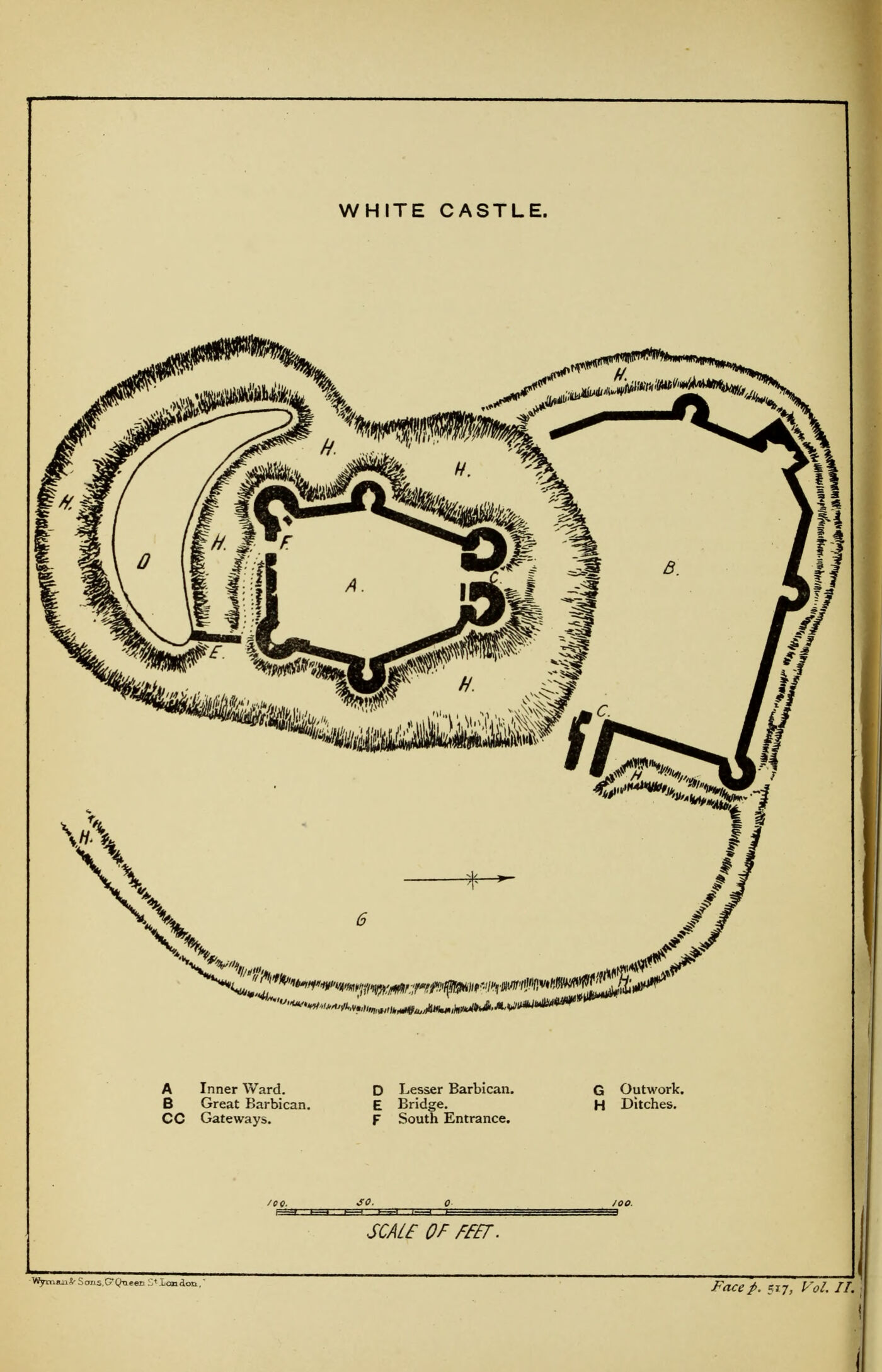
WHITE CASTLE.
1884 · G. T. Clark, Mediaeval Military Architecture, vol. 2 (1884)
Public domain