England · Ruin
Middleham Castle
Middleham Castle is a compact, largely ruinous medieval castle in Middleham, North Yorkshire, built from 1190 and substantially adapted in the 13th–15th centuries. It consists of a very large square Norman keep set within a concentric 13th-century curtain wall, with 15th-century residential ranges added against the inner face. The site includes the nearby earlier motte (William's Hill) and today is an English Heritage care site.
First raised
1190
Its prime
1475
Today
Ruin
As it stood in 1475
What Middleham Castle looked like in its prime.
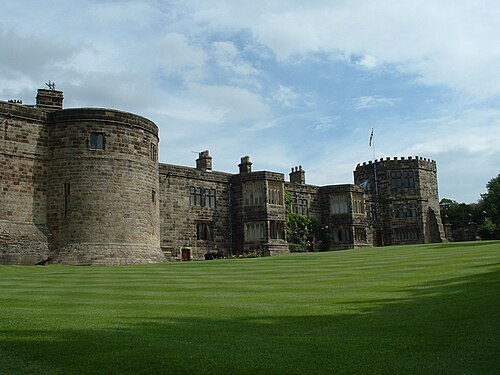
A compact rectangular castle of grey stone: a massive two-storey square Norman keep with turrets at each corner and midway along the walls, set concentrically within a 13th-century curtain wall. Extensive 15th-century residential ranges lean against the inner face with first-floor bridges linking them to the keep; the north-east approach has a towered gate, and the castle sits above surrounding pastures with the earlier motte visible to the south-west. At its prime the roofs, halls and connecting bridges were intact.
Its story
The story of Middleham Castle.
Robert Fitzrandolph's Keep, 1190
Middleham Castle was begun in 1190 by Robert Fitzrandolph, 3rd Lord of Middleham and Spennithorne, to guard the road from Richmond to Skipton and the area of Coverdale. It replaced an earlier motte-and-bailey nearby, William's Hill, whose site can still be seen; historians believe the old castle's defences were timber, and Pevsner judged its 40-foot motte far better placed to command the road than the stone castle that superseded it.
The keep rose only two storeys, yet at 105 feet from north to south and 78 feet from west to east it is one of the largest in England, with two originally vaulted chambers on the ground floor, two grand halls above, and a first-floor entrance reached by staircase. In the 13th century a curtain wall was thrown concentrically around it, making the castle compact and defensible, though it was built more for comfort than security.
The Nevilles and the Kingmaker, 1270–1471
In 1270 the castle came into the hands of the Neville family, whose most famous member was Richard Neville, 16th Earl of Warwick, the "Kingmaker", a leading figure in the Wars of the Roses. After Richard, Duke of York, was killed at Wakefield in December 1460, his younger son Richard, Duke of Gloucester, came into Warwick's care and lived at Middleham with the earl's family. In 1469 the castle briefly held a king: Edward IV, captured by Warwick, was imprisoned there for a short time.
The Nevilles turned the fortress into a residence fit for nobles of their stature, building an impressive range of halls and outbuildings against the curtain walls, linked to the keep by bridges at first-floor level, and raising the ceiling above the great hall.
Richard III and the Rounde Towre
After Warwick fell at Barnet in 1471 and Edward IV was restored to the throne, Richard of Gloucester married Anne Neville, Warwick's younger daughter, and made Middleham his main home. Their son Edward, known as Edward of Middleham, was born at the castle around 1473 or 1476 and died there in 1484. Tradition places his birth in the south-west tower, sometimes called the Prince's Tower on that account, but there is no documentary evidence for it: a survey of 1538 refers to it simply as the "Rounde Towre".
Richard ascended the throne as King Richard III but spent little or no time at Middleham during his two-year reign. After his death at Bosworth in 1485 the castle was seized by Henry VII.
"Untenable and No Garrison", 1644
The castle remained in royal hands until the reign of James I. Under Elizabeth I, Lord Huntingdon had proposed demolishing it entirely for eventual conversion into a manor house, setting out the plan in a letter to the Lord Treasurer along with its possible use by the queen on her royal duties; nothing came of it. The castle passed to Sir Henry Linley in 1604 and was sold to the Wood family in 1662, who held it until 1889.
In 1644 a parliamentary committee sitting in Yorkshire ordered that the castle was "untenable and no garrison should be kept there"; in 1654 and 1655 it nonetheless housed a garrison of thirty men and was capable of holding prisoners, though no action or siege is recorded at the site. Some of the walls were later blown away and the ruin became a public quarry, its stones reused in many of the buildings of Middleham village. English Heritage took the ruins into care in 1984, and the castle is now Grade I listed.
Step inside
11 places to explore in 1475.
The record describes 11 distinct spots at Middleham Castle, including 3 interiors: keep ground floor vaulted chambers, great hall and raised ceiling, south-west 'rounde towre' (prince's tower). Create your own photoreal reconstruction and explore every one, more scenes means more rooms, more angles, and more of the place to stand in.
Build Your Own Castle
Recreate Middleham Castle with AI to explore it.
The artist rebuilds it as it stood in 1475, a photoreal reconstruction that belongs to you alone. Pay with coins, no subscription needed.
Recreate this castle →Defend this castle →Whose castle
Clans who held Middleham Castle.
The families that held Middleham Castle for a decade or more across its history, follow a name to its clan.
Fitzrandolph
Built by Robert Fitzrandolph, 3rd Lord of Middleham and Spennithorne, from 1190.
Neville
Held by the Neville family from 1270, most famously Richard Neville, Earl of Warwick, the "Kingmaker", until seized by Henry VII in 1485.
Held by the Wood family, 1662–1889.
Nearby