Scotland · Ruin
Fast Castle
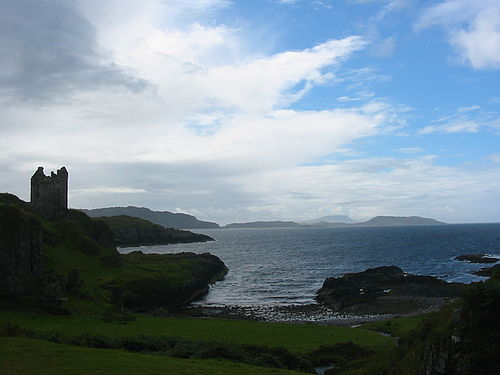
Fast Castle is the ruined remains of a coastal fortress on a narrow promontory in Berwickshire, in the Scottish Borders of south-east Scotland. In its prime it comprised a keep and courtyard encircled by curtain walls and towers, reached by a drawbridge over a narrow ravine; today only foundations and fragments of wall survive and the site is a Scheduled Ancient Monument.
First raised
1522
Its prime
1566
Today
Ruin
As it stood in 1566
What Fast Castle looked like in its prime.
Fast Castle in its prime occupied a narrow sloping plateau 27 by 82 metres at the tip of a rocky promontory, flanked by sheer cliffs up to 45 metres high falling to the North Sea. A continuous stone curtain wall with towers surrounded the plateau, terminating in a stout stone keep at the northern extremity; the landward approach crossed a narrow ravine by a barbican and drawbridge. The headland is grassy and the masonry coastal-grey.
Its story
The story of Fast Castle.
From Bernicia to Patrick Dunbar's Seizure, 1333-1419
It is unclear when the first structure appeared on the promontory. There is evidence of Iron Age habitation, and the site lay centrally in the British kingdom of Bryneich and its Anglo-Saxon successor state of Bernicia. Cliffs of up to 45 metres on either side rendered the castle relatively impregnable; it could be reached only by a drawbridge over a narrow ravine, protected by a barbican, and access to the sea was by a pulley system with a basket.
Fast Castle is first recorded in 1333. In 1346 the site was occupied by an English garrison and used as a base to pillage the surrounding countryside. In 1410 a force led by Patrick Dunbar, second son of the 10th Earl of Dunbar and March, seized the castle and imprisoned the governor, Thomas Holden. Its new Scots governor, William Haliburton, was also able to seize Wark Castle in Northumberland in 1419.
The Homes, Flodden and the Rebuilding, 1503-1522
The castle fell into the hands of the Home family, and in 1503 they hosted Margaret Tudor, daughter of Henry VII, at Fast Castle on her way to marry James IV. After the Scots' defeat and the death of James IV at Flodden in 1513, a battle in which numerous Homes were killed, a power struggle ensued between the Regent Albany and various nobles including Alexander Home, 3rd Lord Home, Chamberlain of Scotland. Fast Castle was destroyed in the chaos in 1515; Alexander Home was executed in 1516 and his land forfeited. The castle was rebuilt by 1522, when the Home estates were restored to his brother George Home, 4th Lord Home.
Rough Wooing to Drury's Brief Hold, 1547-1570
During the Rough Wooing of Scotland by Henry VIII the castle was captured again by the English in 1547, but was back in Scottish hands by the time Mary, Queen of Scots stayed there in 1566; the recapture is said to have been instigated by Madge Gordon, a Coldingham widow. On 11 July 1567 the English ambassador Nicholas Throckmorton stayed with the 5th Lord Home and was "intretyed very well, according to the state of the place, which is fitter to lodge prisoners than folks at liberty, as yt is very little so yt is very stronge".
After the rebellion known as the Rising of the North, Anne Percy, Countess of Northumberland, was lodged at Fast Castle in March 1570. That April an English force led by William Drury briefly held the castle, while the Earl of Sussex besieged Hume Castle, acting against the rebels and their supporters in Scotland. Some of the castle's guns, two brass merlins and four falcons, were taken to Berwick upon Tweed.
Robert Logan of Restalrig and Napier's Treasure Hunt, 1584-1609
Ownership passed to Robert Logan of Restalrig through his mother, a widow of Lord Home. In April 1584 the keepers of Fast Castle, Innerwick and Tantallon were commanded to surrender their castles to the crown. Logan was a notorious dissolute and "ne'er do well" who was implicated in the Gowrie conspiracy to kidnap the young James VI.
In 1594 he contracted with the mathematician John Napier, reputed a wizard, to search Fast Castle for treasure. Napier was to "do his utmost diligence to search and seek out, and by all craft and ingine to find out the same, and by the grace of God either find out the same, or make it sure that no such thing has been there", for a third of anything found. There is no record of any discovery he may have made. Logan died in 1606 and his estates were forfeited in 1609, his corpse having been exhumed and put on trial.
Fause Castle: Wrecking Lights, Ruin and the Scheduled Site
The castle was ruinous by then. It passed briefly to the Douglas family, then back to the Earls of Dunbar, then to the family of Arnot, back to the Homes and finally to the Hall family. Fast Castle was originally known as Fause, or False, Castle, on account of the lights hung from it to mislead shipping: shipmasters travelling in darkness would see them and reckon they had reached a safe haven, only to be guided on to rocks where wrecking parties awaited plunder. Sir Walter Scott is thought to have drawn on the place for the fictional Wolf's Crag in his 1819 novel The Bride of Lammermoor.
The Edinburgh Archaeological Field Society excavated the site between 1971 and 1986. It has been protected as a scheduled monument since October 1981, and lies just outside the St Abb's Head National Nature Reserve run by the National Trust for Scotland. The approach is from nearby Dowlaw farm by a steep trail, with a concrete footway in place of the drawbridge.
Step inside
8 places to explore in 1566.
The record describes 8 distinct spots at Fast Castle, including 3 interiors: central courtyard, keep interior (ground level), sea cave at cliff foot. Create your own photoreal reconstruction and explore every one, more scenes means more rooms, more angles, and more of the place to stand in.
Build Your Own Castle
Recreate Fast Castle with AI to explore it.
The artist rebuilds it as it stood in 1566, a photoreal reconstruction that belongs to you alone. Pay with coins, no subscription needed.
Recreate this castle →Defend this castle →Whose castle
Clans who held Fast Castle.
The families that held Fast Castle for a decade or more across its history, follow a name to its clan.
Home
Held by the Homes, Lords Home, through the 15th and 16th centuries; rebuilt by 1522 when the estates were restored to the 4th Lord Home, and returned to the family again before passing finally to the Halls.
Logan
Passed to Robert Logan of Restalrig through his mother, a widow of Lord Home.
The castle passed finally to the Hall family.
From the archive
Fast Castle on paper: the measured plan and period views.
The survey plan and photographs below are the ground truth this page's reconstructions are checked against, drawn and photographed while the castle was still a working garrison. Every image is public-domain or openly licensed, with its source named.
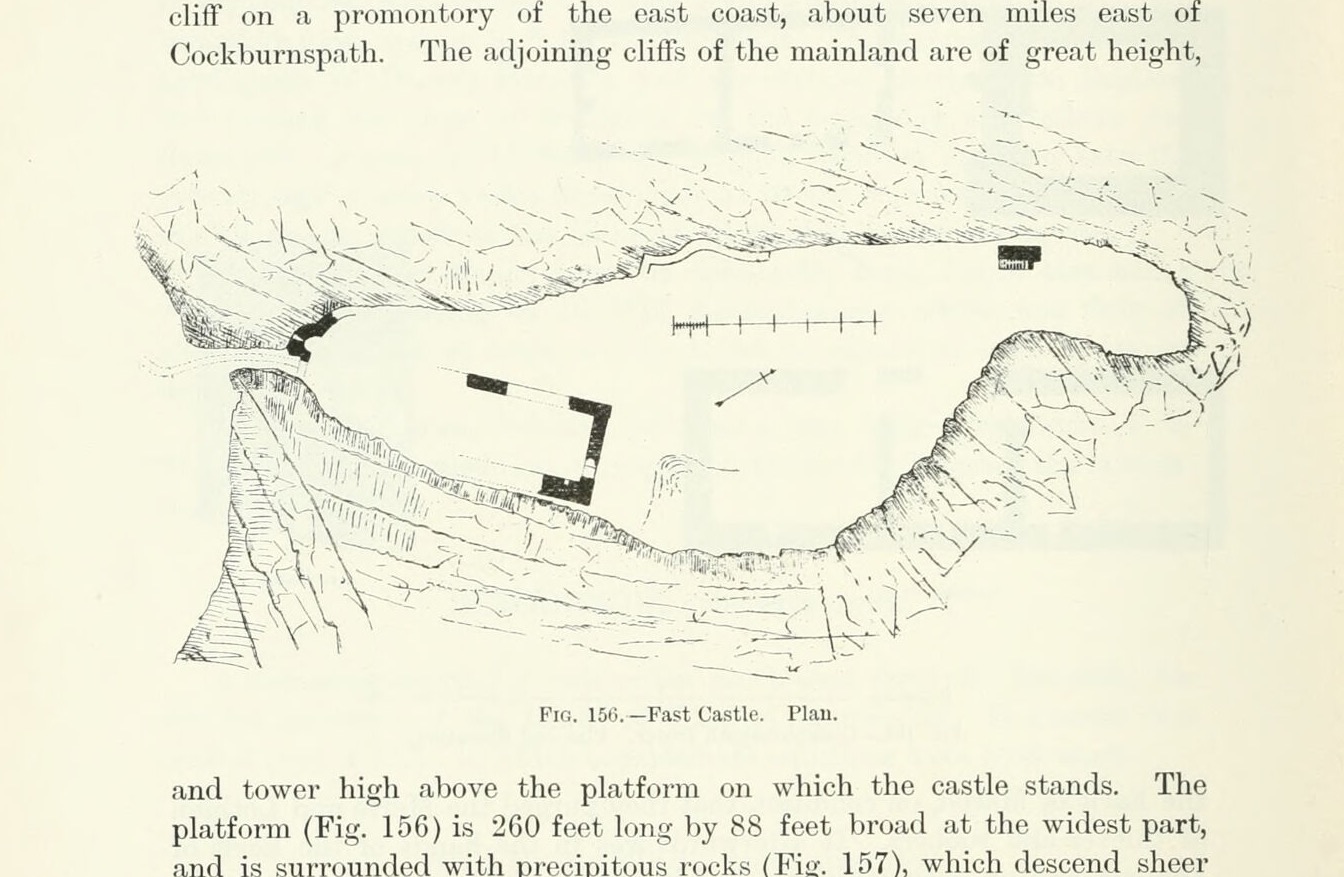
Fig. 156. Fast Castle. Plan.
1889 · MacGibbon & Ross, vol. 3 (1889)
Public domain
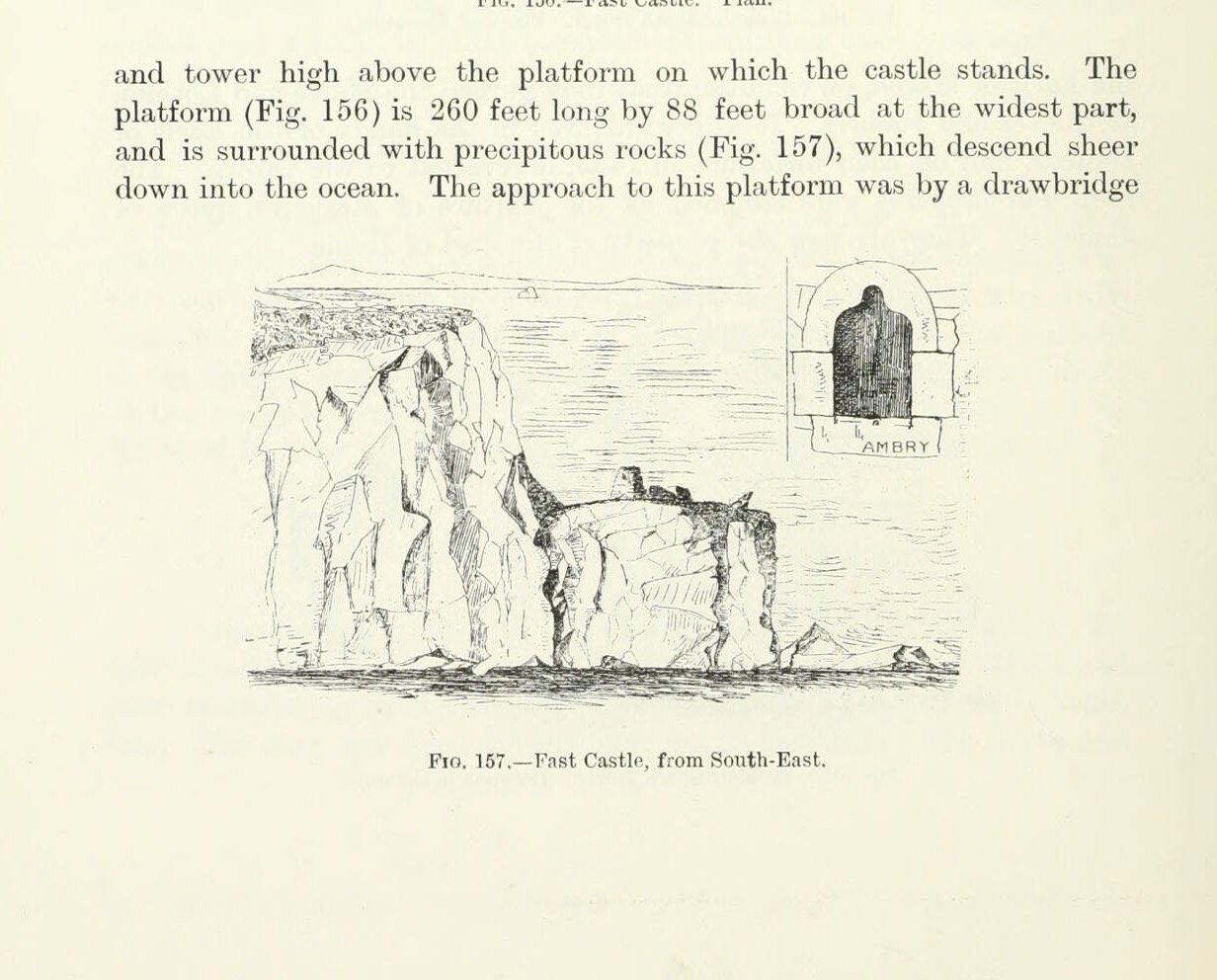
Fig. 157. Fast Castle, from South-East.
1889 · MacGibbon & Ross, vol. 3 (1889)
Public domain
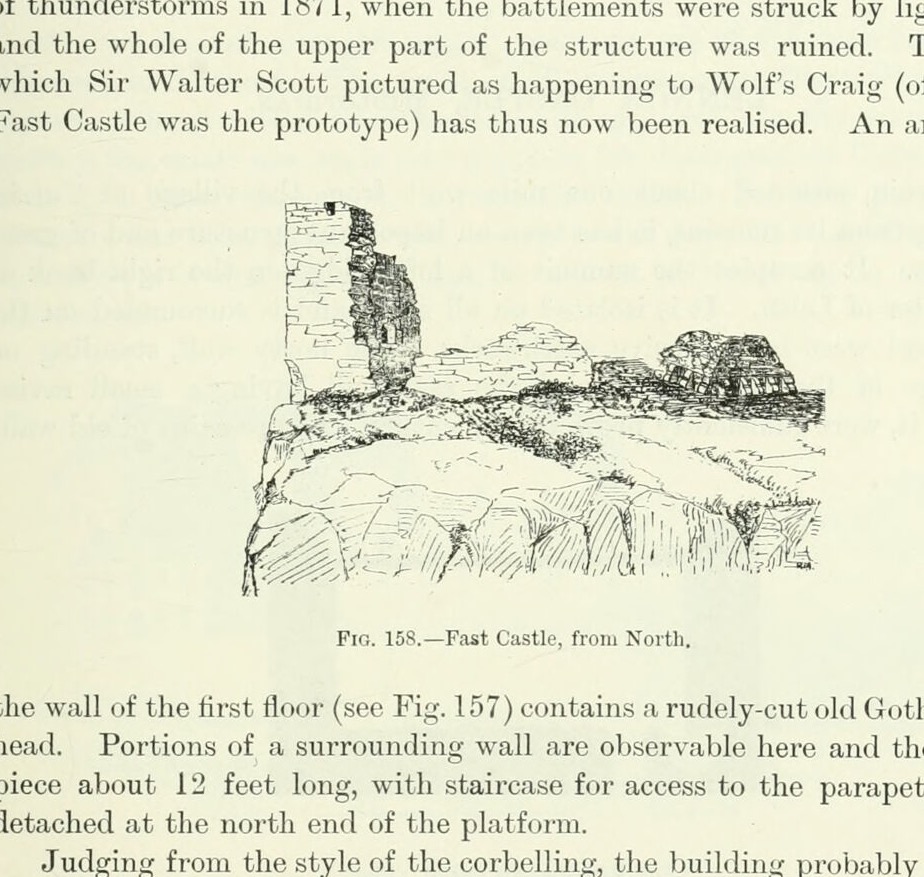
Fig. 158. Fast Castle, from North,
1889 · MacGibbon & Ross, vol. 3 (1889)
Public domain