
Scotland · Still standing
Glamis Castle
Glamis Castle is a large country seat in Angus, Scotland, long held by the Lyon / Bowes-Lyon family and open to the public. The present building largely reflects 17th-century fabric with later 18th–19th century interiors and extensive surrounding parkland. The estate includes formal approaches and an arboretum, and the castle contains a small private chapel and a clock tower that houses family archives.
First raised
1372
Its prime
1900
Today
Still standing
As it stood in 1900
What Glamis Castle looked like in its prime.
A sprawling red‑sandstone castellated house with a central round clock tower flanked by multiple cylindrical corner towers capped by conical slate roofs; crenellated parapets run along connecting ranges. The long east–west façade has many tall chimneys and gabled rooflines, with a gravel forecourt and broad lawns leading up to the entrance. Stone is warm pink‑red; many small mullioned windows puncture the walls. Front towers are roughly 7 m across and the curtain walls are about 1 m thick.
Its story
The story of Glamis Castle.
Malcolm II's Lodge and Robert II's Grant, 1372
People were on this ground long before the Lyons: the Eassie Stone, an intricately carved Pictish slab, was found in the bed of a burn at the nearby village of Eassie. In 1034 Malcolm II was murdered at Glamis, where a royal hunting lodge then stood; the castle's own account has him mortally wounded in a battle nearby and carried to the lodge, on the site of the present castle, to die. Shakespeare, writing Macbeth around 1605, gave his character the thanedom and lodged him here, though the historical King Macbeth, who died in 1057, had no connection with the castle.
A castle stood at Glamis by 1372, when Robert II granted it to Sir John Lyon, Thane of Glamis and husband of the king's daughter. It has been held by the Lyon, later Bowes-Lyon, family ever since. Early in the 15th century the building was rebuilt as an L-plan tower house, and in 1445 the title Lord Glamis was created for Sir Patrick Lyon (1402–1459), Sir John's grandson.
From that century comes the tale of "Earl Beardie", identified variously with Alexander Lyon, 2nd Lord Glamis (died 1486) and with Alexander Lindsay, 4th Earl of Crawford (died 1453). The versions differ, but all have him at cards on the sabbath; refused a game, he swore he would play until doomsday, or with the Devil himself. A stranger duly arrived to take up the hand (the Devil, in the telling), and carried off the Earl's soul, though in some versions he is still at the table.
Janet Douglas at the Stake, 1537
John Lyon, 6th Lord Glamis, married Janet Douglas, daughter of the Master of Angus, at a time when James V was feuding with the Douglases. Her husband died on 17 September 1528. That December Janet was accused of treason for bringing supporters of the Earl of Angus to Edinburgh, then charged with poisoning Lord Glamis, and finally accused of witchcraft; she was burned at the stake in Edinburgh on 17 July 1537. James V seized the castle and stayed at Glamis in November 1538. It was returned to John Lyon, 7th Lord Glamis, in 1543.
The castle's small chapel seats forty-six, and guides tell visitors that one place is always kept empty for the White Lady, the ghost supposed to walk here, generally taken to be Janet Douglas herself.
Patrick, Earl of Kinghorne, and the Commonwealth Garrison
In 1606 Patrick Lyon, 9th Lord Glamis, was created Earl of Kinghorne and began major works, commemorated by the inscription on the central tower: "Built by Patrick, Lord Glamis, and D[ame] Anna Murray". Tradition has linked the English architect Inigo Jones to the redesign, though Historic Environment Scotland consider the King's Master Mason William Schaw the likelier hand, given the traditional Scottish character of the architecture.
Soldiers were garrisoned at Glamis during the Commonwealth of England, Scotland and Ireland. When Patrick Lyon, 3rd Earl of Strathmore and Kinghorne, returned in 1670 he found the castle uninhabitable, and restoration ran until 1689, including the making of a major Baroque garden. Four "brazen" statues were set along the approach avenue in the 17th century (Charles I in boots, James VI in a stole, Charles II in Roman dress and James VII as in his Whitehall portrait) the first two sculpted by Arnold Quellin.
The Death of the 6th Earl, 9 May 1728
On 9 May 1728, after a funeral in Forfar, Charles Lyon, 6th Earl of Strathmore and Kinghorne, was killed by accident. Earlier that evening John Lyon of Brigton had behaved rudely at the house of the Earl's aunt, Lady Margaret Auchterhouse (who was also the sister of James Carnegie of Finhaven), and had pinched her arm. Outside, Brigton, who had harassed Finhaven verbally throughout the day, shoved him into a two-foot-deep kennel, an open sewer, on Castle Street. Humiliated, Finhaven drew his sword to answer him and ran through the Earl, who had stepped between the two men to pacify them.
Imprisoned in the Forfar Tolbooth, Finhaven was attended by a minister who recorded his remorse and his grief at having killed a cousin he loved. Defended by Robert Dundas of Arniston, the Elder, he was found Not Guilty, and the case transformed Scots law by firmly establishing the right of a Scottish jury to judge the whole case, intent included, rather than only the physical facts of an incident. A full-length portrait of the 6th Earl hangs in the castle's drawing room.
From Mary Eleanor Bowes to Princess Margaret
John Lyon, 9th Earl of Strathmore and Kinghorne, succeeded in 1753 and in 1767 married Mary Eleanor Bowes, heiress to a coal-mining fortune; in the 1770s he set about improving the grounds in the landscape style then in fashion. The south-west wing was rebuilt after a fire early in the 19th century, and in the 1920s a huge fireplace was taken from Gibside, the Bowes-Lyon estate near Gateshead, and installed in the Billiard Room, carrying the arms of the Blakiston family, the Gibside heiress Elizabeth Blakiston having married Sir William Bowes.
The best-known legend of the house was in circulation by the later 19th century. The Monster of Glamis was said to be a hideously deformed child born to the family, kept in the castle all his life, his suite of rooms bricked up after his death; some accounts came from the singer and composer Virginia Gabriel, who stayed at Glamis in 1870. An alternative version has a vampire child born to every generation and walled up in that room. In an old story guests hung towels from the windows of every room to find the sealed suite and counted several windows bare from outside, though relatives of the family have said the owners simply removed them. The legend may have been prompted by the true story of the Ogilvies.
Lady Elizabeth Bowes-Lyon, youngest daughter of Claude Bowes-Lyon, 14th Earl of Strathmore and Kinghorne, and his wife Cecilia, was born in 1900 and spent much of her childhood at Glamis. The castle was used as a military hospital during the First World War, and she helped carry its contents clear during a serious fire on 16 September 1916. On 26 April 1923 she married Prince Albert, Duke of York, second son of George V, at Westminster Abbey; their second daughter, Princess Margaret, was born at Glamis on 21 August 1930. Since 1987 an illustration of the castle has featured on the reverse of the Royal Bank of Scotland's ten pound notes, and Simon Bowes-Lyon, 19th Earl of Strathmore and Kinghorne, who succeeded in 2016, lives there.
Step inside
11 places to explore in 1900.
The record describes 11 distinct spots at Glamis Castle, including 5 interiors: private chapel interior, drawing room with full‑length portrait, dining room interior and more. Create your own photoreal reconstruction and explore every one, more scenes means more rooms, more angles, and more of the place to stand in.
Build Your Own Castle
Recreate Glamis Castle with AI to explore it.
The artist rebuilds it as it stood in 1900, a photoreal reconstruction that belongs to you alone. Pay with coins, no subscription needed.
Recreate this castle →Defend this castle →Whose castle
Clans who held Glamis Castle.
The families that held Glamis Castle for a decade or more across its history, follow a name to its clan.
Lyon
Held by the Lyon family (later Bowes-Lyon) since 1372, to this day.
From the archive
Glamis Castle on paper: the measured plan and period views.
The survey plan and photographs below are the ground truth this page's reconstructions are checked against, drawn and photographed while the castle was still a working garrison. Every image is public-domain or openly licensed, with its source named.
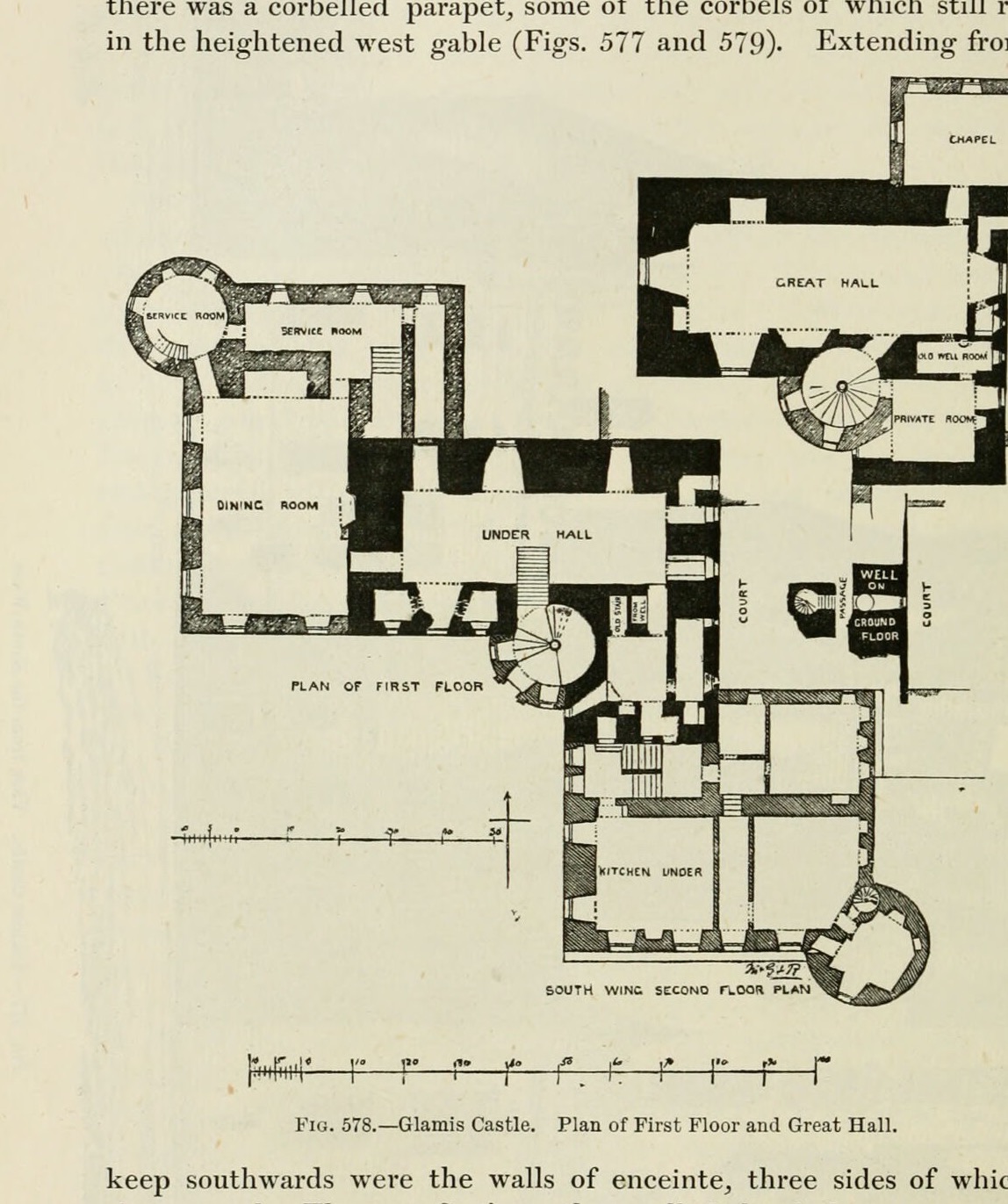
Fig. 578. Glamis Castle. Plan of First Floor and Great Hall.
1887 · MacGibbon & Ross, vol. 2 (1887)
Public domain
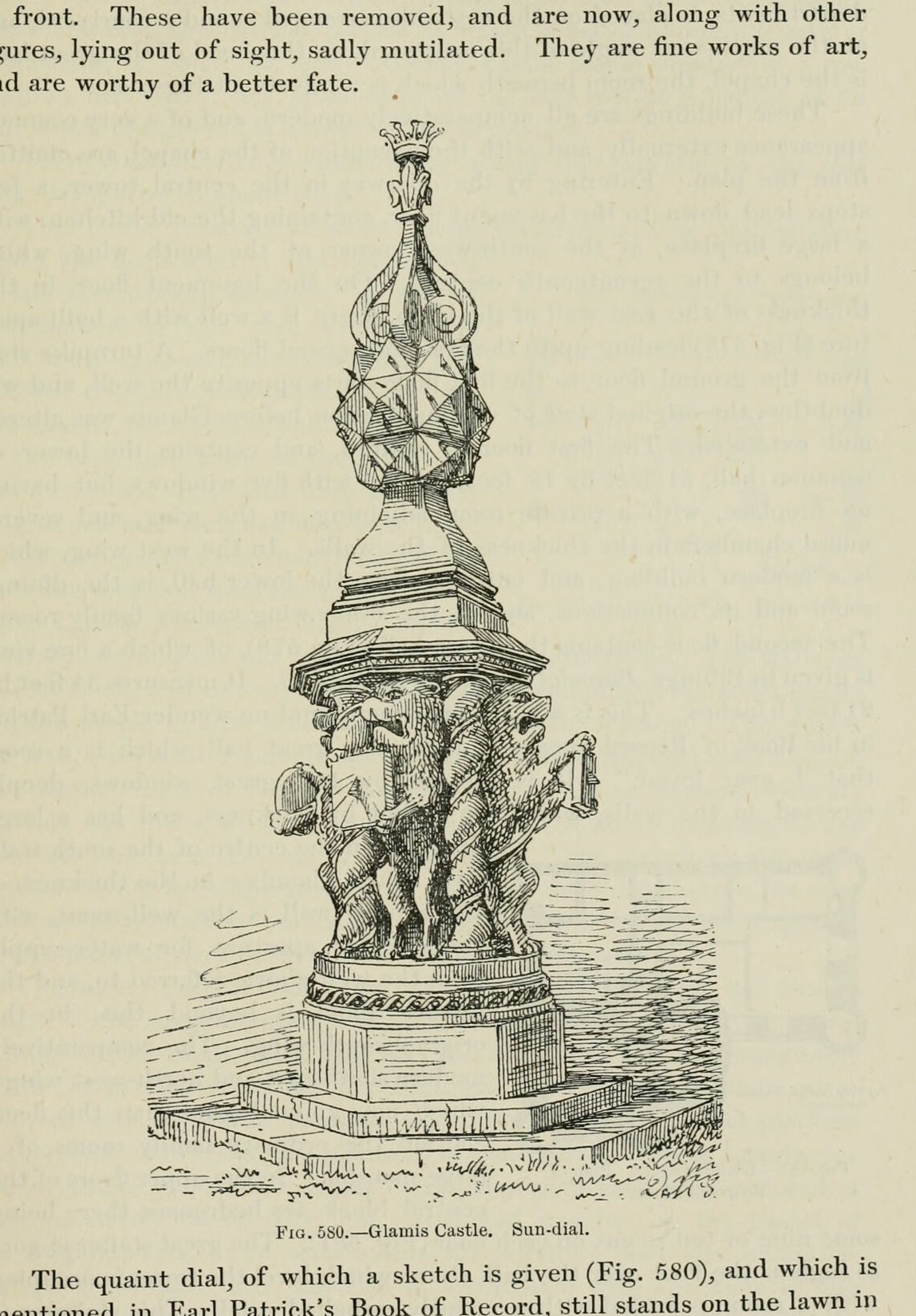
Fig. 580. Glamis Castle. Sun-dial.
1887 · MacGibbon & Ross, vol. 2 (1887)
Public domain


