
Scotland · Restored
Stirling Castle
Caisteal Sruighlea
Stirling Castle is a major medieval and Renaissance royal residence and fortress atop Castle Hill in Stirling, Scotland. Its principal buildings date from the 15th and 16th centuries and it occupies a steep intrusive crag with defensive curtain walls on three sides.
Its prime
1542
Today
Restored
Ranked among Europe’s castles
As it stood in 1542
What Stirling Castle looked like in its prime.
Sits on a steep intrusive crag with sheer cliffs on three sides and a long stone curtain wall running along the cliff edge. The castle is an irregular mass of interconnected stone buildings: long rectangular palace blocks with steep pitched slate roofs and dormer windows, several tower-like projections and bastioned curtain walls. The stone is pale grey-brown masonry; the site overlooks the town and river below with trees on the lower slopes and a defended outer approach facing the burgh.
Its story
The story of Stirling Castle.
Alexander I's Chapel on the Stirling Sill
Castle Hill is quartz-dolerite some 350 million years old, part of the Stirling Sill, glaciated into a crag-and-tail with steep cliffs on three sides, and until the 1890s it guarded the farthest downstream crossing of the Forth. The rock has been identified with the Urbs Iudeu where Penda of Mercia besieged Oswy of Bernicia in 655, though no archaeology puts anyone on Castle Hill before the late medieval period. The first firm record is around 1110, when Alexander I dedicated a chapel here; he died at Stirling in 1124, and under David I the town became a royal burgh and the castle an important administrative centre. William I surrendered it under the Treaty of Falaise after his capture in 1174 (there is no evidence the English ever occupied it, and Richard I formally handed it back in 1189), and died here himself in 1214.
Stirling Bridge, Warwolf and Bannockburn
Edward I invaded in 1296 and found the castle abandoned and empty. He held it barely a year: after Andrew Moray and William Wallace won at Stirling Bridge in 1297, the English commanders William FitzWarin and Marmaduke Thweng retreated inside and were starved into surrender. The Scots gave it up after Falkirk and retook it by siege in 1299, in a force that included Robert Bruce. By 1303 Stirling was the last castle in Scottish hands, and in April 1304 Edward's army arrived with at least 17 siege engines. William Oliphant's garrison surrendered on 20 July, but Edward ordered part of it back inside, because he had not yet deployed his newest engine, Warwolf, believed to have been a large trebuchet, which destroyed the gatehouse.
The bombardment ran for four months. Lead balls stripped from the roofs of nearby churches were thrown at the walls along with stone, Greek fire and some sort of gunpowder mixture, for which Edward had sulphur and saltpetre brought up from England. Impatient at the lack of progress, he set his chief engineer, Master James of St George, to building Warwolf, described as the largest trebuchet in history. For all his earlier threats he spared the Scots of the garrison in the end and executed only one Englishman, who had earlier handed the castle over to them; Sir William Oliphant went to the Tower of London. A skeleton recovered from the site is thought to be the earliest evidence of trebuchet trauma in the archaeological record.
In 1313 Edward Bruce besieged the castle, held by Sir Philip Mowbray, who on 24 June offered to surrender if not relieved within a year: a bargain, struck without consulting King Robert, that gave England twelve months to muster and left the king, in Patrick Fraser Tytler's words, "highly incensed". On 23 June 1314 the armies met at Bannockburn within sight of the walls; Edward II tried to take refuge in the castle, but Mowbray kept his word, refused him, handed the place over and changed sides. Robert had the defences destroyed to prevent English reoccupation. The English were back by 1336; Andrew Murray's siege of 1337 may have seen guns used for one of the first times in Scotland, and Robert Stewart, the future Robert II, retook the castle in 1341–1342.
The Douglas Killing and James IV's Great Hall
The oldest masonry standing is the 1380s foundation of the north gate, from works by Robert Stewart, Earl of Menteith, regent and brother of Robert III. In 1452 James II stabbed and killed William, 8th Earl of Douglas inside these walls when the earl refused to end a potentially treasonous alliance with the Earl of Ross and the Earl of Crawford. Artillery manufacture in the castle is recorded in 1475, and in 1488 James III died at Sauchieburn, fought over almost the same ground as Bannockburn just south of the walls.
Almost every present building went up between 1490 and 1600. James IV completed the King's Old Building around 1497 and began the Great Hall, plastered by 1503 and described as "the grandest secular building erected in Scotland in the late Middle Ages". His Forework gatehouse, probably finished around 1506, drew its round towers from French military architecture but was meant more for show than defence, offering little protection against contemporary artillery. The programme was unfinished when he was killed at Flodden.
The Palace of James V and the Guise Gunworks
James V was crowned in the chapel royal and grew up in the castle under Lord Erskine's guardianship; in 1515 the Regent Albany brought 7,000 men to Stirling to take the boy king from his mother, Margaret Tudor. As king he raised the Royal Palace, called the first Renaissance palace in the British Isles: begun in the 1530s under Sir James Hamilton of Finnart, Master of Works until his execution in 1540, who financed part of it himself in return for land and favours, and largely complete by the late 1540s.
James V died in 1542, leaving the unfinished work to his widow, Mary of Guise. Their infant daughter Mary was brought here for safety in July 1543 and crowned in the chapel royal on 9 September, during the English war known as the Rough Wooing, and was sent on to Inchmahome Priory and then to France in 1548. The castle's gunworks, though, belong not to that war but to Guise's regency in the 1550s, when artillery fortifications including the French Spur went up across the south approach; Guise also employed the Italian military engineer Lorenzo Pomarelli. The French Spur at the east end was an ear-shaped bastion, or orillon, whose emplacements covered the main spur; excavation in the 1970s found much of its stonework still inside the 18th-century defences.
Monck's Guns and the Rising of 1715
William Kirkcaldy of Grange raided Stirling in 1571 and took neither castle nor king, and the rebel Earls of Mar and Angus seized it in April 1584 only to flee to England when Colonel Stewart arrived with an army. After the Union of the Crowns in 1603 the royal family left for London and the castle became principally a military centre, and a prison for persons of rank. Charles II, living here in 1650, was the last reigning monarch to stay. General Monck laid siege on 6 August 1651, erecting gun platforms in the adjacent churchyard; the garrison mutinied and Colonel William Conyngham was obliged to surrender on 14 August, his guns having scarred both the church and the Great Hall.
The attempted Jacobite invasion of 1708 made new defences a priority, and a compromise scheme was complete by 1714: Guardhouse Square behind two ditches swept by covered firing galleries called caponiers. That same year George I stripped John Erskine, 6th Earl of Mar, of the governorship, and Mar answered by raising the Old Pretender's standard in 1715; the Duke of Argyll's troops occupied the fortress, then blocked his road at Sheriffmuir, a battle that was inconclusive but effectively ended the rising.
Blakeney's Counter-Battery: the Last Siege, 1745–1756
Stirling controlled the road between the Highlands and the Lowlands, and the Jacobite army had passed it in September 1745 with neither the time nor the equipment to take it. After the march to Derby and back, the entry into Glasgow on 26 December and the defeat of pro-government militia at Inverurie three days before that, the Jacobites were at their strongest, and Stirling would give them a strong base and a secure port for a second invasion of England: the more urgently because John Drummond, a serving officer of the French army, had been ordered not to cross into England until every fortress held by government troops in Scotland had fallen. The town's defences were only meant to hold for a few days and duly gave way. The castle was another matter: its natural strength had been improved with modern fortifications, and its garrison of six to seven hundred was commanded by William Blakeney, an experienced and determined Irish veteran who had written to the prime minister, Henry Pelham, on 18 October that he was confident of holding it. The Jacobites had no siege equipment worth the name (they had failed to take Edinburgh Castle after holding that town for nearly two months), and senior men among them, James Johnstone included, thought the attempt futile from the start.
Colonel James Grant's field guns were too few and too light to mark the walls. Heavier pieces, including two 18-pounders, had been landed at Montrose in November by Mirabel de Gordon, a French engineer of Scots descent, who reached Stirling on 6 January to run the siege; his artillery did not arrive until the 14th. Grant wanted the guns emplaced near the town cemetery, where they would stand nearly level with the fortifications; Charles took de Gordon's advice and put them on Gowan Hill instead. The bedrock there was too shallow to dig, so the positions had to be built up out of sacks of earth and wool, hauled into place slowly and dangerously, and the wall they faced stood above a near-vertical cliff that was all but impossible to assault. The working parties took casualties from mortar fire every day; Blakeney is said to have kept that down deliberately, not wishing to discourage men from investing so much labour in so poor a position. Opinion in the Jacobite camp divided over whether de Gordon was incompetent or had been bribed.
A relief attempt under Henry Hawley had already been beaten at Falkirk on 17 January, in failing afternoon light and heavy snow, and it changed nothing: the bulk of Hawley's men withdrew to Edinburgh in good order while the Highlanders stopped to loot the baggage train. Gordon finally opened fire on 30 January with three of his six guns in place. Blakeney answered with counter-battery fire so accurate that the Jacobite pieces were dismounted and the position abandoned inside half an hour, since "no one could approach it without meeting certain destruction"; one cannon was afterwards found to have been struck nine times, some of the gouges of surprising depth. That same day Charles learned Cumberland was marching north from Edinburgh and wanted a battle, but the chiefs, who had been unable to stop large numbers of Highlanders going home for the winter, told him the army was in no state to fight. On 1 February the siege was abandoned and the Jacobites withdrew to Inverness. The munitions they had stored in the church of St Ninians blew up during the retreat (carelessness in moving them, more likely than the design later claimed) burying nine townspeople and a number of Jacobites, and throwing Murray of Broughton's wife from the carriage she was passing in. Blakeney, whose promotion had been painfully slow, was made a lieutenant-general and Lieutenant-Governor of Menorca; he was still in command there when the French took the island in June 1756, the loss that brought Admiral Byng to trial and execution.
The Argylls' Depot and the Restored Lodgings
From 1800 the War Office ran the castle as a barracks: the Great Hall lost its hammerbeam roof and was subdivided into accommodation, the Chapel Royal became a lecture theatre and dining hall, the King's Old Building an infirmary and the Royal Palace the officers' mess. The Cardwell Reforms made it the depot of the 72nd (Highland) and 91st (Argyllshire Highlanders) Regiments of Foot in 1873, and the 1881 amalgamation of the 91st with the 93rd (Sutherland Highlanders) created the Argyll and Sutherland Highlanders, whose depot it became.
Calls to restore the Great Hall were being made as early as 1893, but the chance came only when the army left in 1965; that work was finished in 1999, and a ten-year, £12 million programme reopened the Royal Lodgings in June 2011. Scheduled as a monument in 1994 and managed by Historic Environment Scotland, the castle remains the headquarters of the Argyll and Sutherland Highlanders and holds the regimental museum, though Balaclava Company, the regiment's sole surviving unit, has been garrisoned at Redford Barracks in Edinburgh since 2014.
Step inside
8 places to explore in 1542.
The record describes 8 distinct spots at Stirling Castle, including 3 interiors: great hall (interior), chapel royal (interior), king's old building (royal apartments). Create your own photoreal reconstruction and explore every one, more scenes means more rooms, more angles, and more of the place to stand in.
Build Your Own Castle
Recreate Stirling Castle with AI to explore it.
The artist rebuilds it as it stood in 1542, a photoreal reconstruction that belongs to you alone. Pay with coins, no subscription needed.
Recreate this castle →Defend this castle →Whose castle
Clans who held Stirling Castle.
The families that held Stirling Castle for a decade or more across its history, follow a name to its clan.
Chief royal seat of the Stewart dynasty; the Renaissance palace was built by James V.
From the archive
Stirling Castle on paper: the measured plan and period views.
The survey plan and photographs below are the ground truth this page's reconstructions are checked against, drawn and photographed while the castle was still a working garrison. Every image is public-domain or openly licensed, with its source named.
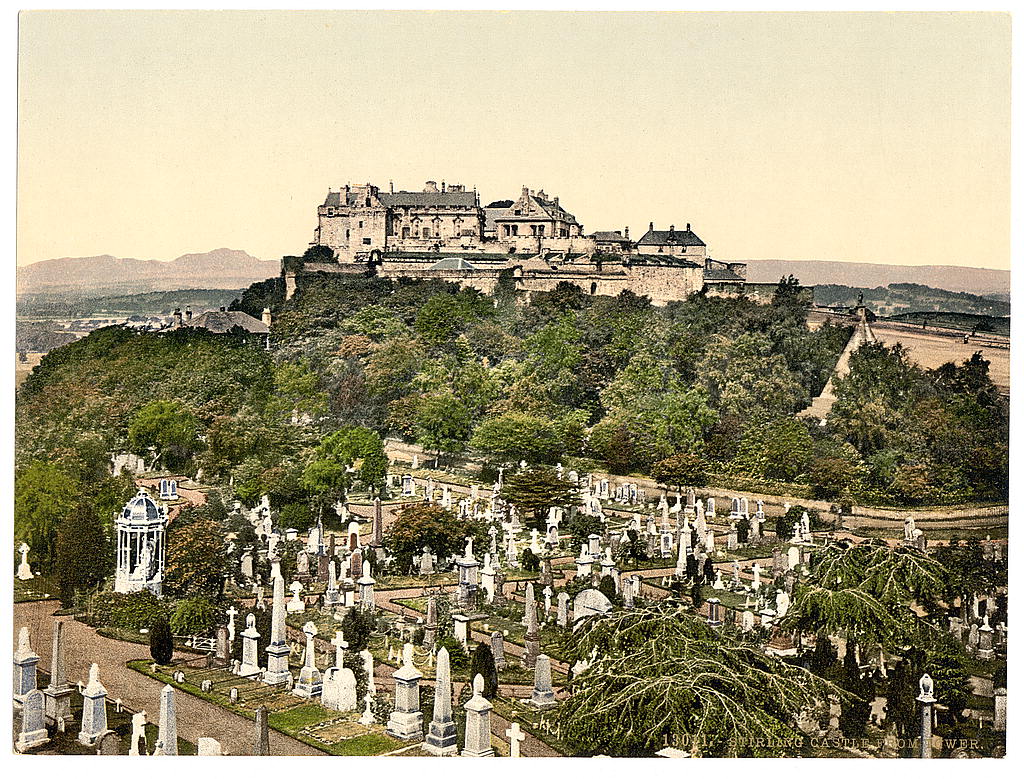
Stirling Castle from tower (photochrom)
ca. 1890-1900 · Library of Congress, Photochrom Prints Collection
No known restrictions on publication (LOC)
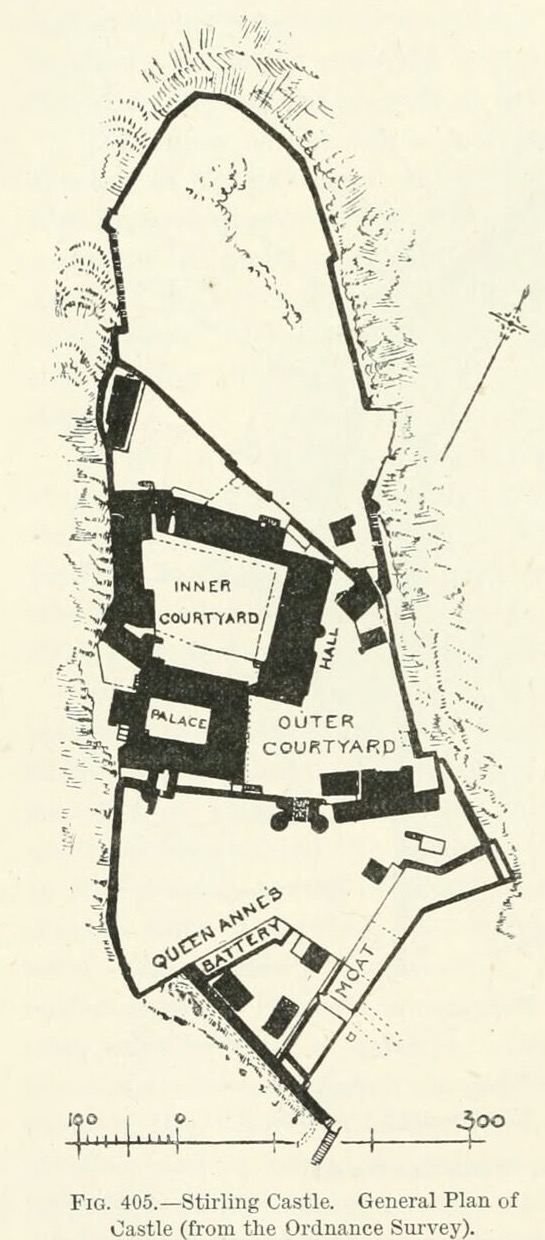
General Plan of Castle (from the Ordnance Survey), Fig. 405
1887 · MacGibbon & Ross, The Castellated and Domestic Architecture of Scotland, vol. 1, p. 466
Public domain (published 1887; authors d. 1902/1930)
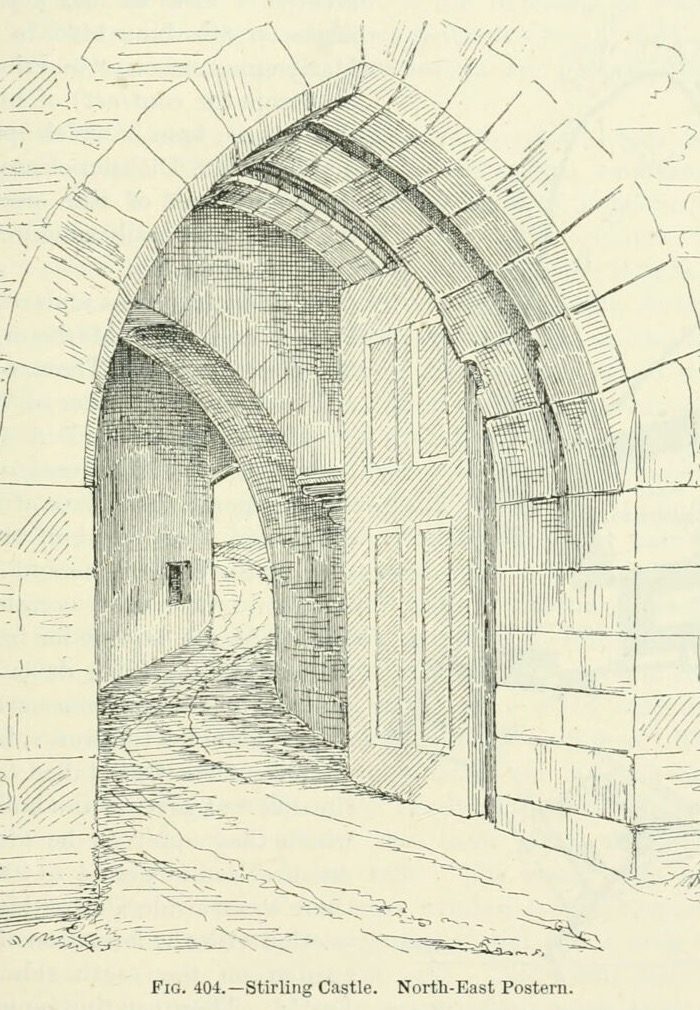
North-East Postern, Fig. 404
1887 · MacGibbon & Ross, vol. 1, p. 465
Public domain
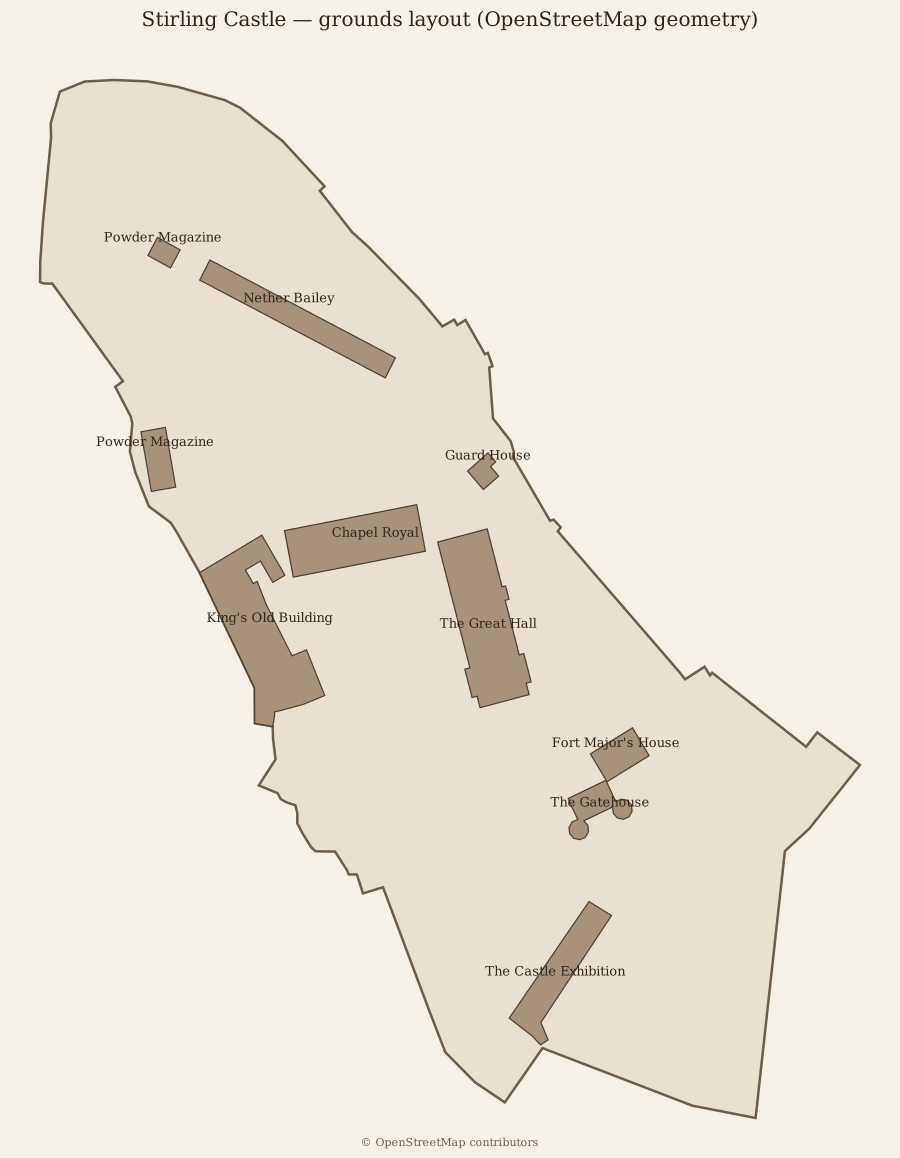
Grounds layout, drawn from OpenStreetMap geometry
2026 · OpenStreetMap contributors
ODbL
Nearby
Landmarks within reach of Stirling Castle.


Questions about Stirling Castle
Where is Stirling Castle?
When was Stirling Castle built?
Why was Stirling Castle built, and what was it used for?
Was Stirling Castle ever attacked or besieged?
Which family or clan held Stirling Castle?
What did Stirling Castle look like in its prime?
Is Stirling Castle still standing, or is it a ruin?
What is inside Stirling Castle and what can you see?
Who owns Stirling Castle now?
Can you visit Stirling Castle?
More castles of Scotland


Explore the city


