Historic Cities · Scotland
Edinburgh through the ages
Edinburgh is the capital city of Scotland and one of its 32 council areas. It is located in southeast Scotland and is bounded to the north by the Firth of Forth and to the south by the Pentland Hills. Edinburgh had a population of 506,520 in 2020, making it the second-most-populous city in Scotland and the seventh-most-populous in the United Kingdom.

Edinburgh in 1560
Reformation Edinburgh
This is Edinburgh at the height of the Scottish Reformation when the Royal Mile stacked with tall tenements led from the king's palace at Holyrood to the castle on its volcanic rock. The walk follows the old approach from the Firth and Leith into the Canongate and along the High Street past St Giles, its luckenbooths and closes, to the castle esplanade.
A compact medieval skyline: the squat, brooding mass of Castle Rock and its stone keep, St Giles' distinct crown spire, and a serried ridge of multi-storey stone 'lands' lining the Royal Mile. Streets are narrow, paved with worn cobbles, the closes falling away in shadow to lower lanes; roofs of tile and slate and timber shop-fronts cluster close together. Smoke from peat and hearth fires softens late-afternoon light over the Nor Loch and harbour beyond.
The route: 21 streets, squares and views
Firth Approach → Leith Shore → Foot of the Canongate → Holyrood Abbey Yard → Holyrood Forecourt → Canongate High Street → Netherbow Port → Luckenbooth Row → St Giles' Churchyard → Mercat Cross → …
Step inside, 14 interiors
Harbour Counting-house · Abbey Choir · Palace Audience Chamber · Port Guardroom · Luckenbooth Shop · High Kirk Nave · Tolbooth Council Chamber · Stone Merchant's Hall · Turnpike Stair and Hall · Tanners' Workroom · Merchants' Guild Hall · Printer's Workshop · Castle Great Hall · St Margaret's Chapel
Planned from the Wikipedia record: History of Edinburgh.
Edinburgh in 1790
Enlightenment Edinburgh
Edinburgh in 1790 is a city of two faces: the ancient, smoky closes and castle of the Old Town, and the new, rational grid of the Georgian New Town rising on open ground north of the Nor Loch. This walk follows the route between those worlds, from distant hill views and harbour approaches into the terraces, squares and busy streets where merchants, lawyers and students move and argue.
A low, compact skyline of stone: the Old Town’s crowded roofs and church spires crowned by the dark mass of Castle Rock, and beyond it the crisp horizontal lines of new Georgian terraces on Princes Street and George Street. Roofs are slate and chimneyed; façades are pale ashlar and sandstone bands; streets are cobbled, often wet or smoky from coal. The Mound’s earthen tip crosses the hollow of the drained Nor Loch, joining neat squares, mews and the wide promenades of the New Town.
The route: 22 streets, squares and views
Arthur's Seat View → Leith Shore and Harbour → Leith Walk → Holyrood Palace and Canongate → Royal Mile / High Street → St Giles' and the Kirkyard → Lawnmarket and Mercat Cross → Tron Kirk and Parliament House → South Bridge Approach → North Bridge Gateway → …
Step inside, 12 interiors
Leith Merchants' Counting-House · Audience Chamber, Holyrood Palace · Antiquarian Bookseller's Shop · St Giles' Nave · Printer's Workshop and Press · Tron Kirk Interior · Natural Philosophy Lecture Room · Princes Street Debating Room · Castle Great Hall · Dundas House Banking Hall · Georgian Drawing Room · Oyster Cellar Club
Planned from the Wikipedia record: New Town, Edinburgh.
Edinburgh in 1880
Victorian Edinburgh
Edinburgh in 1880 is a Victorian capital of stone and smoke where railway steam and brewery chimneys sit beneath medieval heights. This walk moves from the Firth and the docks through Waverley's steam and the terraces of the New Town to the castle esplanade and the hill views that define the city's skyline.
A compact skyline of dark volcanic Castle Rock and the rounded bulk of Arthur's Seat anchors terraces of pale sandstone; Gothic pinnacles such as the Scott Monument and the pinnacled steeples of St Giles rise above regimented New Town streets. Gas lamps and steam from locomotives plume across the valleys, brewery chimneys and industrial smoke add brown-grey veils, while shopfronts and horse traffic animate narrow closes and broad avenues alike.
The route: 22 streets, squares and views
Firth of Forth View, Leith → The Shore, Leith → Leith Walk → Calton Hill → Waverley Bridge Forecourt → Waverley Station Exterior → Princes Street Gardens → Scott Monument → The Mound → National Gallery on the Mound → …
Step inside, 12 interiors
Leith Customs Counting Room · Waverley Main Platforms · Scott Monument Spiral Stair · National Gallery Grand Gallery · RSA Exhibition Room · High Street Taproom · St Giles' Nave · Lady Stair's Parlour · Castle Great Hall · Grassmarket Inn Taproom · Highland Draper's Showroom · South Bridge Vaults Workshop
Planned from the Wikipedia record: History of Edinburgh.
Its story
The story of Edinburgh.
Din Eidyn, Northumbria and the Ceding of Lothian, c.AD 100–1018
When the Romans reached Lothian at the end of the 1st century AD they recorded a Brittonic Celtic tribe called the Votadini; a Roman fort stood at Cramond. Their presumed descendants, the Gododdin, held a stronghold called Din Eidyn, the hillfort of Eidyn, whose exact site has never been identified, though the Castle Rock is the likeliest candidate. Around the year 600 Welsh tradition records that Mynyddog Mwynfawr, the ruler of Gododdin, gathered a war band near Edinburgh to fight the Germanic settlers to the south, and that it was decisively beaten by the Angles at the Battle of Catraeth, probably Catterick.
In 638 the Gododdin stronghold was besieged by forces loyal to King Oswald of Northumbria, and about this time control of the region passed to the Angles. Anglian influence predominated from the mid-seventh to the mid-tenth century, with Edinburgh a frontier stronghold where Northumbrian Old English was spoken and the Brittonic din in the name gave way to the Old English burh. Writing about 1130 from earlier texts, the chronicler Symeon of Durham mentioned a church at Edwinesburch in 854 under the Bishop of Lindisfarne, taken to mean a settlement existed by the middle of the ninth century. In the tenth century Lothian came under the Kingdom of Scotland: the Chronicle of the Kings of Alba records that oppidum Eden "was evacuated, and abandoned to the Scots", read as a cession to King Indulf, who reigned 954 to 962. Edgar the Peaceful formally granted Lothian to Kenneth II at Chester in 973, and Malcolm II ended the Northumbrian threat at Carham in 1018.
David I's Tofts and the English Occupations, c.1124–1341
About 1130 David I established the town below the castle rock as one of Scotland's earliest royal burghs; the earliest documentary trace is a charter of about 1124–27 granting a toft in burgo meo de Edenesburg to the Priory of Dunfermline. Merchants received strips of land called tofts along both sides of one long market street, on condition they built a house within a year and a day, each toft running back to a perimeter dyke to form an enclosed yard, or close. A separate burgh of regality held by the Abbey of Holyrood grew to the east as the Canongate.
Edinburgh was largely in English hands from 1291 to 1314 and again from 1333 to 1341 during the Wars of Scottish Independence, with Lord Basset made Governor of the castle in 1291. In 1334 Edward Balliol, the English-backed claimant to the Scottish throne, handed Edward III large parts of southern Scotland including Edinburgh under the Treaty of Newcastle, and during Edward III's Burnt Candlemas invasion his army reached the town in early February and burnt much of it.
Wool Through Leith, and the Principal Burgh of the Kingdom, 1329–1592
The city's fortune was made partly by the ruin of another: after Berwick, Scotland's main trading port, fell to English occupation in the 1330s, the bulk of the kingdom's profitable export trade in skins, hides and above all wool was routed through Edinburgh and Leith, its port by an arrangement of unknown date that Robert the Bruce's charter of 1329 confirmed. By the middle of the 14th century the chronicler Froissart described a town of around 400 dwellings as "the Paris of Scotland", and James III called Edinburgh in one of his charters principalior burgus regni nostri, the principal burgh of our kingdom. By the reign of James V the burgh's tax assessment sometimes equalled the combined figures of the next three burghs in Scotland, its customs running to half or more of the national total. Incorporated trades of cordiners, websters, hammermen, skinners, fleshers, coopers and baxters served court and town, though rising burgh taxes pushed some crafts beyond the boundary in the sixteenth and seventeenth centuries.
Contemporaries reported wholesale destruction at the time of the Hertford Raid in 1544, but the town recovered slowly. By 1560, when Scotland's total population was estimated at a million, Edinburgh held 12,000 people, with another 4,000 in separate jurisdictions such as the Canongate and Leith. A parish census of 1592 recorded 8,003 adults, 45 per cent of the employed among them domestic servants in the households of the legal and merchant professions or of the landed class. The population kept growing despite repeated outbreaks of plague with high death rates, most severely in 1568, 1584–88 and 1645.
Reformation, Mary's Fall and the Lang Siege, 1560–1583
The Reformation of the mid-16th century, including the Siege of Leith, turned on events in the town. Mary, Queen of Scots, a Catholic, returned from France in 1561 into a discord sown before her arrival: Protestant nobles and churchmen feared that her faith and her claim to the English throne might eventually bring Catholicism back, and remained implacably hostile to her rule. The murders of her secretary David Rizzio and her consort Henry Darnley during her residence at Holyrood Palace brought matters to a crisis, and she was forced to abdicate in 1567. John Knox, one of the town's Protestant ministers, preached at St Giles' calling for her execution as an adulteress and murderess, inflaming popular opinion against her. She was arrested at Carberry and imprisoned at Lochleven Castle, and the civil war that followed her escape, defeat at Langside and flight to England ended when her last loyal supporters surrendered Edinburgh Castle in the "Lang Siege" of 1573.
In 1579 the town council revived plans for a university, for which it had earlier sought Mary's approval without success. James VI agreed to found a college by royal charter rather than by papal bull, as earlier universities had been, underlining Scotland's break with Rome; teaching began in 1583 at the institution that became the University of Edinburgh.
The Crowns Go South, the Parliament Follows, 1603–1707
James VI succeeded to the English throne in 1603 in the regal union known as the Union of the Crowns. Scotland otherwise remained a separate kingdom and kept its Parliament in Edinburgh, but the king moved to London, ruled through a Privy Council, and despite promising to return north every three years came back only once, in 1617. Presbyterian resistance to Charles I's attempt to impose Anglican worship and church government on the Church of Scotland culminated in the Bishops' Wars of 1639 and 1640. After Scotland backed the restoration of Charles Stuart to the English throne, Edinburgh was occupied in 1650 by Oliver Cromwell's forces following the Battle of Dunbar; a headquarters called the Citadel was built at Leith, and at the Mercat Cross in 1654 General George Monck declared Scotland united with the Commonwealth.
The triumph of Presbyterianism in 1689 settled the form of the Church of Scotland; the new establishment worked to purge Episcopalians and heretics and made blasphemy a capital crime. Thomas Aikenhead, an Edinburgh surgeon's son of 18, was indicted for blasphemy by order of the Privy Council for calling the New Testament "The History of the Imposter Christ", and hanged in 1696, the last person executed for heresy in Britain. The Acts of Union of 1706 and 1707 merged the Parliament of Scotland into a Parliament of Great Britain sitting only at Westminster. Many Scots opposed the Union, and there were riots in the city.
Proposals for Public Works: The New Town and the Enlightenment, from 1745
During the Jacobite rising of 1745 Edinburgh was briefly occupied by the Jacobite "Highland Army" before it marched into England; after the defeat at Culloden came reprisals and pacification largely directed at the rebellious clans. The Town Council, keen to emulate Georgian London, stimulate prosperity and reaffirm its belief in the Union, then set about improving and expanding the city. The catalyst was a decision of the Convention of Royal Burghs in 1752 to propose improvements to the capital for the benefit of commerce, in a pamphlet believed written by Sir Gilbert Elliot and shaped by Lord Provost George Drummond. It envisaged a new Exchange for merchants, now the City Chambers, new law courts, expansion north and south, and the draining of the Nor Loch; the geometric plan came out of a Town Council competition in 1766.
From the late 1760s the professional and business classes gradually left the Old Town for the one-family houses of the New Town. Robert Chambers, writing in the 1820s, described a double city: an ancient hill-built one occupied chiefly by the humbler classes, and an elegant modern one. The city's population rose from 49,000 in 1751 to 136,000 in 1831, mostly through migration from the countryside.
The Union had taken members of parliament, aristocrats and placemen to London, but Scots law remained separate, so the courts, the legal profession, the university and the medical establishment stayed, and their lawyers, divines, professors and medical men formed the intellectual middle class that carried the Scottish Enlightenment. The university's Faculty of Medicine, formed in 1726, drew students from across Britain and the American colonies and served as the model for the medical school at the University of Pennsylvania. David Hume, Adam Smith, James Hutton, Joseph Black and Adam Ferguson argued in the Select Society and later the Poker Club, and the Royal Society of Edinburgh was founded in 1783. The Encyclopædia Britannica was designed in the city, first published in three volumes between 1768 and 1771, and printed there until sold to an American publisher in 1898.
Overtaken by Glasgow: Cholera, the Cowgate and the Return of the Parliament
Edinburgh's traditional trades of printing, brewing and distilling kept growing through the 19th century, joined by rubber, engineering and pharmaceutical firms, but there was little industrialisation compared with other British cities. By 1821 Glasgow, enriched by the Atlantic trade and then as a manufacturing centre of the British Empire, had overtaken Edinburgh as Scotland's largest city. The Old Town meanwhile decayed into an overcrowded slum with high mortality, practically segregated from the rest of the city, its subdivided tenements offering the cheapest lodgings in the city. Cholera broke out in 1832, 1848 and 1866. In 1865 Alexander Smith wrote of the Cowgate that it was "the Irish portion of the city", whose inhabitants "keep to their own quarters, and seldom come up to the light of day". After Dr Henry Littlejohn's Report on the Sanitary Conditions of the City of Edinburgh that same year, improvements under Lord Provost William Chambers and the Edinburgh Improvement Act 1867 remade the area into the Victorian Old Town seen today; clearance cut the death rate, but the shortage of cheap new housing pushed other poor districts into worse overcrowding.
On the night of 2–3 April 1916 two German Zeppelins dropped high explosive and incendiary bombs on Leith, the Mound, Lothian Road and the Grassmarket among other places, killing eleven civilians. Having little industry, the city was not a target of the German bombing campaign early in the Second World War; a 1,000 lb bomb hit the Albert Dock at Leith on 22 July 1940, and bombs fell on at least eleven other occasions between June 1940 and July 1942, apparently opportunistic drops by aircraft returning from Clydebank or Belfast. Edinburgh came through almost unscathed. Leith, which had developed an identity of its own as the port, had been merged into the city in 1920, a matter of great resentment; its last shipyard closed in 1983. The Old Town's population fell by more than two-thirds, to 3,000, between 1950 and 1975 as slum clearance took hold, and of 292 houses in the Cowgate in 1920 eight remained in 1980.
From the 1990s a financial district grew on demolished railway land west of the castle and into Fountainbridge, a run-down 19th-century industrial suburb reshaped since the 1980s by the closing of its works and breweries. The Old and New Towns were listed together as a UNESCO World Heritage Site in 1995, managed since 1999 by Edinburgh World Heritage. The Scotland Act 1998 came into force the following year, establishing a devolved Scottish Parliament and Scottish Government in Edinburgh, with defence and foreign affairs reserved to Westminster. The city had a population of 506,520 in 2020, second in Scotland behind Glasgow, and remains the seat of Scotland's highest courts and of the Palace of Holyroodhouse.
From the archive
Edinburgh on paper: the old town as it was mapped.
A period plan or bird's-eye view of the old town, drawn between 1500 and 1850, the streets this page's reconstructions walk. Public domain, with its source named.
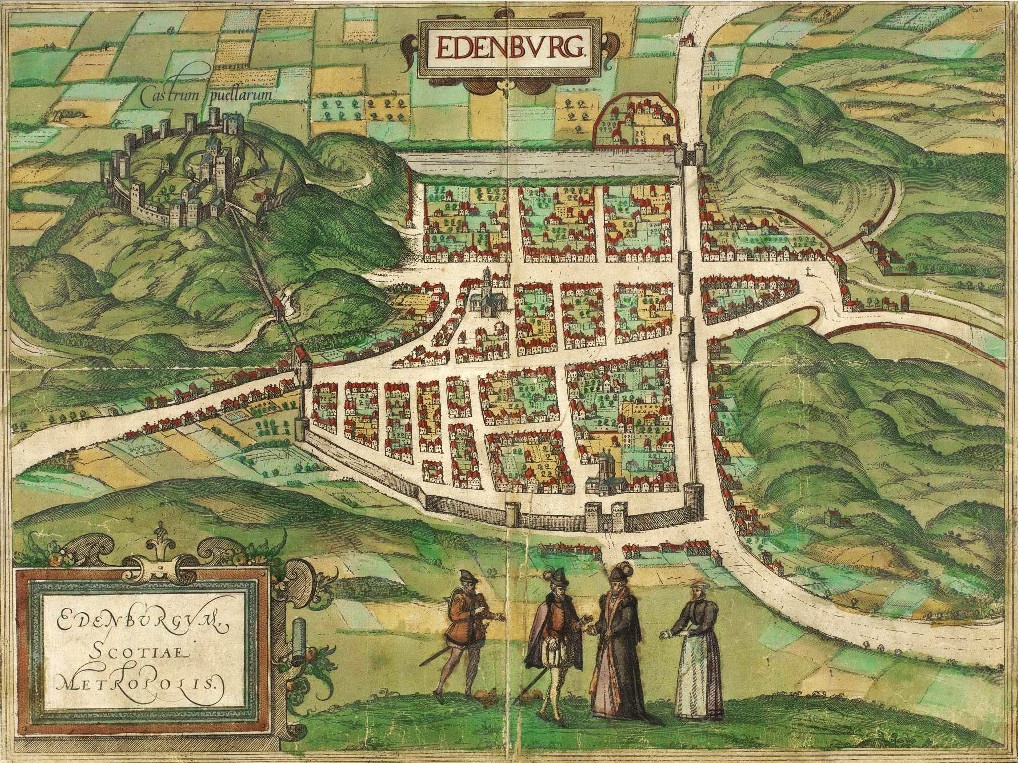
Edenburgum (Edinburgh), Scotiae Metropolis: bird's-eye view from Braun & Hogenberg's Civitates Orbis Terrarum
Shows the walled medieval burgh with rectilinear streets and gates, Edinburgh Castle atop the volcanic rock, defensive towers and the surrounding roads and river approaches.
1581 · Braun & Hogenberg, Edenburgum, Scotiae Metropolis c.1581 · Wikimedia Commons
Public domain (plate dated 1581)
In this city
Landmarks of Edinburgh, see each in its prime


Castles of Edinburgh


More cities to explore
 ScotlandSt AndrewsExplore it in 1450 · 1900
 ScotlandStirlingExplore it in 1300 · 1540
 ScotlandGlasgowExplore it in 1650 · 1775 · 1888
 ScotlandAberdeenExplore it in 1500 · 1880
Castles of Europe · Landmarks of Europe · create your own reconstruction.