
Stadium · Scotland · Still standing
Murrayfield Stadium
Pàirc a' Mhoirich
Murrayfield Stadium is the national rugby union stadium of Scotland, owned by the Scottish Rugby Union and located in the Murrayfield area of Edinburgh. It is an elliptical, multi-tiered stadium that hosts Scotland internationals, club matches and concerts and serves as the SRU headquarters.
First raised
1924
Its prime
1994
Today
Still standing
As it stood in 1994
What Murrayfield Stadium looked like in its prime.
An elliptical concrete and steel bowl with a prominent ring of dark steel trusses supporting a cantilevered roof, tiered seating visible through open bays, and several tall blue cylindrical stair/tower cores on the exterior. The playing pitch is a rectangular grass surface set in a recessed bowl; exterior elevations show exposed structural frames, stair terraces and stacked access balconies. The stadium sits beside flat forecourts and transport access on Roseburn Street.
Its story
The story of Murrayfield Stadium.
From Inverleith to the Polo Club's Fields, Opened 21 March 1925
Scotland's internationals had been played at Inverleith, a ground that was not large enough to cope with the increasing number of spectators. The Scottish Rugby Union identified nineteen acres at Murrayfield and bought them from the Edinburgh Polo Club, raising the money through debentures. A stand and three embankments were built on the site over two years. Arthur Sellers, who had prepared the pitches at Inverleith, came with the move as Murrayfield's first groundsman.
England were the first visitors. On 21 March 1925, 70,000 people watched Scotland beat them to win their first Five Nations Championship Grand Slam, and the ground hosts the majority of Scotland's home test matches.
A Royal Army Service Corps Supply Depot, 1939-1944
During the Second World War the ground at Murrayfield was offered to the nation and taken over by the Royal Army Service Corps, which used it as a supply depot. The armed forces sports authorities arranged two Scotland v England services internationals each year, on a home-and-away basis. Scotland's home fixtures in that series were played at Inverleith for the first two years, returning to Murrayfield in 1944 after the ground was derequisitioned.
104,000 Against Wales and the Debenture Rebuild, 1975-1994
Murrayfield's record attendance of 104,000 was set on 1 March 1975, when Scotland beat Wales 12-10 in the Five Nations Championship. That figure stood as a world record until 1999 and remains a European record. The East Stand was built in 1983.
The stadium hosted concerts in the same decade. David Bowie played to a capacity crowd of 47,000 on 28 June 1983. Simple Minds were booked for 1989 but pulled out, Jim Kerr objecting to the venue's administrators allowing Scottish rugby players to attend the sport's centenary celebrations in South Africa, then still under apartheid.
In October 1991 the union launched another debenture scheme, this time to finance a fuller redevelopment centred on the West Stand, whose replacement was designed with a 48-metre cantilever roof. The old West Stand had housed a museum; it was not replaced, and plans for a new visitor centre were shelved when the game turned professional. The first phase was completed in January 1993 with the opening of the new north and south stands, and the centre section of the West Stand followed in February 1994. Tilbury Douglas carried out the work. A 50 million pound renovation was completed in 1994, and floodlights were installed at the ground for the first time.
Claymores, Challenge Cup Finals and Hearts in Exile, 1995-2024
Murrayfield was one of two home venues for the Scottish Claymores of NFL Europa between 1995 and 2004, the other being Hampden Park in Glasgow, and it staged World Bowl '96 on 23 June 1996. Rugby league arrived with the Challenge Cup Finals of 2000 and 2002; the 2000 final drew 67,247, the ground's record rugby league crowd. Super League's Magic Weekend was held there in 2009.
In December 2003 the SRU board agreed to let Hearts, then in the Scottish Premier League, lease the stadium for match days. Later that month UEFA confirmed that Tynecastle did not meet the minimum criteria for European matches from the 2004-05 season, and Hearts used Murrayfield as their European home for three years, until adjustments at Tynecastle brought it into line with UEFA regulations. Almost 58,000 watched Hearts play Barcelona at Murrayfield in July 2007, the largest crowd at an association football match in Edinburgh for 51 years. Celtic played two qualifying matches there in 2014 with Celtic Park unavailable during Glasgow's Commonwealth Games, and Hearts came back for home games in the 2017-18 Scottish Premiership while construction of a new main stand at Tynecastle ran late.
The stadium took one of the 2018-19 Scottish League Cup semi-finals in October 2018, Hearts against Celtic, in front of 61,161 - the second-largest crowd ever recorded for a football match in Edinburgh. A pre-season friendly between Liverpool and Napoli in July 2019 drew 65,442, the highest football attendance in Scotland since the 1989 Scottish Cup Final. Manchester United played Olympique Lyonnais there on 19 July 2023 before 48,484, and returned on 20 July 2024 to face Rangers in front of 56,574.
Live 8, the Eras Tour and the Sponsors' Names, 1996-2024
Tina Turner played the Wildest Dreams Tour there on 30 June 1996 and U2 brought Popmart in September 1997. The Rolling Stones drew 51,000 on 3 June 1999, and Celine Dion sold out the full 67,000 on 8 July 1999 in her first show in Scotland. In July 2005 Murrayfield hosted the final Live 8 concert, Edinburgh 50,000 - The Final Push, with James Brown, Texas and The Proclaimers among the performers.
Oasis played the ground twice, on the Standing on the Shoulder of Giants Tour in 2000 and again in a sold-out show on 17 June 2009 that proved to be their last concert in Scotland; antisocial behaviour at that second show affected the stadium's licensing arrangements when they were reviewed a few months later. Bon Jovi followed on 22 June 2011, Madonna to a sell-out 52,160 on 21 July 2012, and One Direction to more than 64,000 on 3 June 2014. Foo Fighters played on 8 September 2015, rescheduled from 23 June after Dave Grohl broke his foot. The Spice Girls drew over 55,000 on 8 June 2019, their first Scottish concert in 21 years, and Beyonce sold out 55,000 on 20 May 2023, the first Black woman since Tina Turner in 1996 to perform at the stadium. Taylor Swift's three Eras Tour nights on 7, 8 and 9 June 2024 played to 73,000 each and nearly 220,000 in total, breaking the Scottish concert attendance record three times.
In October 2012 the SRU's chief executive Mark Dodson told the BBC that the union was hunting a name sponsor, calling the national stadium "the single biggest piece of our inventory" and saying it would be crazy not to look at using it to drive revenue; in the same interview he said the SRU was looking for a site for a new 10,000 to 15,000 capacity ground for Edinburgh Rugby. Nematodes damaged the pitch before the 2013 autumn internationals, and the grass was replaced with a Desso surface from the start of the 2014 season. A naming rights deal with BT was agreed in May 2014, making the ground BT Murrayfield Stadium; a five-year partnership with Scottish Gas from July 2023 renamed it again to Scottish Gas Murrayfield and created a two million pound Club and Community Net Zero Fund for Scottish clubs' energy bills and carbon emissions, alongside shirt and stadium sponsorship investment in the women's game.
The Scottish Rugby Union still owns Murrayfield and has its headquarters there, and at 67,144 seats it is the largest stadium in Scotland. Murrayfield Wanderers and their predecessors had played on the ground's back pitches since 1902; the club was asked to vacate in 2018 when the governing body drew up plans to develop the land, and moved its training base to Roseburn while continuing to hire the Murrayfield pitches for some matches. A new 7,800-capacity stadium was built on those back pitches to house Edinburgh Rugby from the start of the 2021-22 season; Edinburgh's matches had returned to the main bowl in February 2018.
Step inside
10 places to explore in 1994.
The record describes 10 distinct spots at Murrayfield Stadium, including 6 interiors: inside west stand, seating bowl view, east stand lower tier seating, north stand behind the goal and more. Create your own photoreal reconstruction and explore every one, more scenes means more photos, more angles and more of the immersive experience.
Build Your Own Castle
Recreate Murrayfield Stadium with AI to explore it.
Rebuilds stop at 1945, so the artist raises this site as it stood in 1925, not today's building, as a photoreal reconstruction that belongs to you alone. Pay with coins, no subscription needed.
Recreate Stadium to Explore →Nearby
Castles within reach of Murrayfield Stadium.


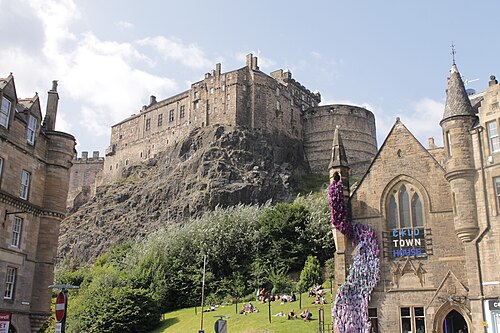
Landmarks within reach of Murrayfield Stadium.


More landmarks of Scotland


Explore the city


