Historic Cities · Scotland
Inverness through the ages
Inverness is a city in the Scottish Highlands in the north of Scotland. Long regarded as the de facto capital of the Scottish Highlands, it is the administrative centre for The Highland Council region where its headquarters are located close to the city centre.

Inverness in 1560
Highland Burgh
Inverness in 1560 is a compact Highland royal burgh where the mountainous hinterland meets the Moray Firth. The walk moves from the river mouth and quays, along the timber bridge into the narrow market streets and up to the castle and the Old High Church, passing hides, hemp, salmon and droves of cattle from the glens.
Stone and timber rise from a lean, green river: a stout castle crowns a low volcanic hill, a small church mound marks St Michael's Mount, and a single narrow wooden bridge spans the fast-flowing Ness. Houses cluster in tight rows of timber frames and wattle or stone, thatch and turf roofs dark with smoke. The quay smells of salt and smoke; market cross and tolbooth punctuate an otherwise modest skyline of chimneys, masts and low roofs beneath frequent grey light.
The route: 21 streets, squares and views
Mouth of the River Ness → Town Quay → Salmon Curing Sheds → Hemp and Hide Yards → Merchant's Hall Yard → Ness-side Boatyard → Timber Bridge over the Ness → Bridge Street → Mercat Cross (Clach na Cudainn) → Tolbooth → …
Step inside, 12 interiors
Quay Warehouse Ground Floor · Salt Curing Room · Tannery Loft and Drying Room · Merchant Hall Chamber · Boatwright's Workshop · Inn Common Room · Tolbooth Council Chamber · Weaver's Loft and Looms · Market Shambles Stall · Friary Refectory Hall · Old High Church Nave · Castle Great Hall
Planned from the Wikipedia record: Inverness.
Inverness in 1880
Victorian Inverness
Inverness in 1880 is the Highland capital newly shaped by rail and the Caledonian Canal, its red sandstone castle and cathedral facing each other across the River Ness. The walk moves from the firth and canal basins into the town’s streets and riverbanks, with railway tourists, tweed shops, Highland games and river islands forming the everyday life you will see.
A compact Victorian skyline of red sandstone turrets and a lancet cathedral spire rises above a broad, slow river threaded with wooded islands. Stone road bridges and narrow iron footbridges link embankments lined with stucco and ashlar shopfronts, while the calved quays and canal basins host dark steamers and sailing coasters. Street life is human-scale: horse-drawn vans, highland tweed in shop windows, men in frock coats and top hats, women in bonnets and crinolines, and crisp coastal light under often-grey skies.
The route: 22 streets, squares and views
Kessock Ferry → Ness Islands → Bank Street Promenade → Ness Bridge → Bridge Street → Inverness Castle → St Andrew's Cathedral → Church Street → High Street → Castle Wynd → …
Step inside, 12 interiors
Boating Pavilion · Courtroom · Stone Nave · Draper's Cutting Room · Tweed Workroom · Barrel-Vaulted Exchange · Booking Hall · Grand Dining Saloon · Lock-Keeper's Kitchen · Saloon Deck · Herring Curing Loft · Games Pavilion
Planned from the Wikipedia record: Inverness.
Its story
The story of Inverness.
From Mesolithic Camps to Columba's Visit of 569
Almost everything known about the earliest Inverness has been recovered ahead of building work. Excavation at Knocknagael Farm, south of the city, in advance of flood defences between 2009 and 2010 showed people living in the area from at least 6500 BC, in the Late Mesolithic, and again from the mid-seventh millennium BC through to the Late Iron Age, with the heaviest activity in the Early Neolithic. A piece of Yorkshire flint from the site suggests Neolithic Inverness may have been trading with Yorkshire. Excavations in the west of the city in 1996 and 1997, before a retail and business park was built, turned up a Bronze Age cemetery, then a Bronze Age settlement with ceramic piece-moulds for casting leaf-shaped swords, and an Iron Age settlement with an ironsmith at work, one of the earliest instances of iron smithing known in Scotland. Roman brooches of the first and second centuries AD found on the Iron Age site show the smiths' neighbours were trading with the empire. A silver chain of 500–800 CE weighing 2.89 kilograms came out of the ground just south of Torvean in 1809, during the digging of the Caledonian Canal.
Inverness was one of the chief strongholds of the Picts. In AD 569 Columba came to convert the Pictish king Brude, who is supposed to have lived in the vitrified fort on Craig Phadrig on the western edge of the modern city. A church or monk's cell is thought to have been founded by early Celtic monks on St Michael's Mount, the mound by the river where the Old High Church and its graveyard stand.
The Royal Burgh and its Four Fairs
The first royal charter came from David I in the twelfth century, around 1160. William the Lion, who died in 1214, granted the town four charters, one of which made it a royal burgh, the status under which Inverness was governed by its own town council for the next eight centuries. It kept four traditional fairs, among them Leth-Gheamhradh, midwinter, and Faoilleach. Alexander III founded a Dominican friary in 1233, of which a single pillar and a worn knight's effigy survive in a graveyard near the centre. The townspeople took their name from a stone: the Clach na Cudainn, the stone of the tubs, on which the women of the town rested their washing at the riverside, and which now stands outside the town hall by the mercat cross. Invernessians were traditionally Clann na Cloiche, the children of the stone.
Rule ran from the castle. Mac Bethad mac Findláich held a castle in the town as Mormaer of Moray and Ross in the eleventh century; Inverness Castle is said to have been built by Malcolm III after he razed the castle, standing about a kilometre to the north-east, in which much later tradition held that Mac Bethad had murdered Malcolm's father Duncan. A battle between Malcolm III and Thorfinn the Mighty is reputed to have been fought in the early eleventh century at Blar Nam Feinne, south-west of the town.
Raids from the Isles, 1187–1491
The same position that made Inverness worth chartering made it worth attacking, and medieval Inverness was raided repeatedly from the Hebrides, particularly by the MacDonald Lords of the Isles in the fifteenth century. In 1187 Dòmhnall Bàn led islanders against men of Inverness Castle at Torvean, under the governor's son Donnchadh Mac an Tòisich; both leaders were killed, and Dòmhnall Bàn is said to have been buried in a great cairn by the river near where the silver chain later surfaced. Local tradition holds that the townspeople beat off Clan Donald in 1340 at Blairnacoi on Drumderfit Hill, north across the Beauly Firth.
In the late fourteenth and early fifteenth centuries the town stood as a symbol of the Duke of Albany's power. On his way to Harlaw in 1411 Donald of Islay took the town and burned the bridge over the Ness. Sixteen years later James I held a parliament in the castle and summoned the northern chieftains to it, arresting three of them for defying his command. Clan Munro defeated Clan Mackintosh at Clachnaharry, just west of the town, in 1454, and Clan Donald and their allies stormed the castle during the Raid on Ross in 1491.
A Governor Hanged, a Citadel Built: 1562 to 1746
In 1562, on the progress mounted to put down Huntly's insurrection, Mary, Queen of Scots was refused entry to Inverness Castle by a governor of the earl's faction; she later had him hanged, and Clan Munro and Clan Fraser of Lovat took the castle for her. Beyond what were then the northern limits of the town, Oliver Cromwell built a citadel able to hold a thousand men; all but a portion of the ramparts was pulled down at the Restoration. The clock tower now called Cromwell's Tower in the Citadel area in fact belonged to a hemp cloth factory built around 1765.
Inverness was fought over again in the Jacobite risings. In early May 1689 it was besieged by Jacobites under MacDonell of Keppoch and relieved by Viscount Dundee, the Jacobite commander, who nonetheless required the town to profess loyalty to King James VII. In 1715 the Jacobites occupied the royal fortress as a barracks. The government built the first Fort George on the site in 1727; in 1746 it surrendered to the Jacobites, who blew it up. The rising of 1745–46 ended a few miles away on Culloden Moor, the last pitched battle fought in the United Kingdom.
Clearance, Emigration and the Fall and Return of Gaelic
In 1783 (the year the American Revolution ended and the Highland Clearances began in Inverness-shire) Coinneach MacChoinnich (1758–1837), a poet of Clan MacKenzie born at Castle Leather, composed the Gaelic poem The Lament of the North. He mocked the Highland gentry for becoming absentee landlords, evicting their tenants en masse in favour of sheep and spending their wealth uselessly in London, accused George III of tyranny and of steering the ship of state into shipwreck, held that truth lay with George Washington and the Continental Army, and argued that the Gaels would do well to emigrate to the New World before the King and the landlords took the last farthing they had. Settlers from Inverness and its district founded a Gaelic-speaking settlement called New Inverness in McIntosh County, Georgia, and expatriates carried the name to Quebec, Nova Scotia, Montana, Florida, Illinois and California.
The town and its hinterland were solidly Gaelic-speaking into the late nineteenth century. The traveller Thomas Kirk described Inverness in 1677 as overwhelmingly Gaelic; by 1704 close to the whole population was fluent and more than three-quarters spoke no other language, and Edward Lhuyd, collecting between 1699 and 1700, recorded a distinct local dialect that speakers from Lewis, Sutherland and Ross held in high regard. Thomas Garnett found the town largely bilingual in 1798, Gaelic the language of the home and English the language of foreign trade, with the older generation generally knowing only Gaelic; in 1828 John Wood noted children flitting between the two, asking in one and being answered in the other.
The collapse followed the Education Act of 1872, which made attendance compulsory and required that only English be taught and tolerated in schools, on pain of corporal punishment. In 1882 the Celtic Magazine, published in Inverness, complained that the enumerators of the 1881 census had returned as English-speaking whole families scarcely any member of whom could express the commonest idea intelligibly in English; by 1901 townspeople were recording their regret at how fast the language had decayed in twenty years. The census counted 4,047 Gaelic speakers in Inverness in 1881, 6,356 in 1891 and 5,072 in 1901, and the number fell from there through emigration and language shift. Gaelic-medium primary schooling returned with Bun-sgoil Ghàidhlig Inbhir Nis, opened in August 2007 and extended in August 2010; at the 2011 census 4.8 per cent of greater Inverness aged three and over spoke Gaelic against 1.1 per cent nationally, and only Greater Glasgow and Edinburgh had more speakers in absolute terms. Bòrd na Gàidhlig has its main office in the city, which hosted the Royal National Mòd in 2014.
Railway Town and Naval Supply Line, 1855–1962
The railway reached Inverness in 1855 with the Inverness and Nairn Railway, absorbed into the Inverness and Aberdeen Junction Railway by 1861. The Lochgorm works followed in 1857, building locomotives for the Highland Railway, formed in 1865 when the Aberdeen and Perth junction companies merged and tying Wick, Thurso and Kyle of Lochalsh into the national network. Fishing, by contrast, barely existed here: the Fishery Board's account for 1900 recorded that although crews from the neighbouring district landed and sold fish at the port, there were neither boats nor fishermen belonging to the place, and when fishing from Inverness resumed in 1908 it was on a small scale.
Both wars turned the town into a supply route. The Far North Line carried coal north for the Home Fleet at Scapa Flow from 1914, and the U.S. Navy opened Naval Base 18 at the Muirtown Basin on the Caledonian Canal for the final stage of assembling mines for the North Sea Mine Barrage, the 230-mile minefield laid between Orkney and Norway, contributing at least 70,000 of them; the canal itself served fishing boats as a shortcut between east and west coasts away from German U-boats. On 7 September 1921 the first UK Cabinet meeting ever held outside London met in the Inverness Town House, called at short notice by David Lloyd George, on holiday at Gairloch, to discuss Ireland; the Inverness Formula agreed there became the basis of the Anglo-Irish Treaty.
In the second war the coal trains ran north again for Scapa Flow. The Luftwaffe surveyed the area in January 1943 but identified the air base as a seaplane base, and Inverness was among the few towns in Scotland to come through the war undamaged. The nearest bombs fell on the British Aluminium works at Foyers, about eleven miles down Loch Ness, killing Archibald MacDonald, a fitter of 52, and causing a fatal heart attack in Murdo MacLeod, a furnaceman of 69, the only civilian deaths from enemy action in the Inverness area. Industry declined after VE Day: the Caledonian Canal was long obsolete, the wartime traffic gone, and the Beeching cuts stripped back the railway infrastructure, the roundhouse being demolished in 1962, with the Far North and Kyle of Lochalsh lines saved only by fierce local resistance.
The Burgh Abolished, the Millennium City Granted, 1975–2008
Inverness governed itself as a burgh from the twelfth century until 1975, and was also the seat of the Sheriff of Inverness, who administered justice across Inverness-shire. When elected county councils were created in 1890 the town was judged large enough to provide county-level functions itself and was left outside the county council's administrative area; it was brought back in as a large burgh in 1930. The burgh was abolished in 1975 and replaced by an Inverness district within the Highland region, itself abolished in 1996 when the Highland Council area was created. The Highland Council, based in the city, remains the principal tier of local government, and its City of Inverness Area Committee chooses one of its members as Provost.
City status followed at the turn of the millennium; the grant is given both as 2000, made as a Millennium City, and as 2001. The letters patent, sealed in March 2001 and held by Inverness Museum and Art Gallery, create a city of Inverness but set no boundaries for it, and in January 2008 the Lord Lyon King of Arms refused a petition to matriculate arms for the city on the ground that there is no legal body to which they could be granted. Inverness is the northernmost city in the United Kingdom, and provides services for the wider Highlands and Islands region, a hinterland of about half a million people across some 39,911 square kilometres, or 51 per cent of Scotland's landmass. Between 1998 and 2008 the city and central Highlands recorded the largest growth in average economic productivity per head in Scotland, an increase of 86 per cent, as distilling and the other traditional industries gave way to employers such as the diabetes diagnostics manufacturer LifeScan, the Centre for Health Science and Scottish Natural Heritage, relocated from Edinburgh.
From the archive
Inverness on paper: the old town as it was mapped.
A period plan or bird's-eye view of the old town, drawn between 1500 and 1850, the streets this page's reconstructions walk. Public domain, with its source named.
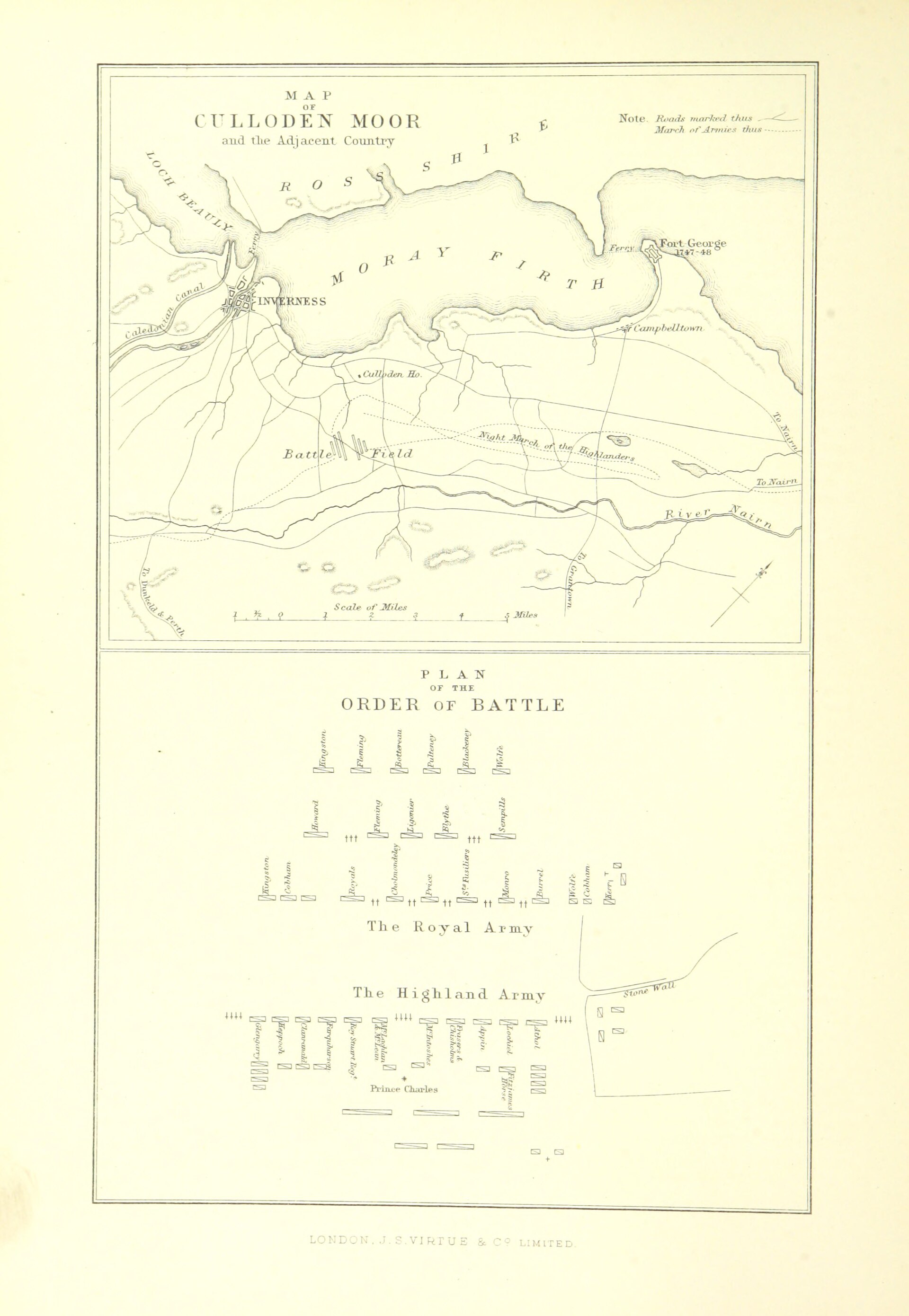
Map of Culloden Moor and the Adjacent Country (showing Inverness)
Inset plan shows Inverness at the mouth of the River Ness with street blocks, the Moray Firth, Fort George and nearby roads.
1746 · The British Library · Wikimedia Commons
No restrictions (plate dated 1746)
Castles of Inverness


More cities to explore
 ScotlandAberdeenExplore it in 1500 · 1880
 ScotlandStirlingExplore it in 1300 · 1540
 ScotlandEdinburghExplore it in 1560 · 1790 · 1880
 ScotlandGlasgowExplore it in 1650 · 1775 · 1888
Castles of Europe · Landmarks of Europe · create your own reconstruction.