
Scotland · Still standing
Inverness Castle
Caisteal Inbhir Nis
Inverness Castle is a red sandstone castellated complex overlooking the River Ness in Inverness, Highland, Scotland. The present main (southern) block was completed in 1836 and the north block, originally a prison, was added in 1848; the building historically housed the sheriff court and county administration and is a Category A listed structure.
First raised
1836
Its prime
1848
Today
Still standing
As it stood in 1848
What Inverness Castle looked like in its prime.
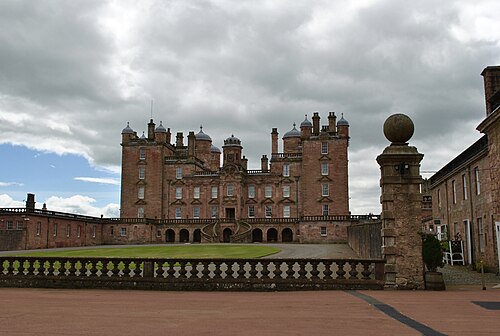
A long red-sandstone castellated frontage set atop a grassy riverbank, composed of a symmetrical seven-bay southern range with a central round-headed entrance and battlemented parapet. The composition includes multiple round towers (one tall cylindrical tower at the left and several shorter drum towers) and a square tower to the right, linked by low bastioned enclosing walls. Windows are predominantly round-headed; roofs are low and largely concealed by crenellations. The complex sits on a sloping embankment above the River Ness.
Its story
The story of Inverness Castle.
Malcolm's Castle and Robert I's Battlements, 1057–1307
A succession of castles has occupied the ground above the River Ness since 1057, the first of them said to have been raised by Malcolm III. Shaw Macduff, reckoned the first chief of Clan Mackintosh, is said to have been made constable of the castle by Malcolm IV in 1163, after helping the king put down a rebellion in Moray. Robert I partially destroyed that first castle in 1307, razing its battlements to the ground.
James I's Parley, 1428
In 1428 James I, working to bring the Highlanders to heel, summoned fifty clan chiefs to a parley at the castle. Where the parliament was then sitting, the account runs, "they were one by one by order of the King arrested, ironed, and imprisoned in different apartments and debarred from having any communications with each other or with their followers". Several chiefs were executed on the spot. Among those taken were Alexander, 3rd Lord of the Isles, and his mother Mariota, Countess of Ross. Alexander was held for twelve months; on his release he came back to Inverness with 10,000 men and burnt the town, but the castle held.
It was occupied again during the Raid on Ross in 1491, and in February 1498 Walter Ogilvy was paid for repairing its two gemmel, or paired, towers. In February 1509 James IV made Alexander Gordon, 3rd Earl of Huntly, hereditary keeper of the castle and sheriff of Inverness.
The Gordons Shut the Gates on Mary, 1562
A further castle, with a tower, was completed in 1548 by George Gordon, 4th Earl of Huntly, who had been obliged by James V and Margaret Tudor to build a hall and chapel on the site in connection with his 1530 marriage to Elizabeth Keith. Huntly was constable until 1562.
When Mary, Queen of Scots, arrived on progress in August 1562 the Gordons refused her entry, and Clan Chattan, Clan Munro and Clan Fraser turned them out of the castle and took it for her. George Buchanan wrote that a great multitude of the ancient Scots came in of their own volition, "especially the Frasers and Munros, who were esteemed the most valiant families among those clans". The governor, a Gordon, was afterwards hanged. Mary came back in September, buying gunpowder and fifteen tartan plaids for her household in the town.
George Munro of Davochgartie and Milntown, who had helped organise the queen's journey, was made keeper of the castle, then ordered in December 1562 to resign it to John Ross, provost of Inverness. In response to the Chaseabout Raid, Mary and Lord Darnley appointed Hucheon Rose of Kilravock keeper on 22 September 1565; by October it had been decided that Huntly should keep it again.
Quite Fallen Down, 1619
In August 1583 James VI ordered John Leslie of Balquhain, Andrew Munro of Newmoir and William Douglas of Lochleven imprisoned in the castle, each with six servants. By May 1619 it was reported to be in a poor state, with "a great part thereof quite fallen down". Writing from Theobalds to the Earl of Mar and Gideon Murray, James ordered repairs once priority works at Linlithgow Palace and Dumbarton Castle were finished, reflecting that "although it may be that we in our own time shall never see it, much less dwell therein, yet may some of our successors take occasion to remain there". The castle was not repaired then. Inverness was besieged again in 1649, 1650, 1689, 1715 and 1746.
Burn's Courthouse, 1836
The present red sandstone building stands on the site of the original castle. Its main southern block, which took in the old County Buildings including the sheriff court, was designed by William Burn and completed in 1836; Thomas Brown II added the north block, first a prison and later a second courthouse, completed in 1848, and Joseph Mitchell designed the bastioned enclosing walls.
After the Local Government (Scotland) Act 1889 created county councils, Inverness-shire County Council met in the courthouse until it moved to Glenurquhart Road in 1963; the building went on hearing sheriff court cases until they moved to the Inverness Justice Centre on 30 March 2020, and it closed to the public in 2021 for renovation and remodelling, with a re-opening planned for 2025.
Four field guns stood at the frontage from 1920, among them one taken by the 5th Battalion Queen's Own Cameron Highlanders at Loos on 25 September 1915 and a pair of Russian guns captured after the siege of Sevastopol and given to Inverness in 1857. The Russian pair were sold for scrap in 1941 for £25, but by mistake a Cameron Highlanders gun taken in France was carried off in place of one of them and scrapped before anyone noticed. As of 2017 only the Loos gun survived, in the Clan Cameron Museum at Achnacarry.
Step inside
8 places to explore in 1848.
The record describes 8 distinct spots at Inverness Castle, including 2 interiors: sheriff court interior (main block), prison corridor / cell area (north block). Create your own photoreal reconstruction and explore every one, more scenes means more rooms, more angles, and more of the place to stand in.
Build Your Own Castle
Recreate Inverness Castle with AI to explore it.
The artist rebuilds it as it stood in 1848, a photoreal reconstruction that belongs to you alone. Pay with coins, no subscription needed.
Recreate this castle →Defend this castle →Questions about Inverness Castle
What is the history of Inverness Castle?
What is inside Inverness Castle?
Why was Inverness Castle built, and what was it used for?
Where is Inverness Castle?
When was Inverness Castle built?
Was Inverness Castle ever attacked or besieged?
What did Inverness Castle look like in its prime?
Is Inverness Castle still standing, or is it a ruin?
More castles of Scotland


Explore the city


