
Scotland · Restored
Castle Stuart
Castle Stuart is a 17th-century Scottish tower house on the banks of the Moray Firth, completed in 1625 for the Earls of Moray. After centuries of dereliction it has been restored and now operates as a luxury hotel; the building retains its original tower-house composition and prominent stair-tower.
First raised
1619
Its prime
1625
Today
Restored
As it stood in 1625
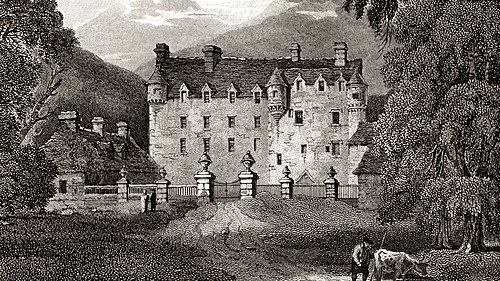
What Castle Stuart looked like in its prime.
A compact, multi-storey stone tower house of ashlar sandstone with a tall rectangular main block and a prominent round stair-tower capped by an open stone crown and finial. To the right a crenellated rectangular tower rises above the roofline; the left range presents steep, stone-slate pitched roofs with several gabled projections and grouped chimneys. Walls show regularly spaced narrow rectangular windows; the house sits on low coastal ground beside the Moray Firth, complete and occupied in its prime.
Its story
The story of Castle Stuart.
Mary, Queen of Scots' Grant to Her Half-Brother
The ground on the shore of the Moray Firth, some 6.5 miles (10 km) north-east of Inverness, came to the 1st Earl of Moray as a grant from his half-sister Mary, Queen of Scots, after her return to Scotland in 1561. The successive murders of Lord Moray and of his son-in-law, the 2nd Earl, carried the building down two generations before anything was finished.
The Tower House Finished by the 3rd Earl, 1625
Work on the tower house is dated to 1619, and it was James Stuart, 3rd Earl of Moray (grandson of the man Mary had granted the land to), who commissioned it and saw it completed in 1625.
Three Centuries Derelict After Charles I
The castle flourished at first, then fell into disuse as the fortunes of the House of Stuart sank through the English Civil War and the execution of Charles I in 1649. It stood derelict for about three hundred years. Restoration eventually brought the tower house back into occupied use as a hotel. It has been a category A listed building since 5 October 1971.
Links Golf on the Firth, 2009
A seaside links course opened alongside the castle on the Moray Firth in 2009, co-designed by managing partner Mark Parsinen with the architect Gil Hanse, and was voted Best New Golf Course by Golf magazine. It went on to host the Scottish Open in 2011, 2012, 2013 and 2016.
Step inside
6 places to explore in 1625.
The record describes 6 distinct spots at Castle Stuart, including the full exterior approach. Create your own photoreal reconstruction and explore every one, more scenes means more rooms, more angles, and more of the place to stand in.
Build Your Own Castle
Recreate Castle Stuart with AI to explore it.
The artist rebuilds it as it stood in 1625, a photoreal reconstruction that belongs to you alone. Pay with coins, no subscription needed.
Recreate this castle →Defend this castle →Whose castle
Clans who held Castle Stuart.
The families that held Castle Stuart for a decade or more across its history, follow a name to its clan.
Built by the Stuart Earls of Moray on land granted to the 1st Earl by Mary, Queen of Scots in 1561, and completed by the 3rd Earl in 1625.
Questions about Castle Stuart
What is the history of Castle Stuart?
Why was Castle Stuart built, and what was it used for?
Does anyone live in Castle Stuart now?
Where is Castle Stuart?
When was Castle Stuart built?
Which family or clan held Castle Stuart?
What did Castle Stuart look like in its prime?
Is Castle Stuart still standing or is it a ruin?
Who built Castle Stuart?
Can you visit Castle Stuart?
More castles of Scotland


Explore the city


