Scotland · Restored
Duncraig Castle
Caisteal Dhùn na Creige
Duncraig Castle is a three-storey Scottish baronial mansion on the south shore of Loch Carron in the Highlands of Scotland, built in 1866 to designs by Alexander Ross for Alexander Matheson. The asymmetrical nine-bay building includes a chapel, a large dining room and an octagonal water tower, and sits within a wooded 40-acre estate with a boathouse and two private islands. A small private railway station on the Kyle of Lochalsh line serves the property.
Its prime
1897
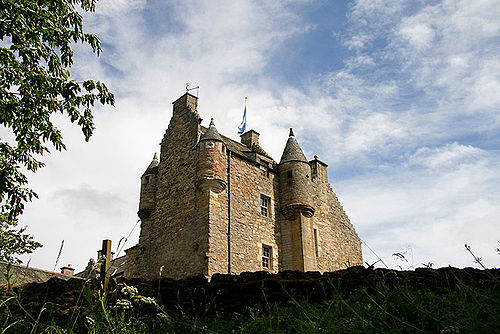
Today
Restored
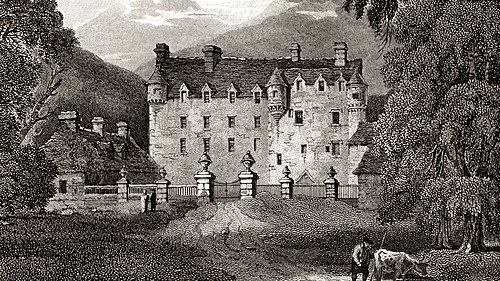
As it stood in 1897
What Duncraig Castle looked like in its prime.
A three-storey, asymmetrical nine-bay Scottish baronial mansion with stepped gables and crenellated roofline, arranged around an irregular plan; an octagonal water tower projects above the massing. The stone-built block sits close to the shoreline of Loch Carron amid estate woodland, with a separate boathouse and small private islands offshore. The composition is interrupted by later additions (a 20th-century wing), but the original baronial silhouettes of gables, crenellations and tower dominate the outline.
Its story
The story of Duncraig Castle.
Alexander Matheson's Country House and the Kyle of Lochalsh Line, 1866–1897
Duncraig was built in 1866 in the Scottish baronial style, to designs by the architect Alexander Ross, for the MP and businessman Sir Alexander Matheson, who had returned to Britain after making a large fortune through the Chinese opium trade and wanted a country home suitable for hosting large gatherings. It stood close to the Mathesons' family seat at Attadale, on the south shore of Loch Carron. Matheson died in 1886, and his family kept the castle, renting it to wealthy tenants who continued its use for summer entertaining.
In 1897 the Highland Railway built the Kyle of Lochalsh Extension to its existing line, including a dedicated station for Duncraig Castle. At its opening the station was for the private use of the Matheson family alone; it later opened to the public.
The Hamiltons' Abandoned Education Scheme and Naval Hospital, 1920s–1945
By the 1920s the Mathesons were in financial difficulty and sold the castle to Sir Daniel Hamilton and his wife Lady Margaret Hamilton, owners of the neighbouring Balmacara estate. The Hamiltons, supporters of social reform, planned to turn Duncraig into a community education centre where local people could train in activities such as weaving; in 1938 the local authority opened discussions with them on the scheme, but it had not come to fruition when the Second World War broke out in 1939. Sir Daniel Hamilton died early in the war, and the castle was used through the hostilities by the government as a naval hospital.
At the end of the war Lady Margaret Hamilton, whose principal residence was Balmacara House, bequeathed Duncraig to Ross-shire council for use as a technical school for the Highlands.
Home Economics College to Empty Ruin, 1945–2002
The education authority ran the castle as a home economics college for girls; a wing was added in modernist style in 1969, and the council removed the fireplaces and installed central heating throughout the building. The college closed in 1989, and Duncraig stood empty and neglected for the next fourteen years, its only interruption a spell in the mid-1990s as a filming base for the BBC's Hamish Macbeth.
The Dobsons of Duncraig, 2002–2009
In 2002 the castle was bought by Sam and Perlin Dobson, who ran a business in Nottingham. Seventeen members of their extended family moved in during the summer of 2003, each couple taking a different wing. None of the bathrooms worked and several ceilings had collapsed; the cost and effort of repairs, combined with the hardship of living in a derelict building through winter, brought growing disputes among the family. They sold their story to a television company, which filmed their first year and produced the five-part series The Dobsons of Duncraig, aired on BBC1 from December 2004. By 2008 only Sam and Perlin's own family remained (the other siblings had left and Sam's parents were evicted following a court order), and in 2009 the Dobsons sold the castle and moved on.
Bed and Breakfast to Private Sale, 2009–2022
Suzanne Hazeldine bought the castle from the Dobsons and opened it as a bed and breakfast, running it for two years before closing in 2010 to renovate it into luxury accommodation. The work was still under way in 2016, when Hazeldine told the Press and Journal she had given the building a "complete overhaul"; a reopening planned for spring 2017 had still not happened by 2020, but by 2021 the castle was again operating for bed and breakfast and weddings. In August 2022 the 40-acre property, with its coach house, private island, jetty and boathouse, was listed for sale as a fifteen-bedroom coastal castle, twelve of the bedrooms lettable with en suite bathrooms. It was sold into private ownership in late 2022 and the bed and breakfast is now permanently closed. The castle has been a category-C listed building since 1982, and its 1897 station on the Kyle of Lochalsh line, category-B listed since 1997, remains open to the public.
Step inside
8 places to explore in 1897.
The record describes 8 distinct spots at Duncraig Castle, including 3 interiors: octagonal water tower (upper level), castle chapel interior, large dining room. Create your own photoreal reconstruction and explore every one, more scenes means more rooms, more angles, and more of the place to stand in.
Build Your Own Castle
Recreate Duncraig Castle with AI to explore it.
The artist rebuilds it as it stood in 1897, a photoreal reconstruction that belongs to you alone. Pay with coins, no subscription needed.
Recreate this castle →Defend this castle →Whose castle
Clans who held Duncraig Castle.
The families that held Duncraig Castle for a decade or more across its history, follow a name to its clan.
Matheson
Built in 1866 for Alexander Matheson MP, near the Matheson seat at Attadale; the family held it until the 1920s.
Held by Sir Daniel and Margaret Hamilton from the 1920s; Margaret bequeathed it to the local council after the Second World War.