
Stadium · Scotland · Restored
Tynecastle Park
Tynecastle Park is a football stadium in the Gorgie area of Edinburgh and the long‑time home ground of Heart of Midlothian Football Club. The bowl is an all‑seated venue split into four named stands (Main, Wheatfield, Roseburn/School End and Gorgie) and has hosted domestic and international matches since 1886. The ground underwent major redevelopment in the 1990s and a rebuilt Main Stand was completed in the 2010s.
First raised
1886
Its prime
2018
Today
Restored
As it stood in 2018
What Tynecastle Park looked like in its prime.
A compact, four‑sided all‑seated football stadium squeezed into an urban block, with a modern pitch‑length Main Stand facing three post‑1990s stands. The three late‑20th century stands show a distinctive goalpost‑style steel tube roof framework mounted at the front, with support towers close to the pitch that carry angled floodlights. The rebuilt Main Stand has a contemporary façade overlooking the forecourt and the club crest above the main entrance; the playing surface sits low within the bowl.
Its story
The story of Tynecastle Park.
Across Gorgie Road from Old Tynecastle, 1874-1902
Heart of Midlothian was formed in 1874 and played at sites in the Meadows, at Powburn and at Powderhall before moving west to Gorgie in 1881. That first Gorgie pitch, called Tynecastle Park or Old Tynecastle, stood where Wardlaw Street and Wardlaw Terrace now run. The ground was regarded as being out of town, and Hearts would sometimes stage two matches for the price of one, or set an admission price well below that charged by their Edinburgh derby rivals Hibernian. In 1886, with the city continuing to expand, tenements replaced the old ground and the club moved across Gorgie Road to the present site, leased from Edinburgh Corporation. A friendly against Bolton Wanderers inaugurated the new home on 10 April 1886, and the first Scottish Football League match there followed on 23 August 1890, when Hearts lost 5-0 to Celtic.
Winning the Scottish Cup in 1891 gave the club enough money for a new clubhouse. The ground took its first international fixture in 1892, a 6-1 Scotland win over Wales watched by only 1,200 people, a snowstorm having led many to assume the match would be postponed. A roof went up on the original South stand the same year. In 1895 Tynecastle staged a "World Championship" match between Sunderland, champions of the English Football League First Division, and the Scottish champions Hearts, which Sunderland won 5-3; a second such game in 1902 ended with Hearts beating Tottenham Hotspur 3-1.
Leitch's Grandstand and the Haymarket Ash, 1903-1939
A small stand and pavilion were built in 1903, and in 1906 the banks of terracing were greatly increased, giving a total capacity of 61,784. A covered enclosure went up on the western "distillery" side in 1911, the same year the ground took its first rugby league match, an Ashes fixture between Great Britain and Australia on the 1911-12 Kangaroo tour that ended in an 11-11 draw. In 1914 the two old stands and the pavilion were replaced by a pitch-length grandstand - the Main Stand - designed by the stadium architect Archibald Leitch. Hearts sold Percy Dawson to Blackburn Rovers for a British record transfer fee of 2,500 pounds to help fund it. A number of items had been left out of the first estimate, and the stand's cost doubled to 12,000 pounds.
Hearts bought the ground outright in 1926, and over the following four years the terraces were expanded using ash carted from the nearby Haymarket railway yards. The club gave the BBC permission to begin radio commentaries from Tynecastle in 1927. New turnstiles were built on Wheatfield Street and subways cut to give access to the terraces. The ground was a regular neutral venue for cup semi-finals in these years, hosting a Scottish Cup semi-final in four consecutive seasons at one stage during the 1920s, and its record attendance came in 1932, when 53,396 watched a Scottish Cup tie against Rangers. By then Tynecastle was tightly squeezed on three sides by narrow streets, Tynecastle High School and the bonded warehouses of the North British Distillery. Hearts considered moving to Murrayfield Stadium, which had opened in 1925, and a new ground at Sighthill was also proposed; the outbreak of the Second World War halted both schemes.
Concrete Terraces, Floodlights and the Mackay Money, 1951-1989
The terraces were concreted in 1951, and in 1954 Tynecastle became Scotland's first all-concrete stadium. The club architects put the modernised capacity at 54,359, but for safety reasons only 49,000 tickets were printed and sold for big matches. Floodlights were installed in 1957. A roof was built along part of the distillery side and in the north-west corner in 1959, paid for by the sale of Dave Mackay to Tottenham Hotspur for 32,000 pounds. Scotland had used the ground for internationals against Wales in the British Home Championship, a fixture considered to have the least box-office potential and often played outside Glasgow, but after the Second World War the Scottish Football Association favoured playing all home matches at Hampden Park unless exceptional circumstances prevented it.
Nothing further was done to the ground until stricter safety regulations came into effect in the 1970s, and Hearts lacked the money to redevelop, having been relegated from the Premier Division twice in five seasons in the late 1970s and early 1980s. The club began to perform better under Wallace Mercer, who took control in 1981. Capacity was cut to 29,000 as benches were installed on the covered distillery terrace in 1982 and in the Main Stand paddock in 1985, and lounges and facilities were fitted into the Main Stand around the same time.
Tynecastle was one of the venues when Scotland hosted the 1989 FIFA U-16 World Championship. The opening group matches drew sparse crowds, but on 20 June 1989 a crowd of 28,555 watched Scotland beat a Portugal side containing Rui Costa and Luis Figo 1-0 in the semi-final. Scotland lost the final to Saudi Arabia.
The Taylor Report, Millerhill and the Rebuilt Ground, 1991-1999
The Taylor Report required all major sports grounds to be all-seated by August 1994. Hearts first entered discussions with Hibernian and the local authorities, but none of the sites suggested suited all parties. In March 1991 the club submitted its own proposal for a 30,000 all-seat stadium at Millerhill, in the south-east of Edinburgh, with offices, a hotel, a supermarket, restaurants and a business park attached; the site lay in the city's green belt and the proposal was rejected later that year. Hermiston was then suggested, and fell through in December 1992 for the same reason.
The collapse of the Hermiston plan forced Hearts to redevelop Tynecastle instead. The entire western and northern sides of the ground were demolished in 1994, making room for the Wheatfield Stand that year and the Roseburn Stand the next, the latter completed in August 1995 at a cost of 1.4 million pounds. Temporary bucket seating was put on the Gorgie Road end terracing until that terracing was razed in 1997 and replaced by the Gorgie Stand, completed in September. The ground was officially renamed Tynecastle Stadium during the rebuilding.
The ground kept its role as a neutral venue through the period, though the last Scottish Cup semi-final played there was Aberdeen's defeat of Hibernian in 1992-93. Once regular live television coverage caused semi-finals to be played at different times, it became Scottish Football Association policy to stage both Scottish Cup semi-finals at Hampden where possible. Nineteen Scottish Cup semi-finals, not counting replays, and eleven League Cup semi-finals have been staged at Tynecastle in total. Rugby league returned eight decades after the Ashes match, the newly created Super League again trying to promote the game in Scotland. It moved two league fixtures to Gorgie: London Broncos against Bradford Bulls, which drew over 7,000 in 1998, and Gateshead Thunder against Wigan Warriors before a smaller crowd in 1999.
Save Our Hearts, Romanov and Budge's Main Stand, 2004-2021
In 2004 the club's chief executive Chris Robinson announced plans to sell Tynecastle, which he called "not fit for purpose", with Hearts renting Murrayfield from the Scottish Rugby Union instead; the prime motivation was to clear the club's debt of nearly 20 million pounds. The plan was almost universally unpopular with supporters, who set up a "Save Our Hearts" campaign to block it, but Robinson and those backing him controlled a slender majority of the issued shares and a deal was preliminarily agreed to sell the site to the property developer Cala Homes for just over 20 million pounds. The sale was cancelled when Vladimir Romanov bought the club in January 2005 and invoked a clause in the initial agreement allowing its annulment on payment of a fixed sum of 75,000 pounds. Later that year the pitch was altered to meet UEFA dimensions, which meant taking out the lowest rows of seating in the Gorgie and Roseburn stands and cut the overall capacity from 18,000 to 17,420.
On 20 August 2007 the club announced it was at an advanced stage in plans to demolish the ageing Main Stand and replace it with a 10,000-seat stand including a hotel and leisure facilities, taking capacity to 23,000. A planning application went to Edinburgh City Council in February 2008, but the state of the club's finances stopped the scheme. The plans were revived in December 2015, when the owner Ann Budge said work would start as soon as possible, and Hearts lodged proposals with the council in March 2016 for a 7,000-seat stand with a nursery, club shop, ticket office and administrative offices. Construction began late in the 2016-17 season, and in April the club announced it would restore the original name Tynecastle Park when the new stand opened. Completion had been expected by September 2017; delays meant four home fixtures had to be moved to Murrayfield, and the ground reopened on 19 November for a league match against Partick Thistle. The new stand replaced Leitch's 1914 grandstand.
Hearts still own and play at Tynecastle, a UEFA category four ground seating 19,852, the sixth-largest football stadium in Scotland. League Cup semi-finals continue to be staged at smaller venues depending on the participants, and the most recent held at Tynecastle was Hibernian's 2-1 win over St Johnstone in 2015-16; the ground has also become the home of the Scotland women's national team. On 2 August 2019 it hosted the opening event of the Edinburgh International Festival, the Los Angeles Philharmonic under Gustavo Dudamel playing Hollywood film scores including Jurassic Park, Star Wars, E.T. and Jaws, with over 15,000 free tickets issued and the concert live-streamed and broadcast on Classic FM. At the 2021 Edinburgh Festival Fringe the play Sweet F.A. was performed on a stage built on the main stand with the pitch as its backdrop, dramatising the women's football club formed during the First World War by workers at the North British Rubber Company's Fountainbridge factory.
Step inside
9 places to explore in 2018.
The record describes 9 distinct spots at Tynecastle Park, including 5 interiors: main stand seating bowl and paddock, wheatfield stand interior slope and seating, roseburn stand (school end) seating and more. Create your own photoreal reconstruction and explore every one, more scenes means more photos, more angles and more of the immersive experience.
Build Your Own Castle
Recreate Tynecastle Park with AI to explore it.
Rebuilds stop at 1945, so the artist raises this site as it stood in 1914, not today's building, as a photoreal reconstruction that belongs to you alone. Pay with coins, no subscription needed.
Recreate Stadium to Explore →Nearby
Castles within reach of Tynecastle Park.

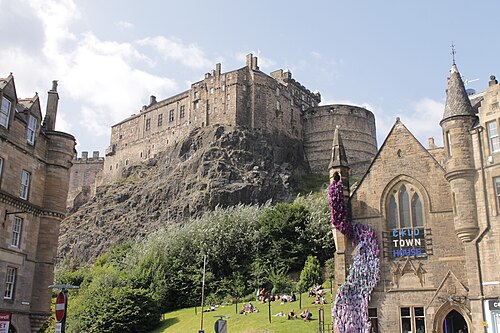

Landmarks within reach of Tynecastle Park.


More landmarks of Scotland


Explore the city


