
Scotland · Partial ruin
Craigmillar Castle
Caisteal Chreag a' Mhuilleir
Craigmillar Castle is a medieval L-plan tower house and courtyard complex on a low rocky hill south-east of Edinburgh. Built from the late 14th century and extended through the 15th and 16th centuries, it comprises a four-storey keep surrounded by a 15th-century inner curtain wall with corner round towers, and a lower outer wall enclosing broad outer courts with a chapel and dovecote.
First raised
1300
Its prime
1566
Today
Partial ruin
As it stood in 1566
What Craigmillar Castle looked like in its prime.
An L-plan, four-storey stone tower house sits on a rocky outcrop, with a projecting southern jamb, thick masonry walls and a stone-flagged parapet walk. A 15th-century curtain wall encircles a roughly 10-metre inner courtyard, with round towers at each corner and machicolations and battlements along the wallhead. Beyond this is a lower outer wall forming a larger outer court containing a chapel and a circular dovecote; the whole complex built of pale grey local sandstone on a low hill amid fields.
Its story
The story of Craigmillar Castle.
The Prestons Take the Rock, 1342–1479
The lands of Craigmillar were granted to the monks of Dunfermline Abbey by King David I in the 12th century. The Prestons arrived in 1342, when David II granted the family two-thirds of the estate; in 1374 Robert II gave the remainder to Sir Simon de Preston, Sheriff of Midlothian. It was Simon's son, or perhaps his grandson Sir George, who raised the L-plan tower house, in place by 1425, when Sir John Preston sealed a charter at Craigmillar.
The courtyard wall wrapping the tower was probably the work of Sir William Preston (d. 1453), who had travelled in France and drew on continental models for it. He also brought home the arm of Saint Giles, presenting the relic to the High Kirk of Edinburgh, where the Preston Aisle is named for him. In 1479 the castle turned prison: John Stewart, Earl of Mar, brother of James III, was held at Craigmillar accused of practising witchcraft against the King, and later died in suspicious circumstances.
A Boy King's Refuge, Hertford's Fire, 1511–1544
Craigmillar was erected into a barony in 1511, and the outer courtyard was built around that time. In September 1517, with plague loose in Edinburgh, the infant James V was moved here for safety; his French guardian De la Bastie had new locks made for the royal chamber and a stable built for the king's mule. During the Rough Wooing (Henry VIII's attempt to force a marriage between his son Edward and the young Mary, Queen of Scots) English troops under the Earl of Hertford burned Craigmillar on 8 May 1544, after sacking Edinburgh. Sir Simon Preston (d. 1569), Lord Provost of Edinburgh and a loyal supporter of Queen Mary, repaired the castle and remodelled the courtyard ranges.
The Craigmillar Bond, 1566
Queen Mary knew the castle already, having met the English ambassador Thomas Randolph there in September 1563. On 20 November 1566 she returned to convalesce after the birth of her son, the future James VI: still in poor health following a serious illness in October and, according to Philibert du Croc, suffering from depression. Tradition puts her bed in the small former kitchen inside the tower house, though she more likely occupied the newer east range.
Before she left on 7 December, her noblemen suggested that her unpopular husband, Henry Stuart, Lord Darnley, could be removed, by divorce or by other means. A pact, the "Craigmillar Bond", was signed by her Secretary of State William Maitland of Lethington and nobles including the earls of Bothwell, Argyll and Huntly, who met first in Argyll's bedchamber and then in Bothwell's room. The bond itself does not survive. Mary made her unhappiness with Darnley plain, but was probably unaware of the plot to kill him. Darnley was to have lodged at Craigmillar on his return to Edinburgh; he chose Kirk o' Field in the town instead, and was murdered there on 10 February 1567.
Gunpowder, a Waiting King and Wax Images, 1571–1662
The castle was drawn into the civil war that followed Mary's fall. On 2 June 1571 Captain Melville and two of his soldiers, fighting for the Queen's cause, were killed in the grounds when a barrel of gunpowder exploded; in 1572 Regent Mar used Craigmillar as his base for the siege of Edinburgh Castle, then held for the exiled Queen, and stables were built for a company of light horsemen. In September 1589 James VI came to Craigmillar while waiting for his bride Anne of Denmark, delayed by contrary winds (passing the time "as a kind lover spends the time in sighing"), and it was here he decided to sail to Norway to meet her. Witchcraft clung to the place: in 1591 Agnes Sampson was accused of placing a charmed wax image in a dovecote at Craigmillar to help her friend Barbara Napier, and John Preston of Haltree sat as commissioner at witchcraft trials in 1661–62.
Sold to the Gilmours, Left to Ruin, 1639–1946
On Sir Robert Preston's death in 1639 Craigmillar passed to a distant cousin, David Preston of Whitehill, whose son sold it out of the family. Sir John Gilmour (a Royalist rewarded after the Restoration with the Lord Presidency of the Court of Session in 1661) bought the castle and the neighbouring Inch estate in 1660, and remodelled the west range into a modern lodging fit for a senior judge. In the early 18th century the Gilmours moved to Inch House, and Craigmillar was ruined by 1775, when the antiquarian and poet John Pinkerton wrote an elegy on it. A proposal of 1842 to renovate it for Queen Victoria came to nothing, but Victoria visited in 1886, and its then owner Walter James Little Gilmour undertook much restoration. The castle has been in state care since 1946 and is maintained by Historic Environment Scotland.
Step inside
12 places to explore in 1566.
The record describes 12 distinct spots at Craigmillar Castle, including 6 interiors: guard room in the jamb, hall (second floor) with carved fireplace, kitchen in the tower jamb and more. Create your own photoreal reconstruction and explore every one, more scenes means more rooms, more angles, and more of the place to stand in.
Build Your Own Castle
Recreate Craigmillar Castle with AI to explore it.
The artist rebuilds it as it stood in 1566, a photoreal reconstruction that belongs to you alone. Pay with coins, no subscription needed.
Recreate this castle →Defend this castle →Whose castle
Clans who held Craigmillar Castle.
The families that held Craigmillar Castle for a decade or more across its history, follow a name to its clan.
Preston
Held by the Preston family, 1374–1660.
From the archive
Craigmillar Castle on paper: the measured plan and period views.
The survey plan and photographs below are the ground truth this page's reconstructions are checked against, drawn and photographed while the castle was still a working garrison. Every image is public-domain or openly licensed, with its source named.
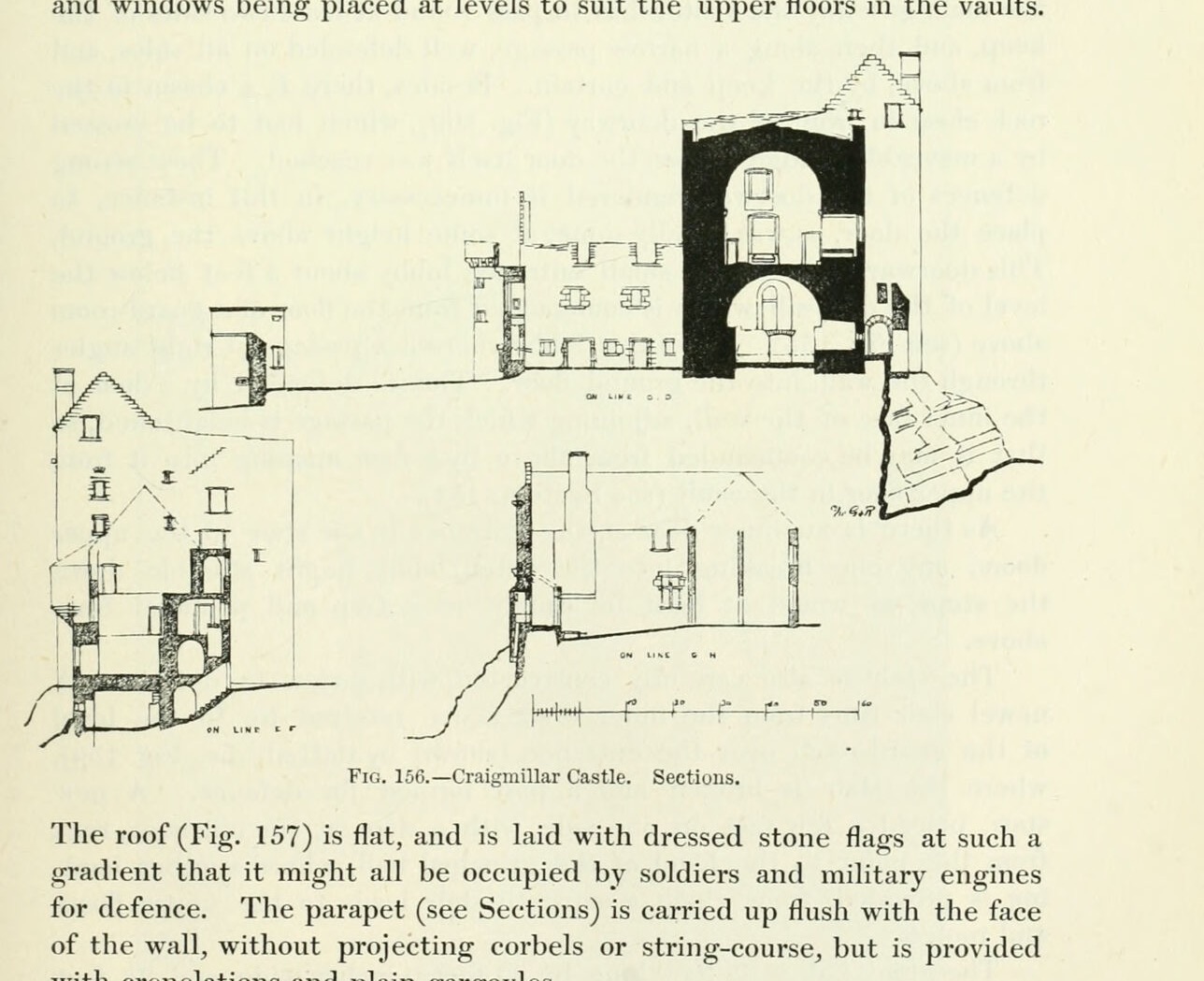
Fig. 155. Craigmillar Castle. Section from East to West.
1887 · MacGibbon & Ross, Castellated and Domestic Architecture of Scotland, vol. 1 (1887)
Public domain
Fig. 156. Craigmillar Castle. Sections.
1887 · MacGibbon & Ross, Castellated and Domestic Architecture of Scotland, vol. 1 (1887)
Public domain
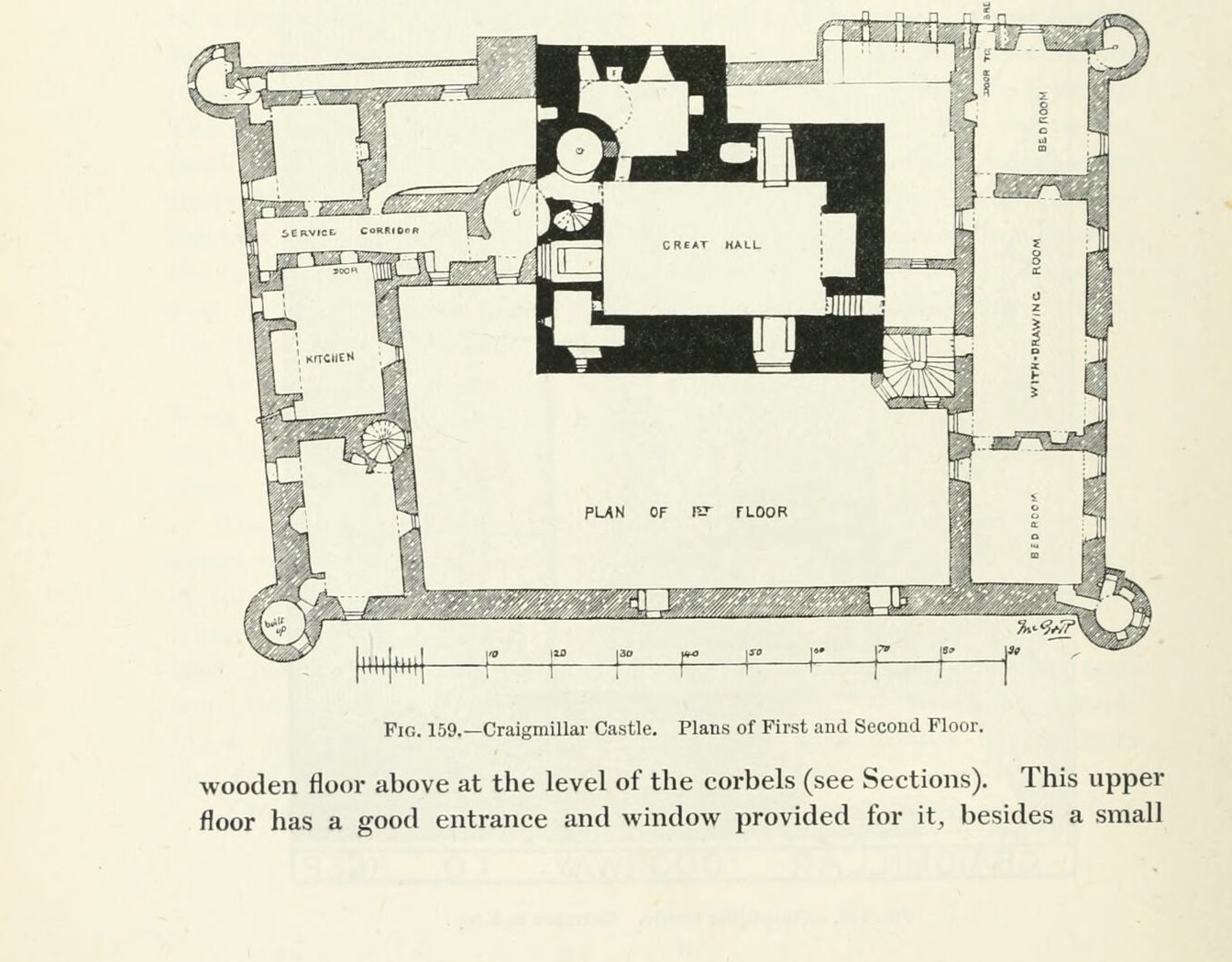
PLAN OF 2ND FLOOR
1887 · MacGibbon & Ross, Castellated and Domestic Architecture of Scotland, vol. 1 (1887)
Public domain
Nearby
Landmarks within reach of Craigmillar Castle.


Questions about Craigmillar Castle
What is the history of Craigmillar Castle?
What is inside Craigmillar Castle?
Who owns Craigmillar Castle now?
Why was Craigmillar Castle built, and what was it used for?
Where is Craigmillar Castle?
When was Craigmillar Castle built?
Was Craigmillar Castle ever attacked or besieged?
Which family or clan held Craigmillar Castle?
What did Craigmillar Castle look like in its prime?
Is Craigmillar Castle still standing, or is it a ruin?
Can you visit Craigmillar Castle?
More castles of Scotland


Explore the city


