
Scotland · Restored
Dalhousie Castle
Dalhousie Castle is a red sandstone L-plan castle near Bonnyrigg in Midlothian, Scotland, long-held by the Ramsay family and now used as a hotel. The surviving fabric includes a mid-15th-century drum tower and a larger 17th-century main block with crenellated parapets and corner turrets.
Its prime
1650
Today
Restored
As it stood in 1650
What Dalhousie Castle looked like in its prime.
A compact L-plan red/brown sandstone castle with a prominent cylindrical drum tower to the left and a rectangular three- to four-storey main block to the right, all topped by crenellated parapets and small round corner turrets. The main façade has regularly spaced sash-style windows, a central high arched entrance between the two ranges, a tall stone chimney rising from the roofline, and climbing ivy on parts of the lower walls; a gravel forecourt and clipped lawn sit before the entrance.
Its story
The story of Dalhousie Castle.
Simundus de Ramesie and the Lands of Dalwolsey
The Ramsays descend from Simundus de Ramesie (Simon of Ramsey) an English knight of Norman descent from the Huntingdonshire village of Ramsey, who followed his lord David, Earl of Huntingdon, to Scotland in about 1140. Counted the founder of Clan Ramsay and the first of the family to hold lands at Dalwolsey, he built the first castle there, on a strategic spot overlooking the River Esk. Of the red stone castle that stands today, the drum tower is the oldest part, dating to the mid 15th century; the majority is 17th-century work on an L-plan. A dry moat originally surrounded the castle, later filled in, and partially excavated in the late 20th century.
Edward I, a Six-Month Siege, and Cromwell's Base
King Edward I stayed at the castle on his way to meet Sir William Wallace at the Battle of Falkirk. In 1400, Sir Alexander Ramsay withstood a six-month siege at Dalhousie by English forces led by King Henry IV. Two and a half centuries later, Oliver Cromwell used the castle as a base for his invasion of Scotland. Through the generations that followed, many Earls of Dalhousie (the chieftains of Clan Ramsay, whose seat this was) took an active part in British political and military leadership.
Eight Centuries of Ramsays, Then the Sale of 1977
Around 1800, Walter Nicol designed a new layout for the walled garden. At the turn of the 20th century the seat of Clan Ramsay moved to Brechin Castle, and through the 20th century Dalhousie was leased out to a series of tenants, including a boarding school. The family retained ownership until 1977, by which time the castle had been in the same family for more than eight centuries, longer than any other castle in Scotland.
Converted into a hotel in 1972, the castle was bought by Von Essen Hotels in 2003 for a reported £10 million. A roof fire on 26 June 2004 caused significant but localised damage, with no major structural harm, and the hotel resumed normal operations after repairs. When Von Essen fell into administration in April 2011, Dalhousie went to market with a guide price of £7.5 million; in March 2012 Robert Parker, owner of Doxford House, Eshott Hall and Guyzance Hall in Northumberland, purchased it for an undisclosed sum.
Step inside
8 places to explore in 1650.
The record describes 8 distinct spots at Dalhousie Castle, including the full exterior approach. Create your own photoreal reconstruction and explore every one, more scenes means more rooms, more angles, and more of the place to stand in.
Build Your Own Castle
Recreate Dalhousie Castle with AI to explore it.
The artist rebuilds it as it stood in 1650, a photoreal reconstruction that belongs to you alone. Pay with coins, no subscription needed.
Recreate this castle →Defend this castle →Whose castle
Clans who held Dalhousie Castle.
The families that held Dalhousie Castle for a decade or more across its history, follow a name to its clan.
Ramsay
Seat of Clan Ramsay and the Earls of Dalhousie; held by the family for more than eight centuries until sold in 1977.
From the archive
Dalhousie Castle on paper: the measured plan and period views.
The survey plan and photographs below are the ground truth this page's reconstructions are checked against, drawn and photographed while the castle was still a working garrison. Every image is public-domain or openly licensed, with its source named.
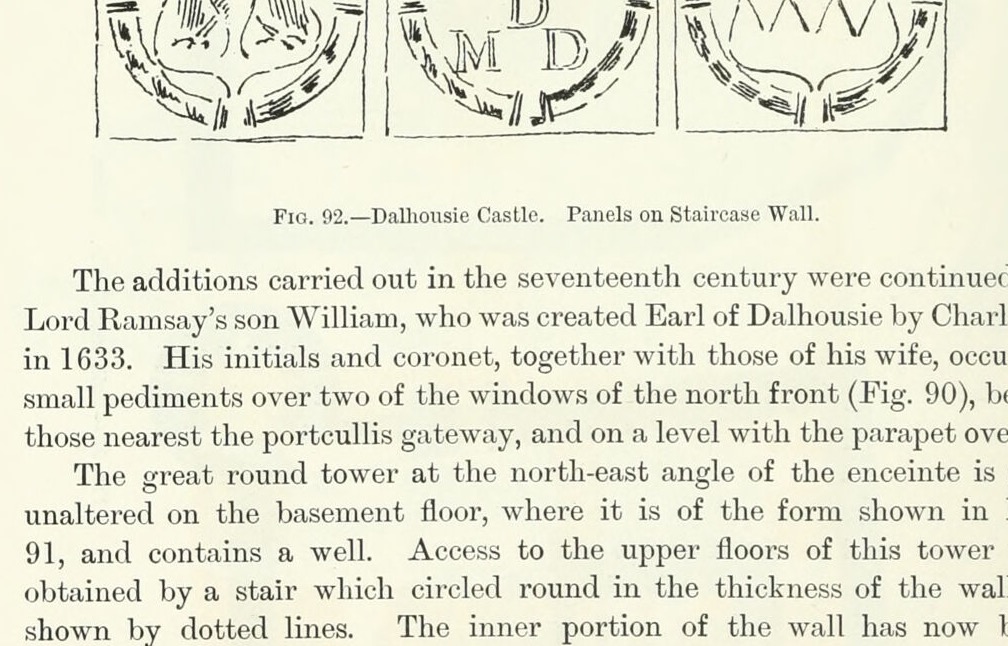
Fig. 92. Dalhousie Castle. Panels on Staircase Wall.
1889 · MacGibbon & Ross, vol. 3 (1889)
Public domain
Nearby
Landmarks within reach of Dalhousie Castle.


Questions about Dalhousie Castle
What is the history of Dalhousie Castle?
Who owns Dalhousie Castle now?
Why was Dalhousie Castle built, and what was it used for?
Does anyone live at Dalhousie Castle now?
Where is Dalhousie Castle?
When was Dalhousie Castle built?
Was Dalhousie Castle ever attacked or besieged?
Which family or clan held Dalhousie Castle?
What did Dalhousie Castle look like in its prime?
Is Dalhousie Castle still standing, or is it a ruin?
More castles of Scotland


Explore the city


