Historic Cities · Scotland
St Andrews through the ages
St Andrews is a coastal university town on the east coast of Fife in Scotland, 10 miles southeast of Dundee and 30 miles northeast of Edinburgh. St Andrews had a population of 16,460 in 2022, making it Fife's fourth-largest settlement and the 45th most populous settlement in Scotland.

St Andrews in 1450
Medieval St Andrews
St Andrews in 1450 is the ecclesiastical heart of Scotland: the vast cathedral stands whole beside the square tower of St Rule, the bishop's castle crouches on the cliff with a sea gate, and a very new university is taking root along South Street. The walk follows the three straight streets that lead to the cathedral, the busy little harbour, and the open links by the sea.
The town reads as stone and slate against sea and sky: a compact cluster of low, steep-roofed houses opening on three straight streets that converge on the cathedral's vast silhouette. Square towers (the cathedral, St Rule's) dominate a skyline of crenellated castle walls and rough ashlar, while narrow lanes, market stalls, fishing boats and the strip of sandy links give scale and constant movement.
The route: 22 streets, squares and views
West Sands Approach → West Port → Castle Street → Market Cross → Market Street → Church Street → North Street → The Scores → The Harbour → Kinness Burn Mouth → …
Step inside, 10 interiors
Market Hall · Harbour Smokehouse · Castle Great Hall · Sea-Gate Guardroom · Bishop's Palace Hall · Choir and High Altar · Cathedral Nave · St Rule's Tower Chamber · St Salvator's Chapel · College Lecture Chamber
Planned from the Wikipedia record: St Andrews.
St Andrews in 1900
Golfers' St Andrews
At the turn of the twentieth century St Andrews is a small coastal burgh whose worldwide reputation as the home of golf draws players, caddies and visitors alongside long-established university and fishing communities. This walk moves from the dunes and links into the town, past the Royal and Ancient clubhouse and the Old Course, through cathedral ruins and the harbour where fishermen mend nets.
Low golden sandstone buildings cluster along narrow streets and the cliff-top Scores; the cathedral stands as a roofless pile of weathered masonry, the castle a squat ruin above the harbour. The links are broad, grazed and wind-bleached, cut by the small stone Swilcan Bridge and bounded by dunes and sea. Dark hickory clubs, horse-drawn carts, striped windbreakers and sober Edwardian dress give colour to the town’s compact, seaside silhouette.
The route: 21 streets, squares and views
West Sands Dunes → West Sands Beach → West Port → Castle Street → South Street → Market Street → North Street → St Salvator's Quadrangle → The Scores → Martyrs' Monument → …
Step inside, 12 interiors
West Port Tollhouse · Clubmaker's Workshop · Tobacconist and Newsroom · St Salvator's Chapel · Tea Parlor · Links Hotel Dining Room · Big Room · Caddies' Locker Room · Ruined Cathedral Nave · Castle Vaulted Chamber · Fisherwife's Kitchen · Pier Waiting Room
Planned from the Wikipedia record: St Andrews.
Its story
The story of St Andrews.
Cenn Rígmonaid and the Relics of Saint Andrew, 747–943
The earliest reference to the place is an entry in the Annals of Ulster recording the death of the abbot of Cinrighmonai under the year 747. Behind it lies Old Gaelic Cenn Rígmonaid, "end or head of the king's moor", likely a translation of an older Pictish name; the king's moor was probably the upland stretching towards Crail, a section of which is still known as Kingsmuir. The element cenn was later replaced by cill, meaning church, giving the modern Gaelic Cill Rìmhinn, anglicised as Kilrymont. The name St Andrews came from the apostle whose relics the cathedral held, and was applied to the secular settlement beside the church from the twelfth century onwards; early sources call it Andrestoun, the toun element later left implicit.
A monastery was established here in the mid-eighth century by the Pictish king Oengus I, holding relics associated with Saint Andrew (an arm, a kneecap, three fingers and a tooth) believed to have been brought to the site by Saint Regulus. In 877 King Causantín mac Cináeda built a new church for the Culdees. In 906 the place became the seat of the bishop of Alba, the boundaries of the see extended to take in the land between the Forth and the Tweed, and in 943 Constantine II abdicated the kingship and took the position of abbot of the monastery.
Bishop Robert Lays Out the Burgh, c.1140–1357
Construction of the present town began around 1140 under Bishop Robert, on an L-shaped hill, possibly on the site of a ruined castle. A charter of 1170 places the new burgh west of the cathedral precinct, along Castle Street and possibly as far as what is now North Street, with the southern side of the Scores as its northern boundary, the Kinness Burn to the south and the West Port to the west. It was bounded by several ports (the Lowland Scots word for a town gate) of which two are still extant: the West Port on South Street, a scheduled monument and one of few surviving town ports in Scotland, and the Sea Yett where The Pends terminates at the harbour.
The parish church of Holy Trinity, the town kirk, was first built around 1144 on land close to the cathedral's south-east gable and dedicated in 1234 by Bishop David de Bernham; between 1410 and 1412 Bishop Warlock moved it to a new site on the north side of South Street. A mill lade, which may have been built before 1144, carried water from a higher point on the Kinness Burn to the water mill in the grounds of the cathedral priory, following the contours of the land so that it arrived at an elevated level. The burgh of St Andrews was first represented at the great council at Scone in 1357.
The Cathedral and the Pilgrim Trade, c.1120–1318
St Rule's Church came first, said to date from around 1120 to 1150; its tall square tower was built to hold the relics of Saint Andrew, and the church became known as the first cathedral in the town. After the death of the bishop who founded the priory of Canons Regular, his successor Bishop Arnold began a new cathedral in 1160 on a site adjacent to St Rule's. It was at one time Scotland's largest building. The work was not completed and consecrated until 1318, by Bishop William de Lamberton, with Robert the Bruce present at the ceremony.
The cathedral made St Andrews the most important centre of pilgrimage in medieval Scotland and one of the most important in Europe. Pilgrims came from all over Scotland in large numbers, hoping to be blessed and in many cases to be cured at the shrine of Saint Andrew, and their presence brought increased trade and development with it. As ecclesiastical capital the town carried political weight as well: the Scottish Parliament met there in 1304, when Edward I, in his capacity as overlord of Scotland, came to be received by Bishop Lamberton, with as many as 130 landowners turning up to witness the event, from Sir John of Cambo to Sir William Murray of Fort.
A University Chartered by an Avignon Pope, 1410–1512
The University of St Andrews was founded between 1410 and 1413. Bishop Henry Wardlaw issued a charter for it between 1411 and 1412, and the Avignon pope Benedict XIII granted it university status, with the power to award degrees to students, in 1413. It started out as a society for learned men in canon law, the arts and divinity, and the chapel and college of St John the Evangelist became the first building to have ties with it, in 1415. Two colleges followed: St Salvator, founded in 1450 by Bishop James Kennedy, and St Leonard, in 1512 by Archbishop Alexander Stewart and Prior James Hepburn. Three ornate ceremonial maces from the fifteenth century survive from that founding period; the university also holds a large astrolabe dating from 1575. It is the oldest university in Scotland and the third oldest in the English-speaking world.
The Bishops' Castle and the Reformation, c.1200–1620
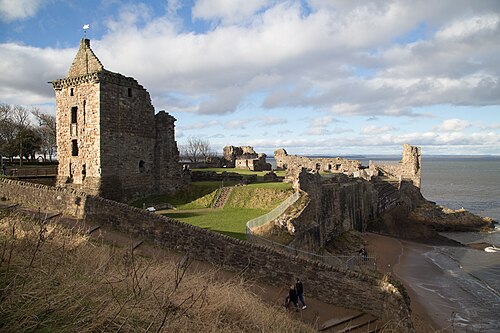
St Andrews Castle was first erected around 1200 as the residence, prison and fortress of the bishops of the diocese, on the cliff-top north of the town, and was rebuilt several times in the centuries after, most notably because of damage incurred in the Wars of Scottish Independence. During the Rough Wooing it was occupied, besieged and stormed, and was severely damaged in the process. The majority of what stands today dates to between 1549 and 1571, commissioned by John Hamilton, Archbishop of St Andrews, in a renaissance style that made the building a comfortable, palatial residence while keeping it well fortified. After the Reformation it passed to several owners who could not maintain its structure and it deteriorated into a ruin; it is now a scheduled monument administered by Historic Environment Scotland.
The Reformation cost the town the standing it had held since the tenth century. The Martyrs Memorial, at the west end of the Scores on a cliff overlooking the sea, was erected to the honour of Patrick Hamilton, George Wishart and other martyrs of the Reformation epoch. From 1559 the town fell into decay after the violent Scottish Reformation and the Wars of the Three Kingdoms, losing the status of ecclesiastical capital of Scotland. What civic standing it regained came on secular terms and slowly: St Andrews was made a burgh of barony in 1614 under the authorisation of the bishop, and King James VI granted it a royal burgh charter in 1620.
The Links and the Recovery of a Declining Burgh, 1552–1894
Golf was played on the links long before the town lived by it. The earliest surviving document, from 1552, records Archbishop Hamilton granting permission for the "playing at golf" on the links adjacent to the "water of eden". Decline was the condition of the following century and a half: the university was considering relocating to Perth around 1697 and 1698, and the town was still in decline through the eighteenth century, even as it became known for links "well known to golfers". The Royal and Ancient Golf Club of St Andrews was founded in 1754, and until 2004 it exercised legislative authority over the game worldwide, except in the United States and Mexico.
Recovery came in the nineteenth century. Hugh Lyon Playfair was provost from 1842 to 1861 and was credited with improving the burgh, the university and the golf club, and the town began to expand beyond its original medieval boundaries with streets of new houses and town villas. Madras College opened to pupils in 1833, founded and endowed by Andrew Bell (1755–1832), a native of the town, who was interested in the demand for a school able to teach both poor and privileged children on one site; its high reputation drew children from throughout Britain, often lodging with masters or residents in the town. The St Andrews School for Girls Company was established in 1877 and took the name St Leonards in 1882. The Open Championship was first staged on the Old Course in 1873, and the town council purchased the course in 1894.
Herring, Gown and the St Andrews Agreement, 1900–2022
The fishing failed before the First World War. At the start of the century the outlook had been better (eight crews prosecuted the summer herring fishing at northern ports, and one crew earned £250 at the English herring fishing), but like many of the smaller fishing stations St Andrews declined in the years before the war. In 1951 The Masque of St Andrews, which dramatised important events in the town's history, was staged in the cathedral grounds as part of the Festival of Britain. Direct rail access disappeared during the 1960s, the St Andrews Railway's connection to the Edinburgh–Aberdeen line at Leuchars ending in 1969. What took the place of fishing was the university, golf and tourism, which increasingly shaped the economy and character of the town through the second half of the twentieth century; from the 1980s the university undertook a substantial programme of investment in its research facilities, and became one of the principal employers in the town.
The town drew unusually intense international media attention in 2001, when Prince William began studying at the university; he met Catherine Middleton while they were students there. In October 2006 the British and Irish governments and the principal political parties of Northern Ireland held negotiations in St Andrews, producing the St Andrews Agreement, which helped create the conditions for the restoration of the Northern Ireland Assembly and a devolved power-sharing executive in 2007. The university marked the 600th anniversary of its foundation in 2013, and the Old Course has hosted the Open in 1990, 1995, 2000, 2005, 2010 and 2015; in 2022 the town held the 150th Open, for which a record 290,000 spectators attended during the week, exceeding the previous attendance record set at St Andrews in 2000. St Andrews had a population of 16,460 at the 2022 census, making it the fourth-largest settlement in Fife, which has been a unitary authority under Fife Council since 1996.
From the archive
St Andrews on paper: the old town as it was mapped.
A period plan or bird's-eye view of the old town, drawn between 1500 and 1850, the streets this page's reconstructions walk. Public domain, with its source named.
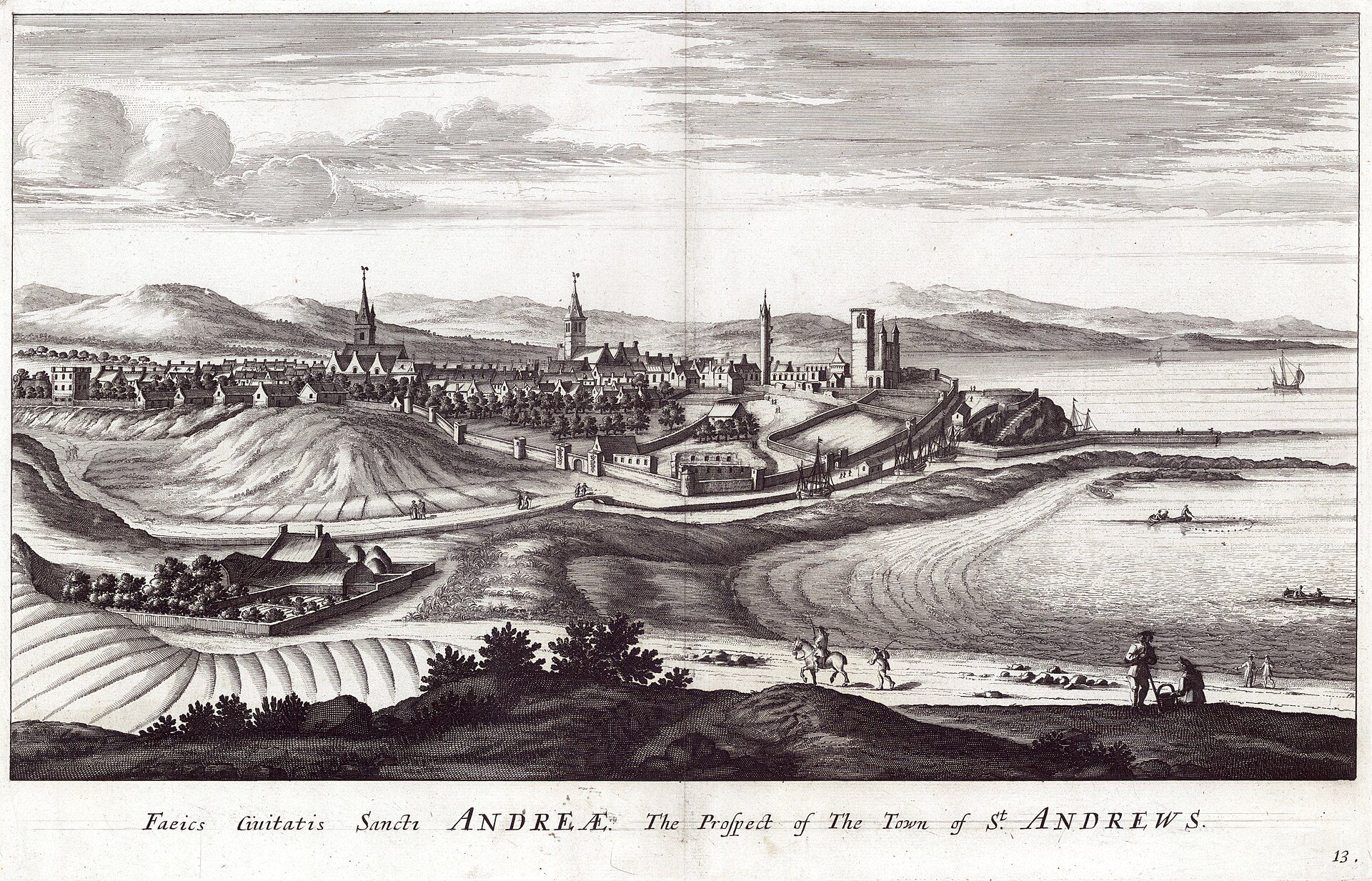
The Prospect of the Town of St Andrews, from John Slezer's Theatrum Scotiae
The cathedral ruins and St Rule's tower stand over the harbour, with St Salvator's steeple and Holy Trinity inside the walls and the castle on its rock above the shore.
1693 · John Slezer · Wikimedia Commons
No restrictions (plate dated 1693)
Castles of St Andrews


More cities to explore
 ScotlandEdinburghExplore it in 1560 · 1790 · 1880
 ScotlandStirlingExplore it in 1300 · 1540
 ScotlandGlasgowExplore it in 1650 · 1775 · 1888
 ScotlandAberdeenExplore it in 1500 · 1880
Castles of Europe · Landmarks of Europe · create your own reconstruction.