
Scotland · Ruin
St Andrews Castle
St Andrews Castle is a medieval fortress sited on a rocky promontory at St Andrews on the Fife coast of Scotland. The surviving remains include a tall rectangular tower, long curtain walls and ranges of ruined buildings clustered around a grassy inner bailey that drops to a beach and the sea below.
First raised
1200
Its prime
1540
Today
Ruin
As it stood in 1540
What St Andrews Castle looked like in its prime.
Large rectangular stone tower with steep, stone-capped upper profile and a small flag, standing at the western end of a compact castle complex; long low curtain walls run eastward along a rocky cliff with battlemented walkways and ruined ranges set around a central grassy bailey; masonry is coarse grey-brown sandstone with many collapsed sections, rooflines mostly gone except the tower cap, and the castle sits directly above a narrow beach and open sea on a rocky promontory.
Its story
The story of St Andrews Castle.
Bishop Roger's Castle and the Wars of Independence, 1189-1337
A castle has stood on the promontory at St Andrews since the time of Bishop Roger (1189-1202), son of the Earl of Leicester. It housed the burgh's wealthy and powerful bishops while St Andrews was the ecclesiastical centre of Scotland before the Protestant Reformation; in their Latin charters the archbishops wrote of it as their palace, signing "apud Palatium nostrum".
Soon after Edward I of England sacked Berwick in 1296, the castle was taken and made ready for the English king in 1303. After the Scottish victory at Bannockburn in 1314 it was retaken and repaired by Bishop William Lamberton, Guardian of Scotland and a loyal supporter of Robert the Bruce. The English recaptured it by the 1330s and reinforced its defences in 1336, but Sir Andrew Moray, regent of Scotland in the absence of David II, retook it after a three-week siege. Shortly after, in 1336-37, the Scots destroyed the castle themselves to keep the English from using it again as a stronghold.
Bishop Trail's Rebuilding and the Bottle Dungeon
The castle lay in ruin until Bishop Walter Trail rebuilt it, completing the work by about 1400; he died within its walls in 1401. James I of Scotland later received part of his education there from Bishop Henry Wardlaw, founder of the University of St Andrews in 1410, and Bishop James Kennedy served as a trusted adviser to James II.
The castle's bottle dungeon, cut from solid rock below the north-west tower, held local offenders under the bishop's jurisdiction alongside grander prisoners: David Stuart, Duke of Rothesay, in 1402 and Murdoch Stewart, 2nd Duke of Albany, in 1425. Of the dungeon the reformer John Knox later wrote, "Many of God's Children were imprisoned here."
Cardinal Beaton, Witch-Burnings and Murder, 1521-1546
In 1521 James Beaton, then Archbishop of Glasgow, won the see of St Andrews and took up residence, altering the castle's defences to withstand artillery as tension grew between English Protestants and Scottish Catholics, and building a new artillery blockhouse. In 1538 he was succeeded by his nephew, Cardinal David Beaton.
Three women from Edinburgh and Dunfermline accused of witchcraft were held at the castle and burned on 10 October 1542. Beaton's opposition to the proposed marriage of Mary, Queen of Scots, to the future Edward VI helped spark renewed fighting in 1544, and in 1546 he had the Protestant preacher George Wishart imprisoned in the castle's Sea Tower and burned at the stake before its walls on 1 March. On 26 May that year, Wishart's friends gained entry disguised as masons, overpowered the garrison, murdered Beaton and hung his body from his window.
The Long Siege, 1546-1547
After the murder, the Protestants took refuge in the castle and formed the first Protestant congregation in Scotland. The regent, James Hamilton, 2nd Earl of Arran, ordered a long siege; in October 1546 his men began a mine cut through solid rock, which the defenders successfully counter-mined, and both passages were rediscovered in 1879. Arran called on Fife lairds to bring their followers and artillery by 4 November 1546. Henry VIII made plans to assist the besieged Protestants, but no English force came.
During an armistice in April 1547, John Knox entered the castle and served as the garrison's preacher. The peace ended when a French fleet arrived bringing the Italian engineer Leone Strozzi, who directed a devastating bombardment; guns were placed on St Salvator's and the cathedral towers, and the castle was rendered indefensible within six hours according to Robert Lindsay of Pitscottie. The defeated defenders were taken away, some imprisoned in France, others, including Knox, condemned to the galleys.
Archbishop Hamilton's Rebuilding and the End of the Archbishopric
The castle was substantially rebuilt by Archbishop John Hamilton, Arran's illegitimate brother and Beaton's successor, but after Hamilton's death in 1571 it was mainly occupied by a succession of constables. Parliament separated the castle from the archbishopric in 1606 and granted it to the Earl of Dunbar, constable since 1603; it was returned to Archbishop George Gledstanes in 1612, though further attempts to re-establish the archbishopric's estates failed.
By 1656 the castle had fallen into such disrepair that the burgh council ordered its materials used to repair the pier. The office of bishop was finally abolished by William of Orange in 1689, leaving the castle without any function.
Step inside
7 places to explore in 1540.
The record describes 7 distinct spots at St Andrews Castle, including the full exterior approach. Create your own photoreal reconstruction and explore every one, more scenes means more rooms, more angles, and more of the place to stand in.
Build Your Own Castle
Recreate St Andrews Castle with AI to explore it.
The artist rebuilds it as it stood in 1540, a photoreal reconstruction that belongs to you alone. Pay with coins, no subscription needed.
Recreate this castle →Defend this castle →From the archive
St Andrews Castle on paper: the measured plan and period views.
The survey plan and photographs below are the ground truth this page's reconstructions are checked against, drawn and photographed while the castle was still a working garrison. Every image is public-domain or openly licensed, with its source named.
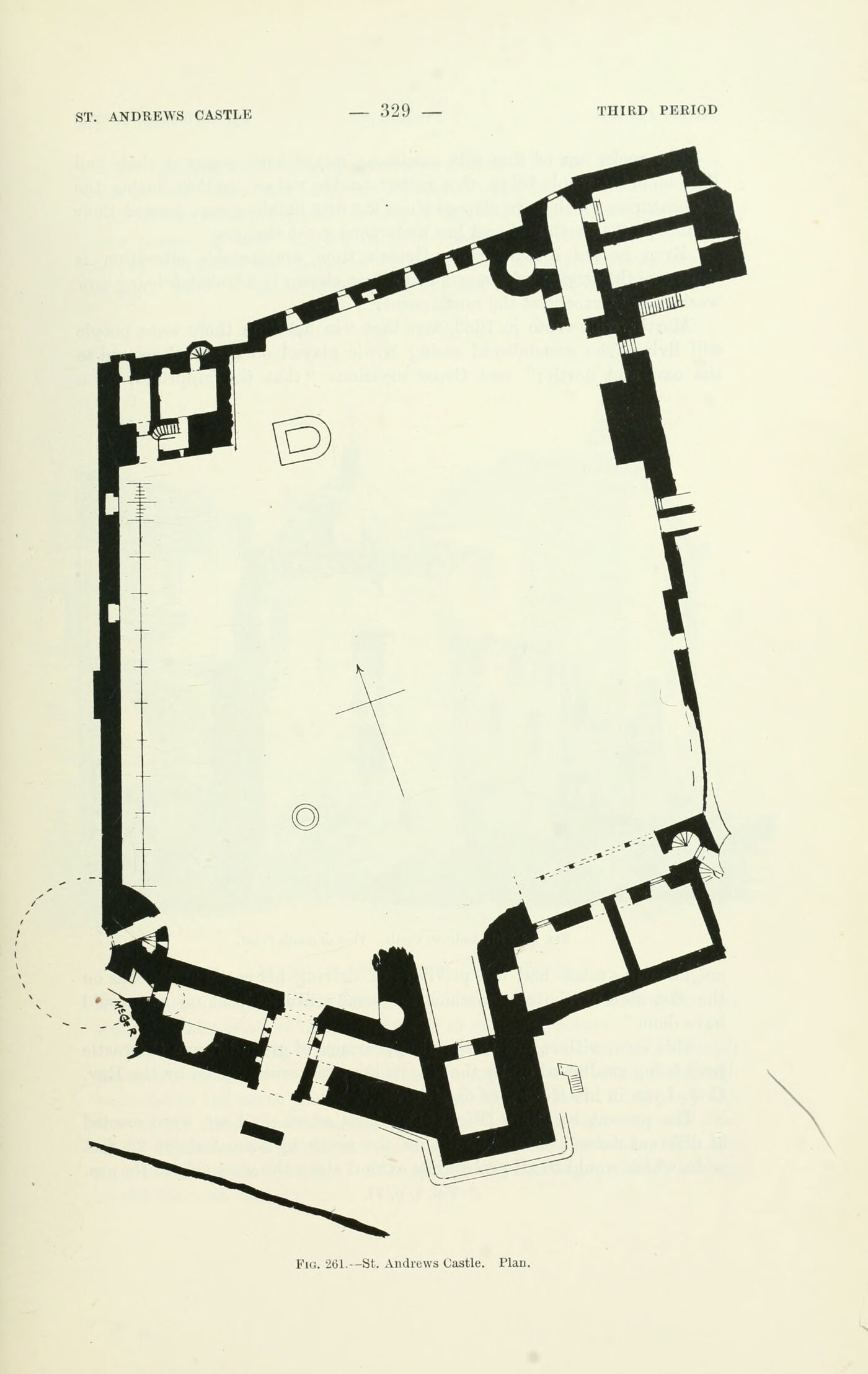
Fig. 261. -- St. Andrews Castle. Plan.
1889 · MacGibbon & Ross, vol. 3 (1889)
Public domain
Nearby
Landmarks within reach of St Andrews Castle.


Questions about St Andrews Castle
What is the history of St Andrews Castle?
What is inside St Andrews Castle?
Who owns St Andrews Castle?
Why was St Andrews Castle built, and what was it used for?
Where is St Andrews Castle?
When was St Andrews Castle built?
Was St Andrews Castle ever attacked or besieged?
What did St Andrews Castle look like in its prime?
Is St Andrews Castle still standing or is it a ruin?
Who built St Andrews Castle?
Can you visit St Andrews Castle?
More castles of Scotland


Explore the city


