Scotland · Ruin
Yester Castle
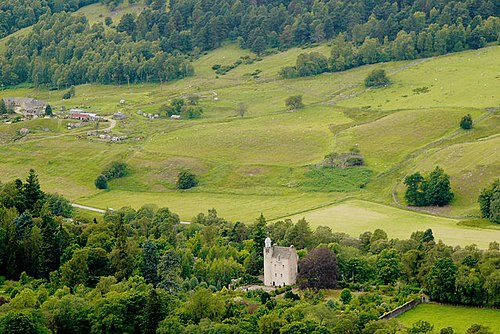
Yester Castle is a medieval ruined castle near Gifford in East Lothian, Scotland. The subterranean Goblin Ha' (Hobgoblin Ha') is the only substantially complete element that survives; the rest of the medieval keep and enceinte are now fragmentary masonry on a wooded slope.
Its prime
1540
Today
Ruin
As it stood in 1540
What Yester Castle looked like in its prime.
A tall, irregular fragment of red-brown sandstone masonry rises from a wooded slope: massive coursed blocks with weathered joints, pockets and small slit openings, and a low round-arched doorway set into the base leading to a subterranean chamber. The top of the ruin is broken away, the wall face stepped where courses have fallen, and ivy and saplings climb the lower stones. The masonry alternates large squared blocks with rougher infill stones.
Its story
The story of Yester Castle.
Hugo de Giffard and the Wizard's Cavern
The barony of Yester was originally known as Yestred, from the Brythonic ystrad, meaning a strath or dale; Latin documents render the place as Zester. King William the Lion granted it to Hugo de Giffard, a Norman incomer given land in East Lothian during the reign of David I. The stone keep raised on the site before 1267 is generally credited to Sir Hugo de Giffard, a grandson of the first laird, who served as a guardian of the young Alexander III and was by repute a magician and necromancer. Alexander III is known to have been at Yester on and around 24 May 1278, corresponding from there with Edward I of England.
Sir Hugo's reputation as the 'Wizard of Yester' attached itself to the castle's undercroft, where he was thought to practise his sorcery. Walter Bower, writing in the 15th century, recorded that old tales told of the castle - or at least its cellar and keep - having been wrought by witchcraft, and of a marvellous underground cavern extending under a large area of ground, popularly called Bo' Hall. That chamber, the Goblin Ha', is the only complete structure the castle still has. Legend supposed that Hugo could raise a magical army through a pact with the Devil, and it was this army of hobgoblins that was held to have built Yester.
Falkirk, Edward I's Confiscations and the Coming of the Hays, 1298-1357
Alexander de Welles, master of Torphichen Preceptory, was killed at the Battle of Falkirk in 1298; heraldic evidence leaves little doubt that he belonged to the Lincolnshire Welles family. Also at Falkirk was Adam de Welles of Lincolnshire and of the castle of Yester, to whom Edward I, during his occupation of Scotland, gave various properties confiscated from the Lothian nobility and gentry. Following the Wars of Independence, Yester was rebuilt as a castle of enceinte.
The Giffard male line ended in 1357, when Joanna, a daughter and co-heiress of the last Sir Hugo de Giffard, married the sheriff of Peebles, Sir William de la Haye of Locherworth - Thomas in some accounts - who was invested with the barony and lands of Yester through his wife. The barony has stayed with the Hay family ever since.
Flodden, the Rough Wooing and Pinkie, 1487-1548
John Hay of Yester was created a Lord of Parliament in 1487, the first Lord Hay of Yester. John, the second Lord, was killed at Flodden in 1513 along with a great proportion of the country's fighting men. In May 1544, during the Rough Wooing, an English army burned the castle, the village and the harvest on its way back from the burning of Edinburgh.
John, the fourth Lord Hay, held Yester against an English force in 1547 but was captured later that year at the Battle of Pinkie and spent three years a prisoner in the Tower of London. In February 1548 the English commander Grey of Wilton took the castle and put George Douglas of Pittendreich in charge of Yester and Dalkeith. French soldiers taken at Yester were used as hostages by the English, and Ulpian Fulwell recorded that the captured garrison was mostly Scottish or Spanish. Two men suspected of shouting insults defaming Edward VI were made to fight a duel at the market place of Haddington.
Abandonment, the Marquessate and the Quarried Ruin, 1557-2021
The fourth Lord Hay died in 1557, and his son William abandoned the old castle for a new tower house on the site of the present-day mansion of Yester House. In 1646 the eighth Lord, John Hay, was created Marquess of Tweeddale. The castle gradually fell into disrepair, and by the late 17th century was in a very parlous state, its stones much quarried for building material; though it almost disappeared completely, Sir Hugo's Goblin Ha' was tenanted by the Marquess's falconer until 1737.
Yester House, with its Adam interiors, was sold in 1972 to the operatic composer Gian-Carlo Menotti and left to his son Chip, who sold it in 2013. In 2021 stone was reported stolen from the supporting walls of the vaults; because the wall was load-bearing, and the ruin protected under the Ancient Monuments and Archaeological Areas Act 1979, the castle was closed to the public pending investigation.
Step inside
5 places to explore in 1540.
The record describes 5 distinct spots at Yester Castle, including 1 interior: goblin ha' (subterranean undercroft). Create your own photoreal reconstruction and explore every one, more scenes means more rooms, more angles, and more of the place to stand in.
Build Your Own Castle
Recreate Yester Castle with AI to explore it.
The artist rebuilds it as it stood in 1540, a photoreal reconstruction that belongs to you alone. Pay with coins, no subscription needed.
Recreate this castle →Defend this castle →Whose castle
Clans who held Yester Castle.
The families that held Yester Castle for a decade or more across its history, follow a name to its clan.
Giffard
Held by the Giffards from King William the Lion's grant of the barony to Hugo de Giffard, a Norman immigrant.
The barony has stayed with the Hays ever since it passed to them, Lords Hay of Yester from 1487, Marquesses of Tweeddale from 1646.
Nearby