
Scotland · Still standing
Broughty Castle
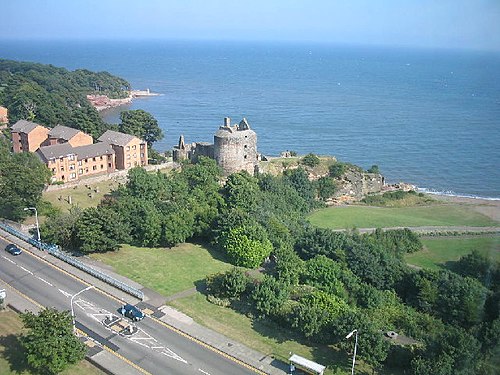
Broughty Castle is a stone tower house and later coastal battery on a low promontory at the mouth of the River Tay in Broughty Ferry, Dundee, Scotland. The four-storey rectangular tower sits within thick curtain walls and late‑19th-century gun emplacements; the site is a scheduled monument now used as a museum.
First raised
1490
Its prime
1891
Today
Still standing
As it stood in 1891
What Broughty Castle looked like in its prime.
A tall rectangular four-storey tower house rises from a squat curtain of low, thick masonry; the tower has a corbelled parapet with crenellations and a flagpole, small vertical slit windows and a few larger rectangular windows. Surrounding walls incorporate low, flat gun-emplacement platforms with rows of embrasures and a grassy top, plus a broad stone quay and sea-facing harbour wall. The stone is a warm grey-brown sandstone; the castle sits on a low coastal promontory at the River Tay mouth and is complete with rebuilt wings and magazines.
Its story
The story of Broughty Castle.
Douglas Licence to Gray Tower, 1454–1495
George Douglas, 4th Earl of Angus, received permission to build on the site at the mouth of the Tay in 1454, and his son Archibald, 5th Earl, was coerced into ceding the castle to the crown. The four-floor tower house at its centre was built by Andrew, 2nd Lord Gray, who was granted the place in 1490; it was completed around 1495.
Sold to the English After Pinkie, 1547–1548
After the battle of Pinkie in September 1547 the castle was surrendered by purchase to the English by its owner, Lord Gray of Foulis. William Patten, who accompanied the Duke of Somerset, noted its strategic importance: it "standeth in such sort at the mouth of the river Tay, that being gotten, both Dundee and St. John's Town (Perth) … shall become subject to this hold or be compelled to forgo their use of the river." Soon after taking possession Edward Clinton cut a ditch across the landward side of the promontory, on the advice of an Italian engineer, Giovanni di Rossetti, and left 100 men guarded by three ships.
Sir Andrew Dudley, brother of the Duke of Northumberland, took the first command, hoping to distribute Tyndale's Bible in Dundee, and thought little of his men: "there was never man had so weak a company, given all to eating and drinking and slothfulness". The town of Dundee agreed on 27 October 1547 to support the garrison and resist Regent Arran, its constable and council signing under duress from Dudley's two gunships. The Earl of Argyll tried to take the castle on 22 November 1547, and again in January 1548 with 150 men led by the soldier Duncan Dundas, without success. Sir Thomas Palmer and Rossetti, by then master of ordnance, noted that a nearby hill overlooked the castle, and Palmer set to fortifying it in February 1548.
Luttrell's Turf Ramparts and the Fall of Broughty, 1548–1550
John Luttrell, formerly commander at Inchcolm, succeeded Dudley and was ordered to build a new fortification on an adjacent site. In November 1548 he told Somerset that its turf ramparts were unstable and could not be strengthened, his enemies would need no guns, "for theye shall fynde hytt fallen downe redy to ther handys." That December Patrick, Lord Gray of Foulis, was summoned to account for his treasons against the Government of Scotland; the French commanders argued for his execution, but he was pardoned at Regent Arran's command.
At a conference at Stirling Castle on Christmas Day 1549 Mary of Guise and her guests agreed that more French guns could be brought against Broughty, and Robert Hamilton of Briggis set pioneers to digging entrenchments for them. Twelve English ships arrived to support the defenders. Mary of Guise watched the assault of 6 February 1550 from across the Tay; Paul de Thermes led the French troops, 50 were killed and 240 injured, and the garrison surrendered six days later at midnight. James Dog of Dunrobin claimed Luttrell as his prisoner, and his ransom of £1,000 Scots was raised on 16 May 1550.
Monck, the Tay Batteries and the Museum, 1651–2025
General Monck's Parliamentary army attacked the castle in 1651 during the Wars of the Three Kingdoms, and the Royalist defenders fled without a fight. After the Gray family sold it in 1666 it gradually became more ruinous. The Edinburgh and Northern Railway Company bought it in 1846 for a harbour for their railway ferry, and in 1855 the War Office acquired it to defend that harbour from the Russians. Renewed fears of a French invasion led the War Office to rebuild and fortify the site in 1860, to designs by Robert Rowand Anderson, with rebuilt courtyard walls, new wings added to the tower and emplacements for nine large guns.
A range for submarine miners, who in an emergency would mine the Tay estuary, was built east of the castle in 1886–87, and a magazine of 1889–91 brought a major remodelling of the gun emplacements. The battery mounted two 4.7-inch quick-firing guns in the First World War, and the last defence-related alteration was a defence post built into the top of the main tower in the Second. The castle remained in military use until 1932 and again between 1939 and 1949; part of the outer battery was demolished in 1967.
Dundee City Council repurposed it as a public museum in 1969, and it is now run by Leisure & Culture Dundee; it has been a scheduled monument since November 1981. Proposed budget cuts put it on a closure list in February 2024, and the council voted on 2 December 2024 to close it. A £50,000 council package allowed it to stay open into late 2025 with some reduced hours, and that September the actor Brian Cox backed the Friends of Broughty Castle campaign, urging the council not to let the place become a "mausoleum".
Step inside
9 places to explore in 1891.
The record describes 9 distinct spots at Broughty Castle, including 3 interiors: main courtyard, south‑east caponier (landward-facing defence), western magazine and store. Create your own photoreal reconstruction and explore every one, more scenes means more rooms, more angles, and more of the place to stand in.
Build Your Own Castle
Recreate Broughty Castle with AI to explore it.
The artist rebuilds it as it stood in 1891, a photoreal reconstruction that belongs to you alone. Pay with coins, no subscription needed.
Recreate this castle →Defend this castle →Whose castle
Clans who held Broughty Castle.
The families that held Broughty Castle for a decade or more across its history, follow a name to its clan.
Nearby
Landmarks within reach of Broughty Castle.


Questions about Broughty Castle
What is the history of Broughty Castle?
What is inside Broughty Castle?
Why was Broughty Castle built, and what was it used for?
Where is Broughty Castle?
When was Broughty Castle built?
Was Broughty Castle ever attacked or besieged?
Which family or clan held Broughty Castle?
What did Broughty Castle look like in its prime?
Is Broughty Castle still standing, or is it a ruin?
More castles of Scotland

Explore the city


