
Scotland · Restored
Kellie Castle
Kellie Castle is a Scottish castle near Arncroach in Fife, long associated with the Oliphant and Erskine families and restored in the 19th–20th centuries by the Lorimer family. The present building is a T-plan stone house with multiple corbelled towers and ranges dating from the 14th to the early 17th century, now owned by the National Trust for Scotland and open to the public.
First raised
1360
Its prime
1617
Today
Restored
As it stood in 1617
What Kellie Castle looked like in its prime.
At its prime in 1617 the castle presents a compact T-plan silhouette: a long three-storey rectangular range linking older towers, with corbelled round turrets on the northwest having steep conical roofs, and another square tower to the east/south-west. Walls are warm-brown sandstone rubble with regular vertical windows set in ashlar surrounds; the roof is covered in stone tiles with several tall, rectangular stone chimneys and gabled dormers. The building sits close to managed lawns and sheltering trees, intact and roofed throughout.
Its story
The story of Kellie Castle.
Clan Kelly, the Siwards and the forfeiture after Bannockburn
The castle's exact origins are unknown, though they likely lie with the now armigerous Clan Kelly, minor earls and barons. Kellie itself is on record by 1150, named in a charter issued by King David I, and its first known owner was Robert of London, an illegitimate son of King William the Lion. By 1266 it had passed to the Siward family, Northumbrians who had helped King Malcolm Canmore overthrow Macbeth. The Siwards backed England through the wars of independence of 1296–1328, and Sir Richard Siward forfeited his Scottish lands after Bannockburn; his daughter Helena, styled Lady Kellie, kept Kellie itself. None of the buildings they occupied appear to have survived.
Two and a half centuries of Oliphants, 1360–1613
In about 1360 Helena assigned Kellie to her kinsman Walter Olifard, or Oliphant, of Aberdalgie, husband of Elizabeth, a daughter of Robert the Bruce. That grant began 250 years of Oliphant occupation lasting until 1613; the lower section of what is now the north-west tower dates from around this time and is said to be haunted.
In 1573 the 4th Lord Oliphant raised a new tower east of the original, believed to have been intended as a jointure-house (a property set aside for a wife after her husband's death), for his wife Margaret. Between 1573 and 1606 the two towers were joined by a range closed at its south-west end by a third tower, producing the T-plan the castle still keeps.
Sir Thomas Erskine and the King's visit of 1617
Kellie was bought in 1613 by Sir Thomas Erskine, who had saved the life of King James VI during the Gowrie Conspiracy by killing Sir Alexander Ruthven, and whom the King had made Viscount Fenton in 1606. James stayed at Kellie in 1617 on his only visit to Scotland after the Union of the Crowns, and appointed Erskine Earl of Kellie in 1619. The ceiling of what is now the library, in the 1573 east tower, was probably plastered in anticipation of that visit: it carries the date 1617 and the monogram "T V F" for Thomas Viscount Fenton, and may be the first room in Scotland decorated in plaster in the London style rather than with the painted beams and boarded ceilings then in fashion.
For much of the seventeenth century the castle belonged to the Erskines of Dirleton. Alexander Erskine (1615–1677), the third earl, served as an investigator in the 1666 case of Margaret Guthrie, an accused witch from Carnbee who was imprisoned in the tolbooth at Anstruther Wester in early May of that year.
The muckle roup of 1830
Methven Erskine, 10th Earl of Kellie, died in 1829 and was succeeded by John Francis Miller Erskine, who abandoned the castle and cleared its contents at a muckle roup, a public auction, in 1830. In 1835 he was confirmed as 26th Earl of Mar and the earldom of Kellie was united with that of Mar. The property then seems to have fallen to James Maitland Hog of Newliston, thereafter titled "of Newliston and Kellie", who made little use of the estate; the castle lay abandoned for many years.
The Lorimers, 1878–1970
In 1878 Kellie was rented from the Earl of Mar and Kellie by James Lorimer, Regius Professor of Public Law at Edinburgh University. The family took it as a holiday retreat, then made it home, restoring plaster ceilings, painted panelling and furniture; his son, the architect Sir Robert Lorimer, was instrumental in much of that work, added a doocot and garden house from 1900 and remade the garden with his sister Caroline-Louise. The tenancy passed to James's widow Hannah in 1890 and, on her death in 1916, to their son the painter John Henry Lorimer, at which point Robert began on the main house, work Hannah had resisted.
John Henry's death in 1936 emptied the castle again, but in the same year Sir Robert's son, the sculptor Hew Lorimer, and his wife Mary renewed the family tenancy, buying Kellie outright in 1948. Phoebe Anna Traquair had painted the panel above the drawing-room fireplace in 1897, after Botticelli's Primavera, while John Henry lived there; Hew and Mary disliked it and covered it in the late 1940s, taking care not to damage it by using cartridge paper and flour paste. Hew sold the castle with 6.5 hectares of garden to the National Trust for Scotland in 1970 but lived on in part of the east tower until 1990, and the Trust restored the Traquair panel in 1996 following his death.
Step inside
6 places to explore in 1617.
The record describes 6 distinct spots at Kellie Castle, including 3 interiors: northwest tower chamber (oldest tower), library in the east (plaster-decorated ceiling), great hall (largest room). Create your own photoreal reconstruction and explore every one, more scenes means more rooms, more angles, and more of the place to stand in.
Build Your Own Castle
Recreate Kellie Castle with AI to explore it.
The artist rebuilds it as it stood in 1617, a photoreal reconstruction that belongs to you alone. Pay with coins, no subscription needed.
Recreate this castle →Defend this castle →Whose castle
Clans who held Kellie Castle.
The families that held Kellie Castle for a decade or more across its history, follow a name to its clan.
Siward
Held by the Siward family from before 1266 until 1360.
Oliphant
Held by the Oliphant family, 1360–1613.
Owned by the Erskines of Dirleton for much of the 17th century; Erskine was created Earl of Kellie in 1619.
From the archive
Kellie Castle on paper: the measured plan and period views.
The survey plan and photographs below are the ground truth this page's reconstructions are checked against, drawn and photographed while the castle was still a working garrison. Every image is public-domain or openly licensed, with its source named.
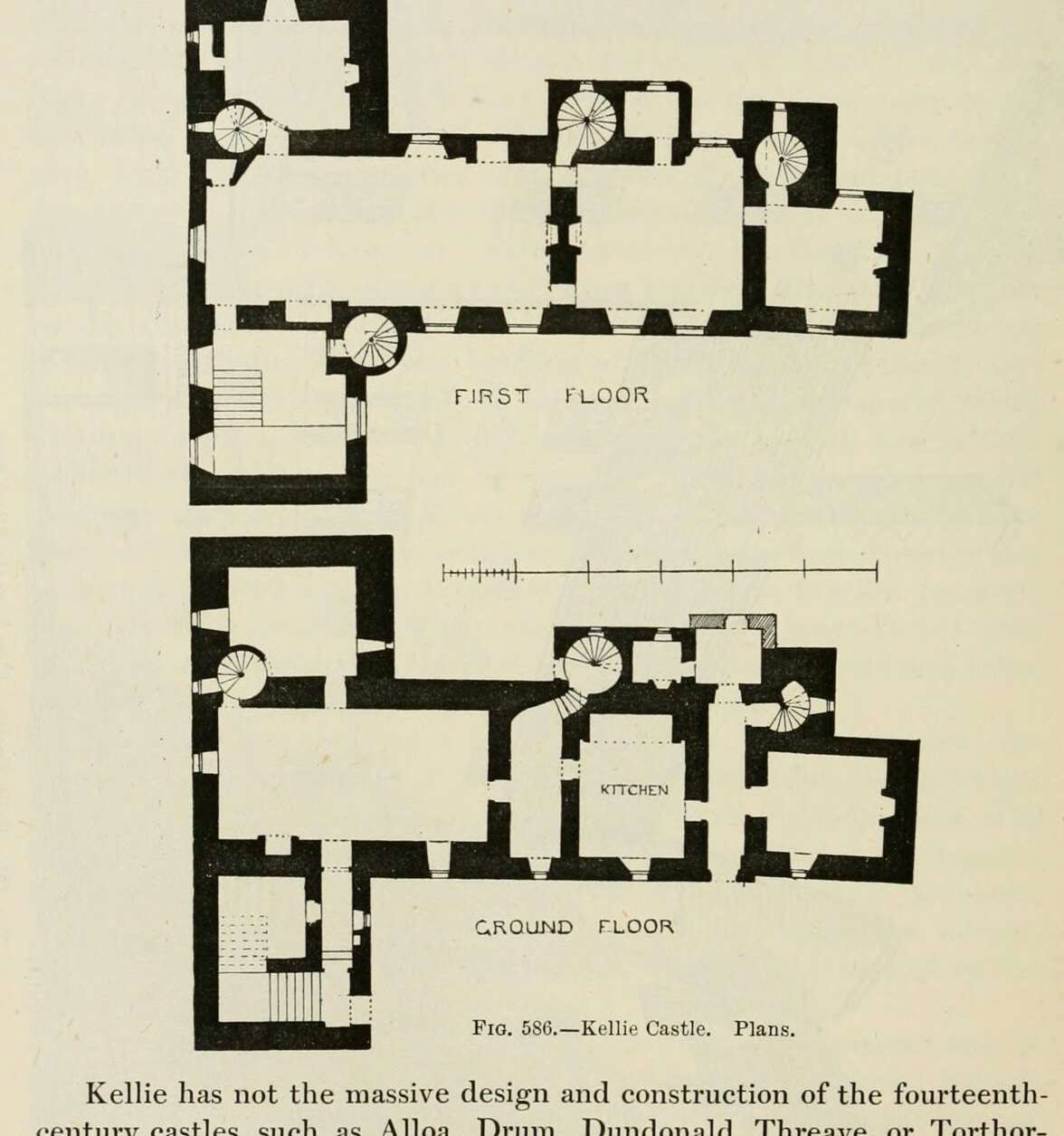
Fig. 586. Kellie Castle. Plans.
1887 · MacGibbon & Ross, vol. 2 (1887)
Public domain
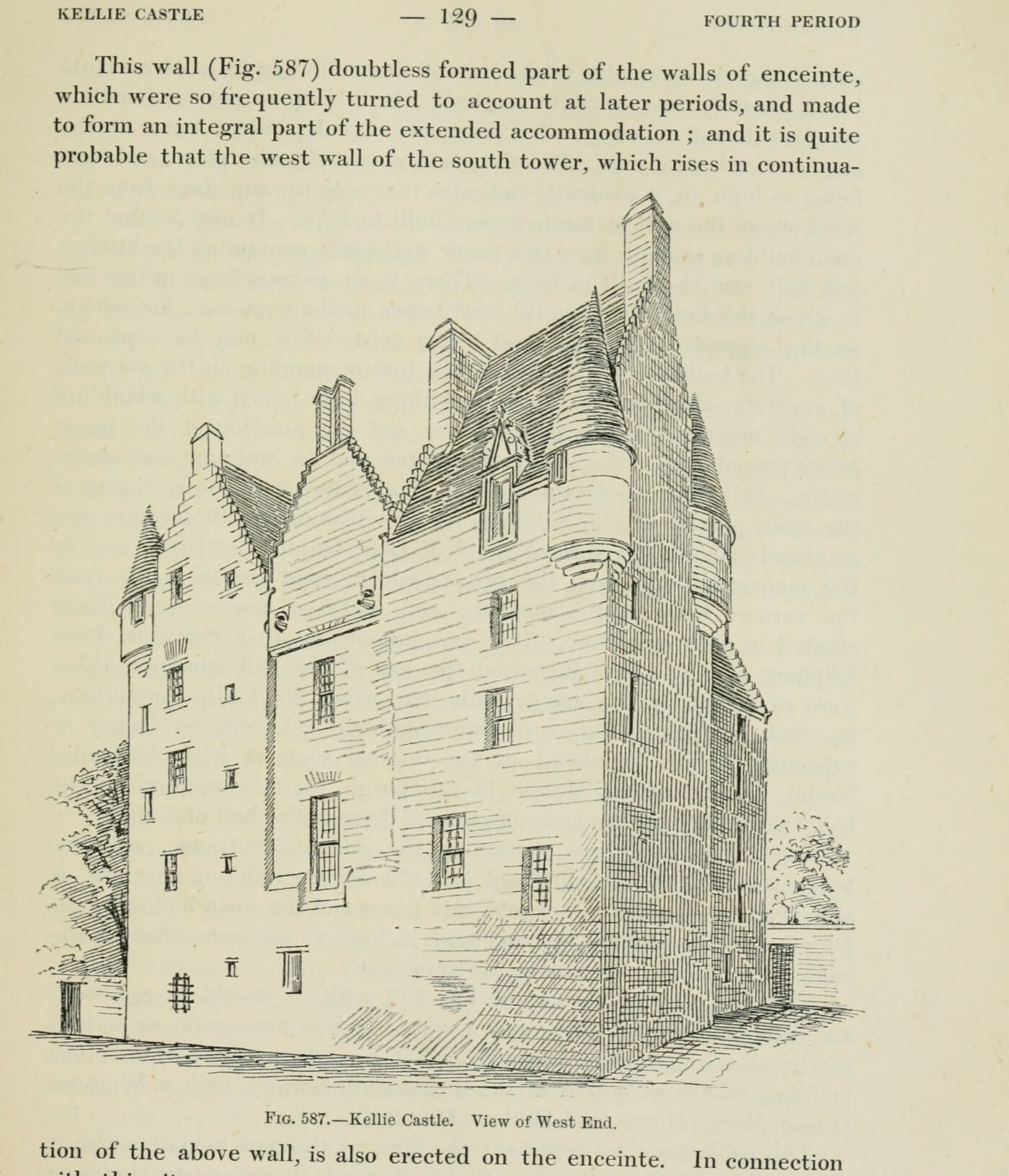
Fig. 587. Kellie Castle. View of West End.
1887 · MacGibbon & Ross, vol. 2 (1887)
Public domain
Nearby
Landmarks within reach of Kellie Castle.


Questions about Kellie Castle
What is the history of Kellie Castle?
What is inside Kellie Castle?
Who owns Kellie Castle now?
Why was Kellie Castle built, and what was it used for?
Where is Kellie Castle?
When was Kellie Castle built?
Which family or clan held Kellie Castle?
What did Kellie Castle look like in its prime?
Is Kellie Castle still standing, or is it a ruin?
Can you visit Kellie Castle?
More castles of Scotland


Explore the city


