
Scotland · Restored
Dairsie Castle
Dairsie Castle is a restored 16th-century Scottish tower house situated about 1.3 km south of Dairsie in north‑east Fife. It overlooks the River Eden and was rebuilt in the 1500s by the Learmonth family; it fell into ruin in the 19th century and was restored in the 1990s and is now used as holiday accommodation.
First raised
1300
Its prime
1583
Today
Restored
As it stood in 1583
What Dairsie Castle looked like in its prime.
A 16th‑century Scottish tower house: a compact, multi‑storey stone tower rising from low riverside ground and overlooking the River Eden. In its prime (c.1583) the tower stood roofed and complete, its weathered masonry forming a clear vertical silhouette above the riverbank; the setting is rural lowland, close to the village of Dairsie, with uninterrupted views across the adjacent fields to the river.
Its story
The story of Dairsie Castle.
The Bishops of St Andrews and the Parliament of 1335
The first castle at Dairsie, on ground above the River Eden 1.3 kilometres south of the village in north-east Fife, was the property of the bishops of St Andrews, and may have been built by William de Lamberton, who held that see from 1298 to 1328. In early 1335 a Scottish parliament sat at the castle.
The Learmonths, the Queen's Jewels and Morton's Siege, 1572-1583
The Learmonth family rebuilt the tower house in the 16th century. In March 1572, during the Marian Civil War, the laird of Dairsie, who was also Provost of St Andrews, invited the English ambassadors Thomas Randolph and William Drury to banquet at the castle. They refused to come, and by one account he instead invited Gavin Hamilton, the new archbishop of St Andrews, Robert Hamilton, minister of St Andrews, and William Skene to enjoy the feast he had prepared.
Patrick Learmonth of Dairsie lent money to William Kirkcaldy of Grange and held some of the jewels of Mary, Queen of Scots, as a pledge. James Douglas, 4th Earl of Morton, then regent of Scotland, asked him to return them. Morton laid siege to Dairsie Castle in 1575. James VI stayed at Dairsie in 1583, following his escape from the Raid of Ruthven in June of that year.
Archbishop Spottiswoode, Ruin and Restoration
In the 17th century Dairsie was sold to John Spottiswoode (1565-1639), Archbishop of St Andrews, who in 1621 built Dairsie Old Church next to the castle. The tower became ruinous during the 19th century. It was rebuilt in the 1990s, having been removed from the schedule of ancient monuments in 1997 ahead of the restoration works, and now operates as holiday accommodation. It is a Category B listed building, designated in March 1984.
Step inside
3 places to explore in 1583.
The record describes 3 distinct spots at Dairsie Castle, including the full exterior approach. Create your own photoreal reconstruction and explore every one, more scenes means more rooms, more angles, and more of the place to stand in.
Build Your Own Castle
Recreate Dairsie Castle with AI to explore it.
The artist rebuilds it as it stood in 1583, a photoreal reconstruction that belongs to you alone. Pay with coins, no subscription needed.
Recreate this castle →Defend this castle →Whose castle
Clans who held Dairsie Castle.
The families that held Dairsie Castle for a decade or more across its history, follow a name to its clan.
Learmonth
Rebuilt the tower house in the 16th century; Patrick Learmonth of Dairsie held jewels of Mary, Queen of Scots, in pledge.
Spottiswoode
Bought in the 17th century by John Spottiswoode, Archbishop of St Andrews, who built Dairsie Old Church beside the castle in 1621.
From the archive
Dairsie Castle on paper: the measured plan and period views.
The survey plan and photographs below are the ground truth this page's reconstructions are checked against, drawn and photographed while the castle was still a working garrison. Every image is public-domain or openly licensed, with its source named.
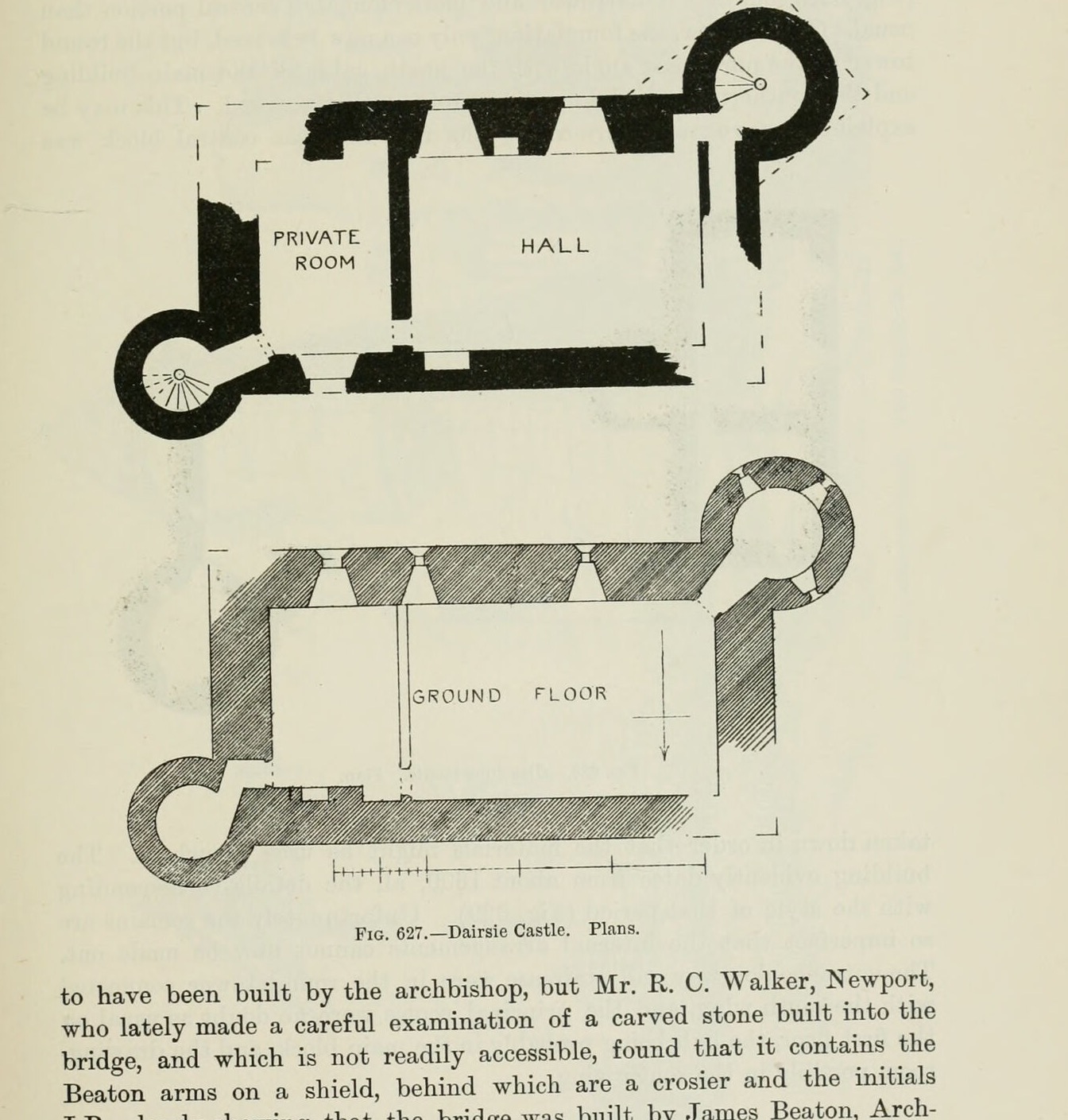
Fig. 627. Dairsie Castle. Plans.
1892 · MacGibbon & Ross, vol. 4 (1892)
Public domain
Nearby
Landmarks within reach of Dairsie Castle.


Questions about Dairsie Castle
What is the history of Dairsie Castle?
Why was Dairsie Castle built, and what was it used for?
Where is Dairsie Castle?
When was Dairsie Castle built?
What did Dairsie Castle look like in its prime?
Which family or clan held Dairsie Castle?
Is Dairsie Castle still standing, or is it a ruin?
More castles of Scotland


Explore the city


