
Scotland · Ruin
Greenan Castle
Greenan Castle is a small 16th-century tower house ruin on a sea cliff near Ayr in South Ayrshire, Scotland. The remains include a single tall stone tower with traces of a walled courtyard and outbuildings set on a promontory above the tidal flats.
Its prime
1603
Today
Ruin
As it stood in 1603
What Greenan Castle looked like in its prime.
A single rectangular stone tower house rises directly from the head of a steep sea cliff, its grey-brown masonry visible against low scrub. Beside the tower are low remnants of a walled courtyard and the footprints of outbuildings (likely stables and a kitchen). The castle stands on a rocky promontory projecting into the sea with tidal sands below; at its prime the tower would have had a complete roof and upper parapet and the courtyard walls closed the headland.
Its story
The story of Greenan Castle.
The Headland Fort and Its Twelfth-Century Re-Use
The first known defensive work on the sea cliff south-west of Ayr was a promontory fort enclosing around an acre, probably a fortified farmstead. Four concentric curved ditches, each about three metres wide, cut the headland off from the land behind, leaving a single causeway as the way in. How long that settlement was occupied is not known. The site was taken up again in the twelfth century, when it was converted into a motte-and-bailey.
Forfeited by the Lord of the Isles, 1476-1493
The Lords of the Isles built a tower house here in the fifteenth century; the standing ruin is sixteenth-century work. In 1476 the lands of Greenan were forfeited by John, Earl of Ross and Lord of the Isles, for treason against James III. In 1493 James IV granted them to William Douglas, son of Archibald, Earl of Angus.
The Murder of Sir Thomas Kennedy and the Auchindrain Executions
Traces of a walled courtyard and outbuildings survive beside the tower, probably stables and a kitchen block, since the small tower has no kitchen inside its walls. In that courtyard on the morning of 12 May 1602, Sir Thomas Kennedy of Culzean and his servant Lancelot Kennedy mounted their horses to ride to Edinburgh, having spent the night with Sir Thomas's half-brother, John Kennedy of Baltersan.
A few miles on, in the woods of St Leonards, they were ambushed by Thomas Kennedy of Drummurchie, Thomas Kennedy brother to the Laird of Bargany, Walter Muir of Cloncaird, Thomas M'Alexander, Thomas Wallace, a boy named Gilbert Ramsay and a borderer, Williame Irrwing. Sir Thomas was killed in retaliation for the death of the young Laird of Bargany at the Battle of Brockloch, near Maybole, in December 1601. Years afterwards the Muirs of Auchindrain, father and son, were executed for their art and part in the murder, and the story gave Sir Walter Scott the matter of his short play An Ayrshire Tragedy.
From the 1603 Lintel to Scheduled Monument, 1603-2015
The entrance lintel carries the inscription JK 1603 FND, for John Kennedy of Baltersan and his third wife Florence NickDowall, who at that date held the lands, Greenan Mill and the salmon-fishing rights on the River Doon. The castle passed through various members of the clan before coming to Thomas Kennedy, Earl of Cassillis, in 1766; around that time it seems to have stopped being lived in.
The ruin has been a scheduled monument since 21 February 1955. It was additionally listed at category B from 14 April 1971 until 24 March 2015.
Step inside
8 places to explore in 1603.
The record describes 8 distinct spots at Greenan Castle, including 2 interiors: kitchen block (interior), stables (interior). Create your own photoreal reconstruction and explore every one, more scenes means more rooms, more angles, and more of the place to stand in.
Build Your Own Castle
Recreate Greenan Castle with AI to explore it.
The artist rebuilds it as it stood in 1603, a photoreal reconstruction that belongs to you alone. Pay with coins, no subscription needed.
Recreate this castle →Defend this castle →Whose castle
Clans who held Greenan Castle.
The families that held Greenan Castle for a decade or more across its history, follow a name to its clan.
From the archive
Greenan Castle on paper: the measured plan and period views.
The survey plan and photographs below are the ground truth this page's reconstructions are checked against, drawn and photographed while the castle was still a working garrison. Every image is public-domain or openly licensed, with its source named.
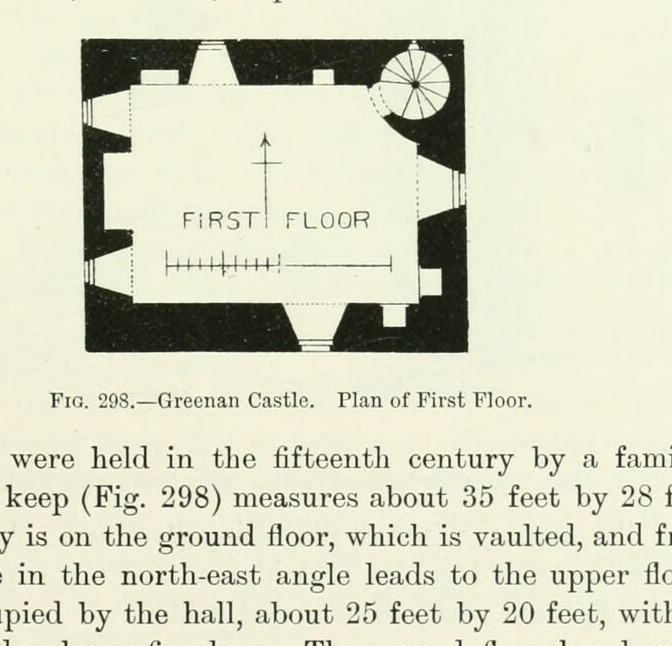
Fig. 298. Greenan Castle. Plan of First Floor.
1889 · MacGibbon & Ross, vol. 3 (1889)
Public domain


