
Scotland · Ruin
Dunnottar Castle
Dunnottar Castle is a medieval fortress on a rocky headland on the north-east coast of Scotland, about 2 miles south of Stonehaven. The surviving stone buildings date mainly from the 14th–16th centuries and the site is best known for the 17th‑century concealment of the Honours of Scotland; the ruins are open to the public today.
First raised
1400
Its prime
1590
Today
Ruin
Ranked among Europe’s castles
As it stood in 1590
What Dunnottar Castle looked like in its prime.
Perched on a narrow rocky headland, the castle consists of a tall square 14th‑century tower house to the west and a series of low stone ranges and curtain walls forming a 16th‑century palace to the east. The buildings are grey‑brown masonry, largely roofless now but originally roofed; the site is joined to the mainland by a thin spit of land and surrounded by sheer red‑coloured cliffs dropping to the North Sea about 50 metres below. A notable stone gatehouse stands at the landward entrance.
Its story
The story of Dunnottar Castle.
Dún Foither Besieged, 681 and 694
A chapel on the rock is said to have been founded by St Ninian in the 5th century, though when the headland was first fortified is unclear. Possibly the earliest written reference is in the Annals of Ulster, which record two sieges of Dún Foither, in 681 and 694; the earlier has been read as an attack by Brude, the Pictish king of Fortriu, extending his power along the north-east coast. The Chronicle of the Kings of Alba records that Donald II, the first ruler to be called rí Alban, king of Alba, was killed at Dunnottar during a Viking attack in 900, and by the account of Symeon of Durham the English king Æthelstan raided as far north as Dunnottar in 934.
How much of that belongs to this headland is unsettled: excavations in the 1980s found no substantive evidence of early medieval fortification here, and Pictish stones from the nearby sea stack of Dunnicaer have prompted the suggestion that Dún Foither stood on the neighbouring headland of Bowduns, three miles to the north.
Wallace, Edward III and the Coming of the Keiths, 1276–1395
Under William the Lion, Dunnottar was a centre of local administration for the Mearns, and by the early 13th century it was known well enough to appear in the Roman de Fergus, an Arthurian romance in which the hero must travel there to retrieve a magic shield. A church on the site was consecrated in May 1276 by William Wishart, Bishop of St Andrews. The poet Blind Harry relates that William Wallace took Dunnottar from the English in 1297, and that he shut 4,000 English prisoners in the church and burned them alive.
In 1336 Edward III ordered William Sinclair, 8th Baron of Roslin, to sail eight ships to the partly ruined Dunnottar and rebuild it as a forward resupply base for his northern campaign; Sinclair brought 160 soldiers, horses, masons and carpenters, and the king came himself in July. The work did not survive the year; the Scottish Regent Sir Andrew Murray took Dunnottar and destroyed its defences again. David II issued a licence to crenellate in 1346, and around 1359 William Keith, Marischal of Scotland, married Margaret Fraser, niece of Robert the Bruce, and was granted the barony. Keith completed the tower house and was excommunicated for building on the consecrated ground of the parish church; a bull of Benedict XIII lifted the sentence in 1395. His descendants were made Earls Marischal in the mid-15th century and held Dunnottar into the 18th.
George Keith Builds a Palace on the Cliff, 1581–1592
James V exempted the Earl Marischal's men from military service in 1531 on the grounds that Dunnottar was one of the "principall strenthis of our realme". Mary, Queen of Scots came in 1562 after the Battle of Corrichie and again in September 1564; James VI stayed ten days in 1580 and convened a meeting of the Privy Council here. In the rebellion of the Catholic nobles in 1592 the castle was captured by Captain Carr for the Earl of Huntly, but restored to Lord Marischal a few weeks later.
George Keith, who succeeded as 5th Earl Marischal in 1581 and founded Marischal College in Aberdeen, rebuilt the medieval fortress as a comfortable home, valuing the place as much for its situation as for its security. A palace of ranges around a quadrangle went up on the north-eastern cliffs, the 13th-century chapel restored and drawn into it, and a stone gatehouse, now Benholm's Lodging, was built with tiers of gun ports facing the approach. Those guns were probably fashionable embellishment rather than serious defence: for all that Dunnottar was called the strongest place in Scotland, the ports in Benholm's Lodging face across the approach rather than along it, which is the wrong way to cover a road. An inventory of 1612 records four brass cannons placed inside the main gate.
The Honours of Scotland, 1651–1652
William Keith, 7th Earl Marischal, came out for the Covenanters in 1639 and, with Montrose, defeated a Royalist attempt to seize Stonehaven; when Montrose changed sides and marched north, the earl stayed inside Dunnottar even as Stonehaven burned. He later joined the Engagers, led a troop of horse at Preston in 1648, and received Charles II here in July 1650, two months before Cromwell broke the Scots at Dunbar. Charles was crowned at Scone on 1 January 1651 with the Honours of Scotland (crown, sword and sceptre), and with Cromwell's troops in Lothian they could not be returned to Edinburgh. In June the Privy Council placed them at Dunnottar, where Katherine Drummond brought them in hidden in sacks of wool, and Sir George Ogilvie of Barras was made lieutenant-governor.
Ogilvie refused the summons to surrender in November 1651. During the blockade his wife Elizabeth Douglas and Christian Fletcher, wife of the minister of Kinneff, planned the removal of the regalia; the king's papers went out first, sewn into the clothes of Anne Lindsay, who walked through the besieging force with them. How the Honours themselves left the rock is disputed. Fletcher stated in 1664 that she carried the crown, sceptre, sword and sword case away among sacks of goods over three visits in February and March 1652; an 18th-century account by a tutor to the Earl Marischal has them lowered from the castle to the beach and taken off in a creel of seaweed. Either way, they were buried beneath the floor of the old kirk at Kinneff.
By May 1652 Colonel Thomas Morgan had the artillery needed to reduce the castle, and Ogilvie surrendered on 24 May on condition that the garrison went free. Finding the Honours gone, the Cromwellians held him and his wife prisoner in the castle until the following year, while a false story was put about that the regalia had been taken overseas. Twenty-one brass cannons and much else were carried off, and Marischal had to sell lands and possessions to pay his fines. The Honours came out from under the Kinneff floor at the Restoration in 1660; Ogilvie was eventually given a baronetcy, while Christian Fletcher was voted 2,000 merks by Parliament that were never paid.
The Whigs' Vault and the Forfeiture of 1716
In 1685, during the Earl of Argyll's rebellion against the new king James VII, 167 Covenanters (122 men and 45 women who had refused the oath of allegiance) were seized and held in a cellar at Dunnottar from 24 May until late July. Twenty-five got out, of whom two were killed falling from the cliffs and fifteen recaptured; five died in the vault; thirty-seven were freed after taking the oath. The rest were transported to Perth Amboy in New Jersey under a colonisation scheme of George Scot of Pitlochie, and many died on the voyage, Scot among them. The cellar beneath the King's Bedroom has been known as the Whigs' Vault ever since.
Four years later the castle served the other side of the same quarrel: in 1689, during Viscount Dundee's campaign for the deposed James VII, Dunnottar was garrisoned for William and Mary with Lord Marischal as captain, and seventeen suspected Jacobites from Aberdeen were held there for about three weeks. In the rising of 1715 George Keith, 10th Earl Marischal, led cavalry at Sheriffmuir; when the rebellion was abandoned he fled to the Continent, and in 1716 his titles and estates, Dunnottar included, were declared forfeit to the crown. The forfeited lands were bought in 1720 for £41,172 by the York Buildings Company, which dismantled much of the castle; the ruins changed hands several times (the earl himself buying Dunnottar back briefly in 1761), before Weetman Pearson, 1st Viscount Cowdray, purchased them in 1919 and his wife began a programme of repairs.
Step inside
9 places to explore in 1590.
The record describes 9 distinct spots at Dunnottar Castle, including 2 interiors: chapel incorporated into the palace, king's bedroom and the whigs' vault (cellar). Create your own photoreal reconstruction and explore every one, more scenes means more rooms, more angles, and more of the place to stand in.
Build Your Own Castle
Recreate Dunnottar Castle with AI to explore it.
The artist rebuilds it as it stood in 1590, a photoreal reconstruction that belongs to you alone. Pay with coins, no subscription needed.
Recreate this castle →Defend this castle →Whose castle
Clans who held Dunnottar Castle.
The families that held Dunnottar Castle for a decade or more across its history, follow a name to its clan.
Keith
Property of the Keiths from the 14th century and seat of the Earls Marischal until the last Earl forfeited his titles for joining the Jacobite rebellion of 1715.
From the archive
Dunnottar Castle on paper: the measured plan and period views.
The survey plan and photographs below are the ground truth this page's reconstructions are checked against, drawn and photographed while the castle was still a working garrison. Every image is public-domain or openly licensed, with its source named.
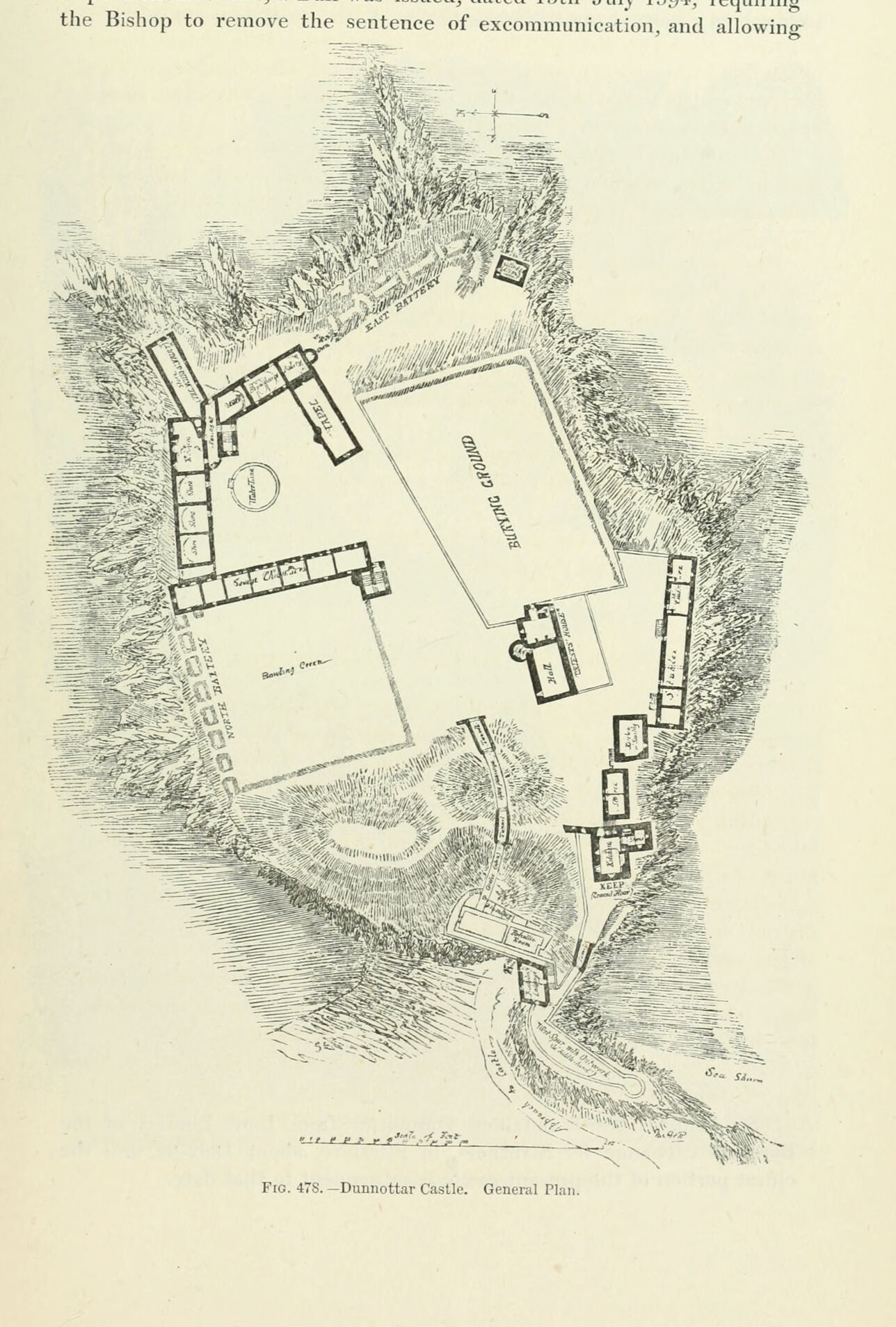
Fig. 478. Dunnottar Castle. General Plan.
1887 · MacGibbon & Ross, Castellated and Domestic Architecture of Scotland, vol. 1 (1887)
Public domain
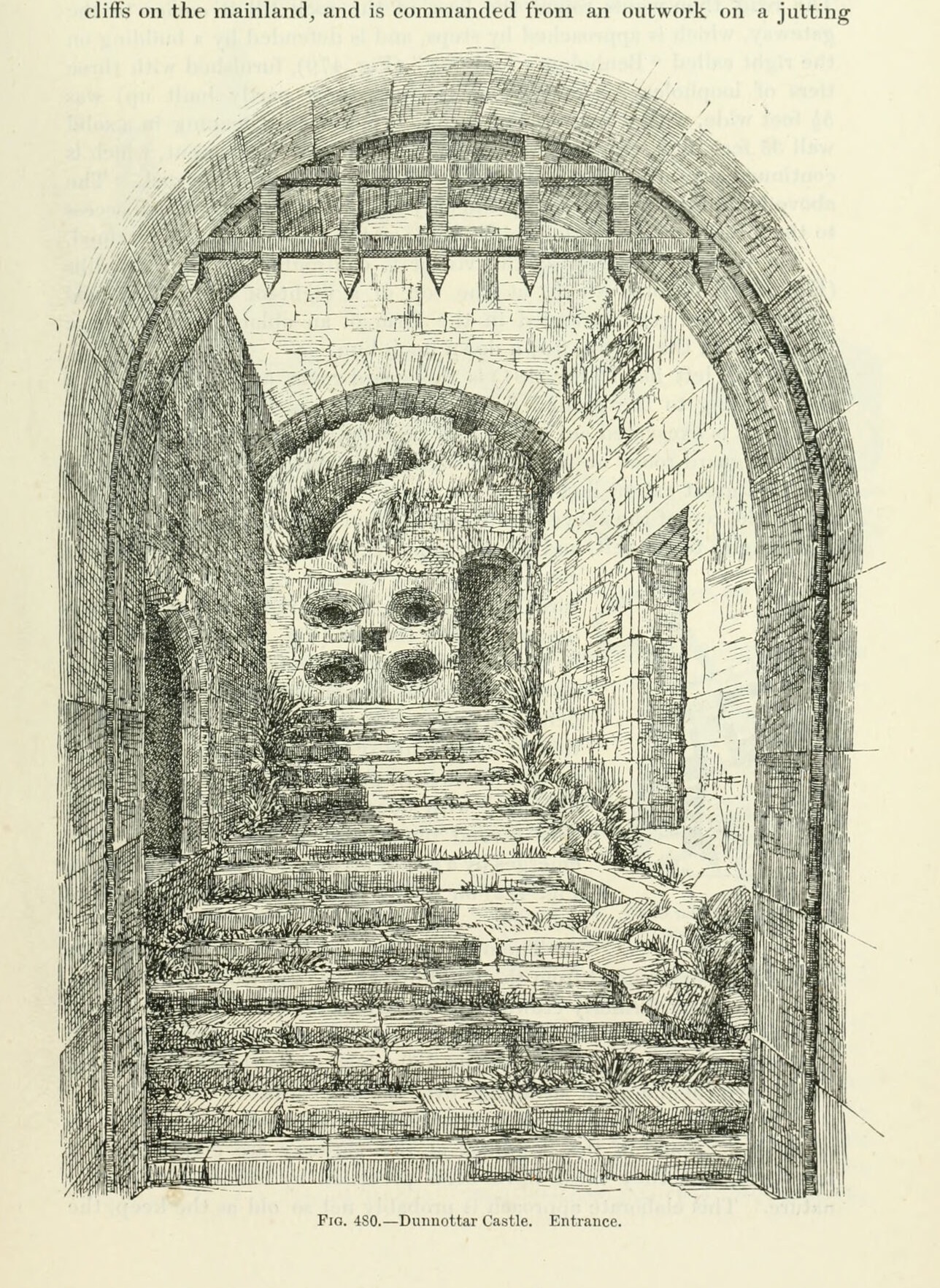
Fig. 480. Dunnottar Castle. Entrance.
1887 · MacGibbon & Ross, Castellated and Domestic Architecture of Scotland, vol. 1 (1887)
Public domain
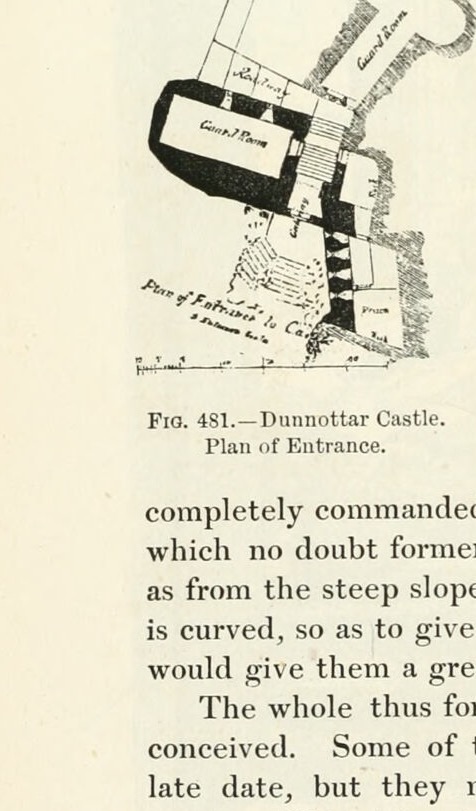
Fig. 481. Dunnottar Castle. Plan of Entrance.
1887 · MacGibbon & Ross, Castellated and Domestic Architecture of Scotland, vol. 1 (1887)
Public domain


