Moore
also Ó Mórdha, More
By the moor, or sons of Mórdha; English heath and Irish sept under one Anglicisation.
- Origin
- London, England
- Famous bearer
- Lieutenant-General Sir John Moore (1761–1809), commander at Corunna
- Register
- English family
The Moore arms and country

Coat of armsArms of Moore of DroghedaBorne by the Drogheda line, one branch of the name rather than all of it.Wikimandia · CC BY-SA 4.0 
Coat of armsMoore (of Wichford, Hampshire) armsBorne by the Wichford line, one branch of the name rather than all of it.Lobsterthermidor · CC BY-SA 3.0

_arms.png)
- Coat of arms: Granted to an individual and inherited down that one documented line. These are the arms of particular families of the name, not of everyone who shares the surname.
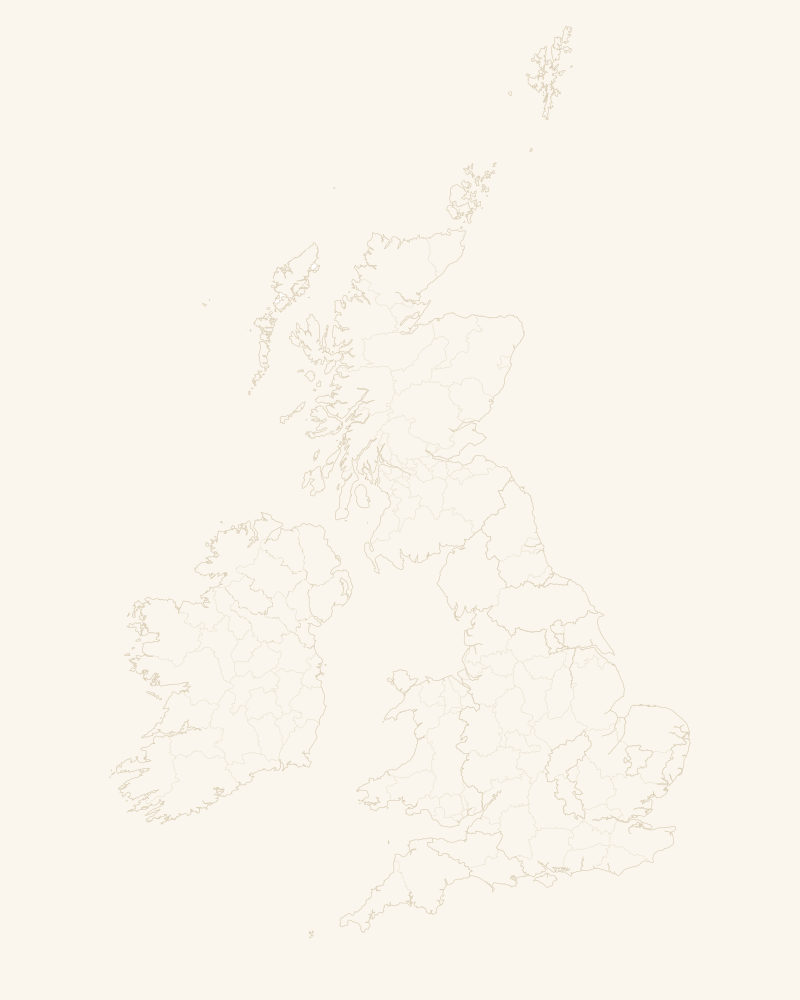
This name is thick on both sides of the border, so the map shows the whole of Britain and Ireland with every region it touches highlighted. It is a regional pattern for the surname, not proof that your branch lived in each place.
CoreHistoric reach
The seat of Moore
Seat vacantChief
No one leads the Moore community yet. When the movement opens, you can stand for its leadership, or help elect whoever does.
Current mission
No shared goal set yet. Once Moore has leadership, it sets the public focus: a restoration, a gathering, a real-world project that helps its own.
The Moore clan is being rebuilt. Join the waiting list for the movement today, and you help decide who leads it and what it does.
Help rebuild the Moore clan →What does the Moore name mean?
Two unrelated origin pools converged in the modern surname. (1) English locative, the moor; from a family settled near a moor or wet-ground heath, particularly common across the Saxon and Danish settlement zones of north-east and central England. (2) Irish, Anglicisation of Ó Mórdha, descendant of Mórdha ('majestic', 'great'). The Ó Mórdha were the principal sept of Laois from the 12th century, with their stronghold at the Rock of Dunamase. The Scottish equivalent Muir is a separate, parallel locative surname with the same root meaning. The three pools, English locative, Irish Ó Mórdha, Scottish Muir, overlap in the modern Moore spelling but are distinct in their lineage.
The history of Moore
Four unrelated names that came out sounding the same
Moore is one surname on paper and at least four in the blood. From Middle English mor, open land or bog, it marked the family living beside a moor or heath. From Irish it is Ó Mórdha, descendant of Mórdha, from mordha, 'stately and noble', the chief sept of Laois. From Norman French it is de la Mare, worn down by English clerks into More and then Moore. From the Latin name Maurus, 'dark skinned', by way of Old French More, it was a nickname fixed on one man of dark complexion and inherited by descendants it did not describe. The spellings converged; the lineages never did.
Around it sit cousins, some real and some only apparent. Scottish Muir and Mure are a separate, parallel locative name from the same root. The Manx Moar is not a landscape word at all but an office, the collector of manorial rents on the Isle of Man. The Welsh epithet Mawr, 'great', was anglicised into Moore outright, and the German Mohr, which sounds identical, is unrelated to any of it. Between them these routes made one of the great surnames of the English-speaking world: 32nd in England, 19th in Ireland in 1901 with 15,417 bearers, and 16th in the United States in 2000.
The man who lived by the moor
The commonest English route is the plainest. Middle English mor meant open uncultivated ground (heath, wet ground, bog), the land nobody ploughed and everybody had to skirt. A man farming its edge was known by it, because that was how you found him. The English Moores lie densest across Yorkshire and the Home Counties, in the Saxon and Danish settlement zones of north-east and central England, with the name long established from Kent and Surrey through Berkshire and Buckinghamshire to Lancashire and the West Riding.
That byname became a surname only when England built the machinery to make it one. Family names in England are generally traced to the preparation of the Domesday Book in 1086, first among the feudal nobility and gentry, spreading slowly downward until by 1400 most English families, and those of Lowland Scotland, carried hereditary names. It was not always welcome. In the late Middle Ages compulsory surnames were resisted because they were associated with taxes: a byname that stuck was a byname the collector could follow.
De la Mare, De La More, More, Moore
A separate strand came in with the Conquest. The Norman settlement all but replaced the old English landholding class. By the Domesday survey of 1086 only about five per cent of land south of the Tees remained in English hands, and the newcomers marked themselves by putting 'de', of or from, before the name of their village or estate in France. That territorial surname was a direct consequence of feudal landholding, and it is the mould the Moore name was poured into.
The De La Mare family of Normandy came over with William, and in England the name was progressively anglicised (de la Mare, De La More, More, Moore) while they held at Benenden in Kent for several centuries. Many later crossed the Atlantic, among them the Reverend John Moore of Newtown, Long Island. The family traces its own heritage to Viking Norway and the coastal district of Møre og Romsdal, from the Old Norse Moerr; some have gone further and made Rollo, founder of the dukes of Normandy, one of the kindred, on the reading that his father was Rognvald Eysteinsson, Earl of Møre. That last link is a tradition, not a documented descent.
Ó Mórdha and the Rock of Dunamase
The Irish Moores are the opposite of a topographic accident. Ó Mórdha is dynastic (descendant of Mórdha, from mordha, 'stately and noble') and the Ó Mórdha were the principal sept of Laois from at least the 12th century. Their seat was the Rock of Dunamase, the limestone outcrop above the modern village of Stradbally, a fortress strong enough to dominate the east–west axis of the Irish midlands.
From that rock they held their country for three hundred years. Through the 13th to 15th centuries the Ó Mórdha resisted, and often defeated, Anglo-Norman attempts to plant Laois, most famously holding off the assault of Sir William Vesci in 1297. Tradition reaches much further back: the historian C. Thomas Cairney counted the O'Mores among the chiefly families of the Loígis, who came in turn from the Cruthin, held to be the first Celts to settle in Ireland between 800 and 500 BC, but that is a claim about prehistory rather than a charter, and the sept's documented power begins at Dunamase.
Queen's County, the Slieve Bloom and Rory Óg
The Tudor confiscation of Laois in the 1550s ended it. The county was remade as Queen's County, a planted shire, and the Ó Mórdha were pushed off their own ground into the Slieve Bloom hills as displaced kerns: fighting men without land in the country they had ruled. Rory Óg Ó Mórdha kept an active resistance running out of those hills until he was killed in 1578.
The name outlasted the lordship. Under English clerks Ó Mórdha became O'More, then O'Moore, then simply Moore, so that one of the oldest Gaelic septs of the midlands ended up filed under an English word for wet ground that had nothing to do with it. Not every Irish Moore descends from the sept: Anglo-Norman Moores settled in the province of Munster soon after the invasion and are called de Mora in Irish, a phonetic rendering of the English name from moor, or heathy mountain. Two Irish Moores, one Gaelic and dispossessed, one Norman and planted, under a single spelling.
Corunna, the Irish Melodies and a captain at Wembley
The name's most celebrated soldier is Lieutenant-General Sir John Moore (1761–1809), the Glasgow-born general who built the British light infantry, saved his army by a brilliant winter retreat to Corunna, and fell at the head of his men in the hour the battle was won.
The Irish line runs strongest in letters and music. Thomas Moore (1779–1852) of Dublin wrote the Irish Melodies ('The Last Rose of Summer', 'Believe Me, If All Those Endearing Young Charms', 'The Minstrel Boy') and remains the most internationally famous Irish bearer of the name. George Moore (1852–1933) wrote Esther Waters, Brian Moore (1921–1999) of Belfast wrote Black Robe and The Lonely Passion of Judith Hearne, and Christy Moore, born at Newbridge in 1945 and a founder of Planxty and Moving Hearts, carries the midland tradition into living memory. The English locative line had its own century in Henry Moore (1898–1986) of Castleford, the foremost British sculptor of his age, and Bobby Moore (1941–1993) of Essex, who captained England and lifted the World Cup in 1966.
One thing about the American Moores has to be said plainly. During the era of the transatlantic slave trade many Africans were given new names by their enslavers, and a great many African American family names have their origin in slavery rather than in migration from Europe. Moore is carried in large numbers by both routes. A Moore whose line runs back to a Laois sept or a Kentish heath and a Moore whose line runs back to an enslaver's ledger share a spelling and nothing else; this page tells the first story and does not pretend it is the second.
Champions of the Moore name
The bearers whose lives are inseparable from this surname. Each has their own page, biography, achievements, geography, connection to the family.
Also found in
The Moore name has substantial historical presence beyond England. See it on Ireland.
Historic Places, Rebuilt
Explore the streets and seats the Moore name knew, rebuilt with AI as they stood in history.
Castles that share the Moore name
The same name on the map, look one up, see what it looked like in its prime, and recreate it to explore.
All castles in England → · Strongest castles in England → · Castles of Europe
Play As Your Clan
Hold a real castle against whatever you choose to send at it, take a ship out in her own service years, or stand at the shoulder of someone the record remembers. The chronicler sets the scene; the deeds are yours.
Notable bearers of the Moore name
- Lieutenant-General Sir John Moore (1761–1809), commander at Corunna
- Henry Moore (1898–1986), sculptor
- Thomas Moore (1779–1852), poet, Irish Melodies
- Christy Moore (b. 1945), folk singer (Planxty, Moving Hearts)
- George Moore (1852–1933), novelist (Esther Waters)
- Brian Moore (1921–1999), Belfast novelist (Black Robe)
- Bobby Moore (1941–1993), England football captain, 1966 World Cup