England · Legendary
Camelot
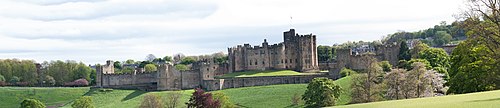
Camelot is a legendary castle and court associated with King Arthur, first named in 12th-century French romances and later popularised by medieval and Renaissance writers. Its precise location is unspecified in the tradition and it functions more as the idealised capital of Arthur's realm than as a single historical site. The romances place a mighty castle and a cathedral called St. Stephen's within a city on a river, surrounded by plains and forests.
Its prime
520
Today
Legendary
As it stood in 520
What Camelot looked like in its prime.
As told in medieval romance tradition: a fortified riverside city set on broad plains and forest edge, dominated by a large cathedral with a tall central spire and a nearby mighty castle of stone with multiple round and square towers, curtain walls and crenellated battlements. The castle contains a great hall centred on the Round Table; the city is pierced by narrow streets and dotted with many church roofs, while a wide meadow outside the walls serves as the lists for jousts.
Its story
The story of Camelot.
Chrétien de Troyes Names It, in the 1170s
Camelot has no place in the early Arthurian material. It first appears in Chrétien de Troyes's Lancelot, the Knight of the Cart, dating to the 1170s, and even there its footing is unsteady: the name is missing from some manuscripts, and in the C manuscript (which might carry the proper reading of Chrétien's original) it is replaced by the Old French phrase con lui plot, "as he pleased". The scribes who keep it cannot agree on the spelling: Chamalot, Camehelot, Chamaalot, Camalot. Arthur, one Ascension Day, leaves Caerleon and holds a most magnificent court at Camelot, and that is all of it, a mention in passing, nothing described.
For Chrétien, Arthur's chief court was Caerleon in Wales, the king's primary base in Geoffrey of Monmouth's Historia Regum Britanniae; his Arthur holds court like any medieval monarch, at a number of cities and castles in turn.
The Prose Cycles Build a City, Then Raze It
Only in the 13th-century French prose romances, the Vulgate and Post-Vulgate cycles, did Camelot begin to supersede Caerleon, and much of what it gained was borrowed from Geoffrey's description of the Welsh town: the impressive architecture, the many churches, the courtesy of its inhabitants. Romances written in English or Welsh mostly ignored the shift; Sir Gawain and the Green Knight is the exception that sets Arthur's court there.
The Lancelot-Grail cycle gave the city a geography: it stands on a river downstream from Astolat, and its cathedral of St Stephen's (founded in the story by Josephus, son of Joseph of Arimathea) is the religious centre for the Knights of the Round Table. In a mighty castle stands the Round Table itself, created by Merlin for Uther Pendragon; there Galahad takes the Siege Perilous, and there the knights swear to find the Holy Grail.
The same cycles pull it down. In Palamedes and the Post-Vulgate cycle, King Mark of Cornwall, who had besieged Camelot once already, razes it to the ground during his invasion of Logres after the Battle of Camlann. In the Tavola Ritonda no besieger is needed: with Arthur dead, the city is abandoned and falls to ruin.
Malory's Winchester, Caxton's Wales
In the 15th century Thomas Malory, compiling Le Morte d'Arthur mostly from the French romances, created the image of Camelot most familiar today, and fixed it to a real English town, identifying it firmly with Winchester. The choice was probably inspired partly by that city's own history: it had been the capital of Wessex under Alfred the Great, and it held the Winchester Round Table, made in the 13th century but widely believed to be the original by Malory's time. His own editor rejected the association: William Caxton held that Camelot was in Wales and that its ruins could still be seen, a likely reference to the Roman ruins at Caerwent.
Leland's Camalet and the Cadbury Dig, 1966–1970
In 1542 John Leland reported that the locals around Cadbury Castle in Somerset, a site formerly known as Camalet, considered it to be the original Camelot. The theory drew strength from Cadbury's proximity to the River Cam and the villages of Queen Camel and West Camel, and it stayed current long enough to help inspire a large-scale excavation four centuries later.
Leslie Alcock dug the hill from 1966 to 1970 under the title "Cadbury-Camelot", and the name won the work much media attention. What came out of the ground was substantial. The site seems to have been occupied as early as the 4th millennium BC, and from around 470 to have been refortified and held by a major Brittonic ruler and his war band until about 580, by far the largest known fortification of the period, double the size of comparable caers. Mediterranean artefacts point to extensive trade, Saxon ones to possible conquest. Alcock himself later grew embarrassed by the supposed Arthurian connection; following David Dumville's arguments he came to regard the evidence as too late and too unreliable to support it, and modern archaeologists have followed him in calling the place Cadbury Castle hill fort.
The Rival Camulodunums, and the Name Itself
The name's derivation is uncertain, and etymology has repeatedly been pressed into service for a location. Ernst Brugger suggested a corruption of Camlann, the site of Arthur's final battle in Welsh tradition; John Morris looked instead to Camulodunum, one of the first capitals of Roman Britain, a name he thought Romanised Britons might have carried into the legend as they looked back on a golden age under Rome. That town is modern Colchester, and the fit is poor: it lay well within territory usually thought to have been conquered early in the 5th century by Saxons, and Colchester Museum is blunt about the historical Arthur: "It would be impossible and inconceivable to link him to the Colchester area, or to Essex more generally."
Peter Field proposed a different Camulodunum, a former Roman fort at Slack on the outskirts of Huddersfield in West Yorkshire. Graham Phillips rejected the word Camelot entirely as Chrétien's invention and put Arthur's capital at the Roman city of Viroconium near Shrewsbury, citing archaeological evidence of a grand palace in use around AD 500; Alistair Moffat identified Camelot with Roxburgh in Scotland. The Arthurian scholar Norris J. Lacy covered the whole field in a sentence: "Camelot, located nowhere in particular, can be anywhere."
Step inside
8 places to explore in 520.
The record describes 8 distinct spots at Camelot, including 3 interiors: hall of the round table, st. stephen's cathedral nave, tombs of kings and knights. Create your own photoreal reconstruction and explore every one, more scenes means more rooms, more angles, and more of the place to stand in.
Build Your Own Castle
Recreate Camelot with AI to explore it.
The artist rebuilds it as it stood in 520, a photoreal reconstruction that belongs to you alone. Pay with coins, no subscription needed.
Recreate this castle →Defend this castle →