Historic Cities · England
Oxford through the ages
Oxford is a cathedral city and non-metropolitan district in Oxfordshire, England, of which it is the county town.

Oxford in 1400
Medieval Oxford
Oxford in 1400 is a fortified market town dominated by its growing university and the stone towers of parish and college churches. This walk moves from the river approach and town walls into the university precincts, past medieval colleges, markets and the castle, ending on the castle mound with a broad view over spired roofs and the Isis.
Low, packed stone and timber roofs cluster along narrow, rutted streets beside the braided channels of the Isis and Cherwell. Parish spires and college towers punctuate a skyline of lead, tile and pale oolite; the city wall with its gates and ditches still encircles the town. Streets smell of leather, woodsmoke and cattle; scholars in dark hoods and townspeople in coarse wool move between market stalls, bridges and college courts.
The route: 22 streets, squares and views
Grandpont Causeway → South Gate → St Aldate's Street → Oseney Abbey → Oxford Castle → Castle Mound → North Gate (St Michael's) → Cornmarket → Carfax → St Mary the Virgin → …
Step inside, 14 interiors
Abbey Scriptorium · St George's Hall · North Gate Chapel · Market Shambles · University Church Nave · Hall of Scholars · Fellows' Hall · Student Commons · College Hall · Arcaded Garth · Common Hall · Gate Chamber · Library Chamber · Chapel Choir
Planned from the Wikipedia record: History of Oxford.
Oxford in 1670
Restoration Oxford
Oxford in 1670 is the university city freshly returned to prominence after hosting the king's court during the 1665–66 plague, its new public buildings and college quadrangles reshaping the skyline. The walk moves from the river approaches past college fronts, markets and coffeehouses to Wren's new Sheldonian and the compact cluster of medieval spires and towers.
The skyline is a tight jumble of medieval towers, square college quadrangles and low-pitched tiled roofs, punctuated by the recent classical mass of the Sheldonian. Streets are narrow, paved or packed-earth, flanked by stone college walls, timber-framed houses and shopfronts. Riverbanks and meadows are integral to the townscape: the Isis and Cherwell cut channels and reed-edges, while sunlight picks out pale oolite stone and dark timber in the early-evening glow.
The route: 24 streets, squares and views
Grandpont Causeway Approach → Folly Bridge and the Isis → St Aldate's Street → Christ Church Meadow → Christ Church Great Quadrangle → Christ Church Hall Front → Carfax Junction → High Street → University Church of St Mary → Broad Street → …
Step inside, 12 interiors
Cathedral Choir · Great Refectory · St Martin's Nave · University Church Nave · Sheldonian Painted Ceiling · Divinity School Vaulted Hall · Humfrey's Medieval Manuscript Room · All Souls Fellows' Hall · Brasenose College Dining Hall · Queen's Lane Coffee Room · Merton Chapel Choir · Magdalen Chapel Choir
Planned from the Wikipedia record: History of Oxford.
Oxford in 1890
Victorian Oxford
This is Oxford at the height of the Victorian university town: colleges expanding, new museum ironwork bright, and an amplified skyline of towers and spires. The walk follows arrival into the city, the academic high street and museum quarter, the rivers and meadows where punts glide, and finishes looking back over the compact medieval centre of colleges and cathedral spires.
The skyline is a clustered silhouette of stone towers and gothic spires relieved by the domed Radcliffe Camera; brick, Bath stone and darker Cotswold stone predominate. Streets are narrow and paved, shopfronts signboarded, and gas lamps line principal ways. The University Museum’s iron-and-glass court presents bright metallic glints next to Keble College’s polychrome brick. River meadows and avenues of elms and plane trees soften the town’s compact, collegiate profile.
The route: 22 streets, squares and views
View from Boar's Hill → Oxford Railway Station → Oxpens and New Road → Carfax → Cornmarket Street → Covered Market → High Street East → Radcliffe Square → Radcliffe Camera → Bodleian Exterior → …
Step inside, 14 interiors
Station Waiting Room · Victorian Draper's Showroom · Covered Market Arcade · Exeter College Hall · Radcliffe Reading Room · Divinity School Vaulted Hall · Sheldonian Ceremony Chamber · Iron-and-Glass Central Court · Keble College Chapel · Palm House Conservatory · Punt Livery Boathouse · Magdalen Chapel Choir · Great Dining Hall · Cathedral Choir
Planned from the Wikipedia record: History of Oxford.
Its story
The story of Oxford.
The Oxen's Ford and the Mercian Frontier, c.900–1004
The name is Old English Oxnaford and Old Norse Öxnafurða, the oxen's ford, a shallow river crossing. Around 900 an important north–south cattle route linking the south of England to the Midlands needed to cross the Thames, and at Oxford the river splits into many channels, giving a relatively shallow and therefore crossable place for people, goods and animals. The settlement grew around that traffic. The precise ford is still argued over (any approach to the town involved several of them), though most of the archaeological evidence points to the south-west.
The earliest notice of the place comes in the Anglo-Saxon Chronicle for 912, which records that Edward, son of Alfred the Great, came into possession of "London and Oxford and all regions which owed obedience to these cities". In the tenth century Oxford was a military frontier town between Mercia and Wessex (built on the northern bank inside Mercia, directly opposite Wessex territory across the water), and was raided by Danes. In 1002 many Danes were killed here during the St Brice's Day massacre ordered by Æthelred the Unready; the skeletons of more than thirty suspected victims were unearthed in 2008 during building work at St John's College. The massacre contributed to King Sweyn I of Denmark's invasion of England in 1003 and to the sacking of Oxford by the Danes in 1004.
Robert D'Oyly's Castle and the Borough Charters
Oxford was heavily damaged in the Norman invasion of 1066. The town was assigned to a governor, Robert D'Oyly, who built Oxford Castle in 1071 to confirm Norman authority and raised the stone causeway known as Grandpont so that traffic, oxen and carts included, could cross the flood plains. D'Oyly set up a monastic community in the castle, St George in the Castle, where Geoffrey of Monmouth wrote his History of the Kings of Britain in 1139. The earliest town walls were a turf bank with a timber palisade, later replaced in stone; the Saxon tower that first served as the north gate survives, incorporated into St Michael's church.
Burgesses are recorded at Oxford in 1086, and the earliest known municipal charter was issued around 1155 by Henry II, granting its citizens the same privileges and exemptions as the capital of the kingdom enjoyed; from the early thirteenth century the corporation was headed by a mayor, and Oxford's status as a liberty ran on until the nineteenth century. A charter of 1191 in the name of "the citizens of Oxford of the Commune of the City and of the Merchant Guild" confirmed the gift of the island of Midney to the canons of Oseney. The town was besieged during the Anarchy in 1142 and the castle attacked in the Barons' War of the early thirteenth century. Richard I and King John were both born at Beaumont Palace in Oxford, on 8 September 1157 and 24 December 1166. Parliaments were often held here in the thirteenth century, and the Provisions of Oxford (instigated by a group of barons led by Simon de Montfort) are often regarded as England's first written constitution. There is evidence of Jews living in the city as early as 1141; the community is estimated to have numbered about 80 to 100 in the twelfth century, and David of Oxford and his wife Licoricia of Winchester were among its prominent members.
Scholars, Colleges and Townsmen, c.1120–1381
The University of Oxford is first mentioned in twelfth-century records, with evidence of magistri teaching here around 1120; it is the oldest university in the English-speaking world. Its scholars gave the monarchy a pool of trained government servants, with benefices from college endowments supplying royal civil servants at no cost to the crown. Of the hundreds of aularian halls that sprang up across the town only St Edmund Hall, of about 1225, remains; what ended them was the emergence of colleges (University College in 1249, Balliol in 1263, Merton in 1264) founded as Europeans were beginning to translate the Greek philosophers and supported by the Church in the hope of reconciling that philosophy with Christian theology. Friars followed the scholars in the early thirteenth century, Agnellus of Pisa among them; Roger Bacon, Duns Scotus and William of Ockham came out of their houses.
The relations between town and gown were violent. In 1209 two scholars were killed by townspeople (by one account a townsman hanged them for an alleged murder), and a number of academics left, some going to Cambridge to found a sister university. To prevent further trouble the Papal Legate drew up the Oxford Ordinance of 1214, granting scholars rights that placed them beyond the legal reach of the townspeople. The quarrel did not end there: as many as 93 students and townspeople were killed in the St Scholastica Day riot of 1355, which ran for days. As the town declined economically in the later Middle Ages, the University gained power over it at the expense of the urban community, expanding its landholdings and becoming a substantial employer and consumer of goods and services. In 1381 the theologian John Wycliffe was expelled from the University, and the Lollard movement followed from it.
Sweating Sickness, Dissolution and the Martyrs' Fires
The sweating sickness epidemic of 1517 was particularly devastating in Oxford and Cambridge, where it killed half the population of both towns, students and dons among them.
The Reformation dismantled the ecclesiastical institutions of what had been a heavily clerical town: the monasteries were closed in the 1530s, and officials of the monarch threw books relating to Roman Catholicism out of Duke Humfrey's Library. St Frideswide's Priory was extended and taken into the structure of Cardinal's College shortly before its refounding as Christ Church in 1546, and has served since as the cathedral of the Diocese of Oxford, the diocese created in 1542 being what raised Oxford from town to city. In 1555 the Oxford Martyrs were tried for heresy and burnt at the stake for their beliefs and teachings on what is now Broad Street: the bishops Hugh Latimer and Nicholas Ridley in October 1555, and the former archbishop Thomas Cranmer in March 1556. The Victorian Martyrs' Memorial in St Giles' commemorates them.
The King's Capital, the Siege of 1646 and the Castle Gaol
Expelled from London, Charles I moved his court to Oxford in 1642 and made the city his headquarters and de facto capital until 1646. In that year, during the Siege of Oxford, the city surrendered to Parliamentarian forces commanded by General Fairfax and was occupied by Colonel Richard Ingoldsby. It suffered serious fires in 1644 and again in 1671. In 1652, on news that Charles II was approaching, the Parliamentarians garrisoned in Oxford Castle pulled down its defences and withdrew to New College, badly damaging the college in the process; the city walls were by then in poor condition, the moat rented out as a fishpond and the towers used as living space, so a new set of ramparts had to be built against any coming siege.
Charles II in turn housed his court here during the Great Plague of London in 1665–66, and was forced to leave, reluctantly, when the plague came too close. The castle had been used as the local prison after the civil war; in 1785, after John Howard judged the old buildings to be in a poor state, a new prison complex was built on the site.
Coal by Canal, the Railway Brewers and the County Borough of 1889
The Oxford Canal reached the city in 1790, connecting it to Coventry and the industrial Midlands and bringing a steady supply of cheap coal; the Duke's Cut, completed by the Duke of Marlborough in 1789, linked the canal to the Thames. In 1844 the Great Western Railway connected Oxford to London Paddington via Didcot and Reading; the first station, at Grandpont, was a terminus awkward for northern routes, and was replaced in 1852 by the present station on Park End Street when the Birmingham line opened.
Brewing and malting appear to have been the most popular trades in the city in the sixteenth century, and several colleges had their own breweries, one at Brasenose surviving until 1889. The railways cut both ways, widening the market for Oxford's brewers while letting brewers further afield compete for the city's own: by 1874 there were nine breweries in Oxford and thirteen agents shipping beer in from elsewhere. The controversy around the Oxford Movement in the Church of England drew attention to the city as a focus of theological argument, and a permanent military presence arrived with Cowley Barracks in 1876. From the late thirteenth century the borough had straddled two counties, taking in a small part of Berkshire north of the main channel of the Thames; that ended in 1889, when the Berkshire portion was transferred to Oxfordshire and the enlarged borough was made a county borough.
Morris Motors, Cowley, and the City of Two Halves
The First World War emptied much of the University as students, fellows and staff enlisted, soldiers in training taking some of their places in college rooms; wounded and disabled men were treated in new hospitals set up in the Examination Schools, the town hall and Somerville College. In 1910 William Morris, later Lord Nuffield, founded a motor-car business in the city and opened an assembly plant at Cowley, and in the 1920s Morris Motors Limited began mass-producing cars there, transforming the economy and society of a place where printing and publishing were also well established by that decade. By the early 1970s more than 20,000 people worked at the Morris Motors and Pressed Steel Fisher plants: a city of two halves, the university to the west of Magdalen Bridge and the car town to the east, which produced the remark that "Oxford is the left bank of Cowley".
Oxford was largely spared the German air raids of the Blitz, which has been put down to Hitler's plans to make it the new capital and perhaps to the absence of heavy industry such as steelworks or shipbuilding; it was still affected by rationing and by an influx of refugees from London and other bombed cities, and college buildings served as temporary barracks and training areas. Cowley then lost jobs heavily in the 1980s and 1990s during the decline of British Leyland; much of the original factory was demolished in the 1990s and the land became the Oxford Business Park, while the surviving smaller site has built the Mini for BMW, its owner since 2000.
Migrant labour drawn to the car plants and the hospitals, later immigration from South Asia and a large student population have given the city a cosmopolitan character, particularly around Headington and the Cowley Road; population estimates for 2011 showed 22 per cent of residents from black or minority ethnic groups against 13 per cent for England as a whole. Oxford Brookes University, formerly the Oxford School of Art and then Oxford Polytechnic, received its charter in 1991. The city boundaries were extended in 1929 to take in Headington, Cowley, Iffley and Wolvercote, in 1957 to take in Blackbird Leys, and in 1991 to take in Littlemore, Marston, Risinghurst and Sandhills. Oxford is the county town of Oxfordshire and had a population of 166,034 in 2024.
From the archive
Oxford on paper: the old town as it was mapped.
A period plan or bird's-eye view of the old town, drawn between 1500 and 1850, the streets this page's reconstructions walk. Public domain, with its source named.
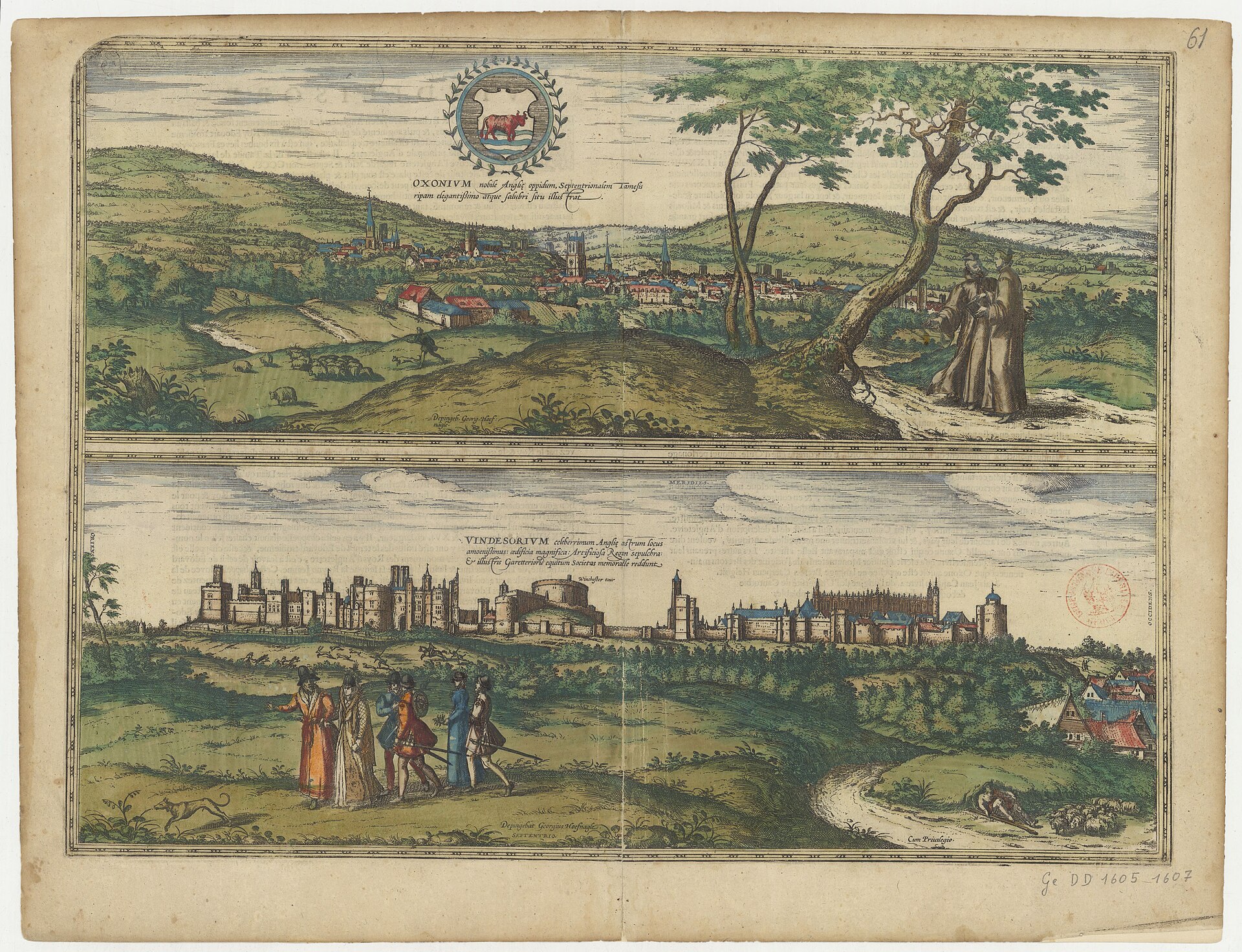
Bird's-eye view of Oxonium (Oxford), from Georg Braun & Frans Hogenberg's Civitates Orbis Terrarum
Panoramic view showing Oxford’s spired churches and college buildings across the surrounding hills, with the town’s coat of arms in the cartouche.
Public domain (plate dated 1645)
In this city
Landmarks of Oxford, see each in its prime


Castles of Oxford

More cities to explore
 EnglandCoventryExplore it in 1450 · 1935
 EnglandWinchesterExplore it in AD 900 · 1400
 EnglandLondonExplore it in AD 200 · 1390 · 1600 · 1885
 EnglandYorkExplore it in AD 300 · AD 950 · 1420 · 1800
Castles of Europe · Landmarks of Europe · create your own reconstruction.