
England · Partial ruin
Oxford Castle
Oxford Castle is a large medieval castle on the western side of central Oxford whose surviving medieval fabric includes a tall rectangular tower (St George's Tower), the motte, curtain walls and remnants of other towers. Most of the stone castle dates to the late 12th and 13th centuries; later it was reused as county administration and a prison, and today the medieval remains are preserved and listed.
Its prime
1235
Today
Partial ruin
As it stood in 1235
What Oxford Castle looked like in its prime.
A stone urban castle set against the western edge of the medieval town, dominated by a tall tapering rectangular tower of pale coral-rag stone (St George's Tower) and linked by straight stone curtain walls to other towers. The castle stands on a pronounced motte, surmounted by a ten-sided stone shell keep enclosing a very small inner courtyard; walls show narrow vertical slits and larger recessed openings for halls, all built of roughly coursed light-coloured limestone and ragstone.
Its story
The story of Oxford Castle.
Robert D'Oyly's Castle, 1071–1073
According to the Abingdon Chronicle, Oxford Castle was built between 1071 and 1073 by the Norman baron Robert D'Oyly the elder, who had come over with William the Conqueror and held extensive Oxfordshire lands. Oxford had been stormed in the Conquest, and William directed D'Oyly to build a castle to dominate the town. D'Oyly set it on the west side of the town, diverting the Castle Mill Stream to form a moat around a gravel motte originally some 60 feet high. In 1074 he and Roger d'Ivry endowed a chapel with a college of priests, soon dedicated to St George.
The tallest tower, St George's, is now believed to be older than the castle itself, a late Saxon watch tower of about 1020 guarding the west gate of the city. By the late 12th or early 13th century the palisades and wooden keep had been replaced in stone: a curtain wall incorporating St George's Tower, and a ten-sided shell keep on the motte with a 54-foot well beneath it against siege.
Matilda in the Snow, 1142
Robert D'Oyly the younger, the founder's nephew, held the castle during the Anarchy and, after initially backing King Stephen, declared for the Empress Matilda, who based her campaign at the castle from 1141. Stephen answered in the autumn of 1142, seizing the town and besieging Matilda in the castle for three months, raising two siege mounds (Jew's Mount and Mount Pelham), and waiting for her supplies to fail. In December Matilda escaped: in the popular telling she waited for the Castle Mill Stream to freeze, dressed in white as camouflage in the snow, and was lowered from the walls with three or four knights before slipping through Stephen's lines in the night, though William of Malmesbury has her leaving by one of the gates. She reached Abingdon safely; the castle surrendered the next day. Robert had died in the final weeks of the siege, and the castle passed to William de Chesney for the rest of the war; Henry D'Oyly, Robert's son, reclaimed the constableship in 1154.
Barbican, Prison Clerks and the Black Assize
Attacked again in the Barons' War of 1215–17, the castle was strengthened afterwards: in 1220 Falkes de Breauté demolished the Church of St Budoc to build a moated barbican defending the main gate, and the Round Tower went up in 1235. Henry III turned part of the castle into a prison for troublesome University clerks and gave the chapel stained glass in 1243 and 1246. From the 1350s the castle had little military use, turning instead to county administration, jail and criminal court.
On 13 January 1400 Henry IV sat in judgment there over rebels of the Epiphany Rising, men who had risen for the deposed Richard II. Assizes were held at the castle until 1577, when plague broke out at the "Black Assize": the Lord Lieutenant of Oxfordshire, two knights, eighty gentlemen and the entire grand jury died, among them Sir Robert D'Oyley. In 1611 James I sold the castle, and by 1613 it belonged to Christ Church, its keep by then split by a large crack.
Slighted by Its Own Garrison, 1646–1652
In the First Civil War the Royalists made Oxford their capital, and Parliamentary forces took the city by siege in 1646. The occupying commander, Colonel Richard Ingoldsby, fortified the castle rather than the town, and in 1649 demolished most of the medieval stonework, replacing it with modern earth bulwarks and reinforcing the keep with earthworks as a probable gun platform. In 1652, with Charles II's forces near, the Parliamentary garrison pulled down these defences too and withdrew to New College; Oxford saw no fresh fighting. The keep itself was demolished early in the 18th century.
From County Gaol to Malmaison
After the Civil War the castle served as Oxford's prison, leased by Christ Church to wardens who charged prisoners for their board; its gallows executed Mary Blandy in 1752. The reformer John Howard condemned the vermin-ridden gaol in the 1770s, and the Oxford County Justices bought the castle in 1785 and rebuilt it, beginning under the architect William Blackburn and finishing under Daniel Harris in 1805; the old chapel was demolished and part of its crypt moved and rebuilt in 1794. The prison was extended in 1876 (its inmates included a seven-year-old girl sentenced in 1870 to seven days' hard labour for stealing a pram), and became HM Prison Oxford in 1888.
The prison closed in 1996 and the site reverted to Oxfordshire County Council. It has since been redeveloped as a heritage complex, officially opened on 5 May 2006, with a Malmaison hotel occupying the former prison blocks; the motte, St George's Tower and crypt are Grade I listed, and the site is protected as a Scheduled Monument.
Step inside
9 places to explore in 1235.
The record describes 9 distinct spots at Oxford Castle, including 3 interiors: shell keep, inner courtyard, underground chamber beneath the keep, st george's chapel and crypt. Create your own photoreal reconstruction and explore every one, more scenes means more rooms, more angles, and more of the place to stand in.
Build Your Own Castle
Recreate Oxford Castle with AI to explore it.
The artist rebuilds it as it stood in 1235, a photoreal reconstruction that belongs to you alone. Pay with coins, no subscription needed.
Recreate this castle →Defend this castle →Whose castle
Clans who held Oxford Castle.
The families that held Oxford Castle for a decade or more across its history, follow a name to its clan.
D'Oyly
Built by Robert D'Oyly the elder, 1071–1073; held by his family through the Anarchy, with the constableship reclaimed by Henry D'Oyly in 1154.
From the archive
Oxford Castle on paper: the measured plan and period views.
The survey plan and photographs below are the ground truth this page's reconstructions are checked against, drawn and photographed while the castle was still a working garrison. Every image is public-domain or openly licensed, with its source named.
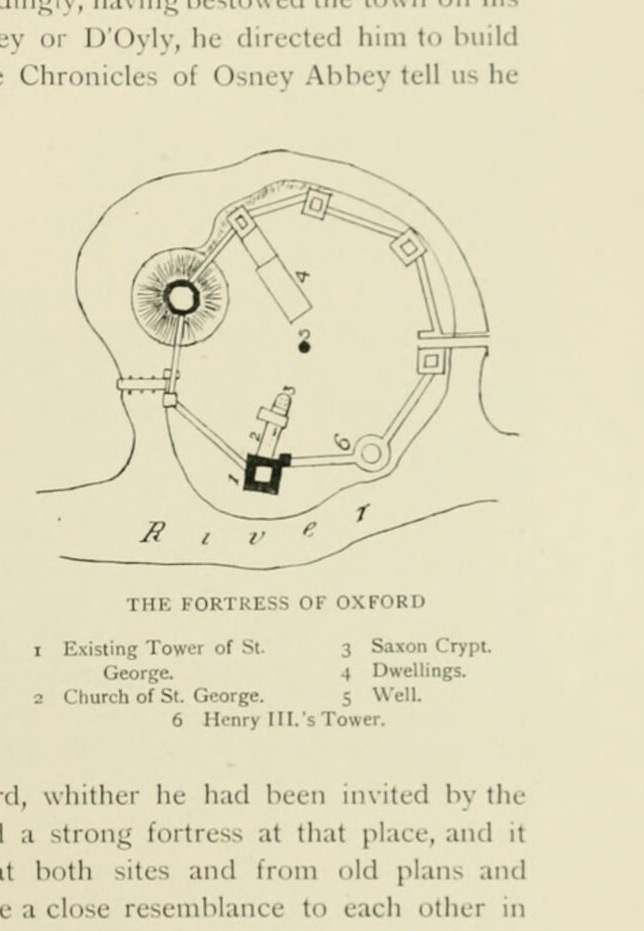
THE FORTRESS OF OXFORD
1897 · J. D. Mackenzie, The Castles of England, vol. 1 (1897)
Public domain
Nearby
Landmarks within reach of Oxford Castle.


Questions about Oxford Castle
What is the history of Oxford Castle?
What is inside Oxford Castle?
Who owns Oxford Castle now?
Why was Oxford Castle built, and what was it used for?
Where is Oxford Castle?
When was Oxford Castle built?
Was Oxford Castle ever attacked or besieged?
Which family or clan held Oxford Castle?
What did Oxford Castle look like in its prime?
Is Oxford Castle still standing, or is it a ruin?
Can you visit Oxford Castle?
More castles of England

Explore the city


