Historic Cities · England
Winchester through the ages
Winchester is a cathedral city in Hampshire, England. The city lies at the heart of the wider City of Winchester, a local government district, at the western end of the South Downs National Park, on the River Itchen. It is 60 miles (97 km) south-west of London and 14 miles (23 km) from Southampton, its nearest major city.

Winchester in AD 900
Alfred's Winchester
This is Winchester at the moment it is being remade as a defended burh under King Alfred and his successors: a new grid of straight streets within ancient Roman walls, two great minsters side by side, a royal hall and the first moneyers striking silver pennies. The walk follows the narrow paved lanes, the river mills and water meadows of the Itchen, and the gates and walls that frame urban life.
Low stone church towers and the squat mass of the Old Minster dominate a town of close timber houses with thatch and plaster, narrow paved streets cut by a newly imposed grid, and stout Roman walls punctured by gates. The River Itchen threads mills and green watermeadows, smoke and cloth-dyers' vats stain the air, and the scale is human: carts, packhorses and clustered markets beneath flags and simple pennants.
The route: 21 streets, squares and views
St Catherine's Hill Approach → South Gate → Southgate Street → High Street → St Peter Cheesehill → Old Minster Forecourt → New Minster Precinct → Cathedral Precinct → Royal Palace → The Mint → …
Step inside, 13 interiors
Merchant's Hall · Parish Nave · Great Nave · Scribe's Scriptorium · Chapter House · Great Hall · Moneyer's Workshop · Assay House · Gate Tower Chamber · West Gate Guardroom · Upper Mill Floor · Weir-Keeper's Hut · Convent Refectory
Planned from the Wikipedia record: Winchester.
Winchester in 1400
Medieval Winchester
Winchester in 1400 is a compact walled city midway through William of Wykeham's rebuilding: the cathedral nave is being remade in the new Perpendicular manner while his college fills its new courts with scholars. Visitors will find scaffolded stone, timber-framed streets, markets for cloth and wool, river meadows and the almshouse of St Cross beyond the meads.
From the surrounding downs the city reads as a pale chalk-and-flint knot of steeples and towers, its cathedral dominating long and low with scaffolds and lead roofs gleaming. Roofs are tile and thatch, houses timber-framed and whitewashed, gates and stone bridges puncture the Roman walls, streets are narrow and crowded with packhorses, carts and market stalls beside the slow River Itchen and its water-meadows.
The route: 22 streets, squares and views
Winchester from St Giles' Hill → St Giles' Hill Cloth Fair → Eastgate → High Street and Buttercross → Great Hall (Round Table) → Jewry Street → Kingsgate → Cathedral Close Gate → Winchester Cathedral West Front → Cathedral Nave and Scaffolds → …
Step inside, 12 interiors
Tallow Chandler's Workshop · Hall beneath the Round Table · Merchant's Counting-House · Chapel above Kingsgate · Cathedral Chapter House · Nave under Perpendicular Scaffolding · Bishop's Great Chamber · College Chapel · Scholars' Hall · Brethren's Hall · Itchen Mill Wheel Room · Westgate Gatehouse Chamber
Planned from the Wikipedia record: Winchester.
Its story
The story of Winchester.
From Iron Age Oppidum to Venta Belgarum
Three Iron Age hillforts stand near Winchester (Oram's Arbour, St Catherine's Hill and Worthy Down), and in the Late Iron Age a more urban settlement of the type known as an oppidum developed here, though the archaeology of that phase remains obscure. The place became an important centre for the British Belgae, and it is still unclear how the tribe came to control the original settlement. Caesar recorded that the Belgae had crossed the Channel as raiders, probably in the first century BCE, and only later established themselves; that account of continental invaders has been challenged in recent years by scientific studies which favour gradual change through increased trade links rather than migration. To the Celtic Britons the settlement was probably Wentā or Venta, from a common Celtic word meaning “tribal town” or “meeting place”.
After the Roman conquest of Britain the settlement served as the civitas capital of the Belgae, distinguished as Venta Belgarum, “Venta of the Belgae”. In the early years of the province it mattered less than Silchester and Chichester, but it eclipsed them both by the latter half of the second century. Stone defensive walls went up at the beginning of the third century, by which time the town covered some 144 acres (58 ha), placing it among the largest in Roman Britain by surface area, with only a limited suburban area outside the walls. Roman roads ran from Venta to Cunetio, Calleva Atrebatum, Portus Adurni, Clausentum and Sorviodunum. Like many other Roman towns, Winchester began to decline in the later fourth century.
Cair Guinntguic to Wintanceaster: Alfred's New Grid
Despite the Roman withdrawal from Britain, urban life here continued much as it had done into the mid fifth century. The settlement shrank, but work was carried out to improve its defences, and it may have functioned as a centre for a religious community or a royal palace, since the Christian cemeteries established in the Roman period stayed in use. Winchester appears in early Welsh literature and is commonly identified as Cair Guinntguic, listed among the 28 cities of Britain in the History of the Britons attributed to Nennius; it is Caerwynt in Modern Welsh. Between 476 and 517 the town and the country around it seem to have been fortified by several Jutish settlements and to have operated as part of a larger polity.
In Old English the place became Wintanceaster, “Fort Venta”. In 648 King Cenwalh of Wessex erected the Church of St Peter and St Paul, later known as the Old Minster, and it became a cathedral in the 660s when the West Saxon bishop's see was transferred from Dorchester on Thames. The street pattern Winchester still uses dates from reconstruction in the late ninth century, when Alfred the Great obliterated the Roman plan in favour of a new grid laid out to defend the town better against the Vikings. The city's first mint appears to date from the same period.
Bishop Æthelwold's Reform and the West Saxon Premier City
Two new ecclesiastical foundations appeared in the early tenth century: the convent of Nunnaminster, founded by Alfred's widow Ealhswith, and the New Minster. Bishop Æthelwold of Winchester was a leading figure in the monastic reform movement of the later tenth century; he expelled the secular canons from both minsters and replaced them with monks. He also created the drainage system known as the Lockburn, which served as the town drain until 1875 and still survives. In the same years the Old Minster was enlarged as a centre of the cult of the ninth-century Bishop of Winchester, Saint Swithun. The three minsters were the home of what the architectural historian John Crook describes as “the supreme artistic achievements” of the Winchester School.
How much of a capital that made Winchester is disputed. The consensus among historians of Anglo-Saxon England is that the court was mobile in this period and that there was no fixed capital at all. Martin Biddle has suggested Winchester was a centre for royal administration in the seventh and eighth centuries; Barbara Yorke questions this, taking it as significant that the shire was named after Hamtun, the forerunner of Southampton. Catherine Cubitt calls Winchester “the premier city of the West Saxon kingdom”, and Janet Nelson describes London and Winchester as Alfred's “proto-capitals”.
The Cathedral of 1079, Wolvesey Castle and the Round Table
Winchester Cathedral was originally built in 1079 and remains the longest Gothic cathedral in Europe, with fabric spanning the eleventh to the sixteenth centuries. Bishops including William of Wykeham are buried there, as are Anglo-Saxon monarchs such as Egbert of Wessex and later kings including Canute and William Rufus. It was once an important pilgrimage centre and housed the shrine of Saint Swithun; the Pilgrims' Way to Canterbury begins at Winchester. The Pilgrims' Hall in the Cathedral Close, thought by Winchester City Council to have been built in 1308, is the earliest hammer-beamed building still standing in England, and was part of the hostelry that housed pilgrims to the shrine.
Wolvesey Castle, the Norman bishop's palace, dates from 1110 and stands on the site of an earlier Saxon structure. Henry de Blois enhanced it during the Anarchy of his brother King Stephen's reign, and was besieged there for some days; a fire burned the city in 1141 during the Rout of Winchester. De Blois also founded the almshouses and the vast Norman chapel of the Hospital of St Cross, just outside the city centre, in the 1130s. A “wayfarer's dole” of ale and bread has been handed out there since at least the fourteenth century and still is, supposedly instigated to aid pilgrims on their way to Canterbury.
The Great Hall of Winchester Castle was built in the twelfth century and rebuilt between 1222 and 1235, and it survives in that later form; apart from the hall, only a few excavated remains of the stronghold are left among the modern law courts. The hall holds King Arthur's Round Table, which has hung there from at least 1463. The table itself dates from the thirteenth century and was originally unpainted; it was painted for Henry VIII in 1522.
The Winchester Jewry, from Abraham Pinch to Licoricia
Jews lived in Winchester from at least 1148, and in the thirteenth century the community here was one of the most important in England. The city held an archa, the chest in which records of debts were kept, and the Jewish quarter lay in the heart of the city, on what is now Jewry Street. A series of blood libel claims were made against the community in the 1220s and 1230s, and those claims were probably the cause of the hanging of the community's leader, Abraham Pinch, in front of the synagogue of which he was the head. Simon de Montfort ransacked the Jewish quarter in 1264, and in 1290 all Jews were expelled from England. A statue of Licoricia of Winchester, described as “the most important Jewish woman in medieval England”, was unveiled in Jewry Street on 10 February 2022.
Wool, William of Wykeham and a Slow Decline
During the Middle Ages Winchester was an important centre of the wool trade, and then went into a slow decline. In the fourteenth century William of Wykeham played a part in the city's restoration: as Bishop of Winchester he was responsible for much of the cathedral's present structure, and he founded Winchester College, the oldest public school in the United Kingdom still using its original buildings. The Deanery in the Cathedral Close, which dates back to the thirteenth century and was originally the Prior's House, was the birthplace of Arthur, Prince of Wales, in 1486. In the sixteenth century Queen Mary Tudor and King Philip II of Spain were guests at Wolvesey just before their wedding in the cathedral.
The Buttercross Riot, the Lost Walls and the County Town
The City Cross, known as the Buttercross, has been dated to the fifteenth century. In 1770 Thomas Dummer bought it from the Corporation of Winchester, intending to re-erect it at Cranbury Park near Otterbourne; when his workmen arrived to dismantle it they were stopped by the people of the city, who “organised a small riot”, and had to abandon the task. The agreement was cancelled and Dummer put up a lath and plaster facsimile instead. George Gilbert Scott restored the Buttercross in 1865 and it still stands in the High Street, now a Scheduled Ancient Monument. The city walls fared worse: a large portion of them, built on Roman foundations, was demolished in the eighteenth and nineteenth centuries as they fell into ruin and the gates became a barrier to traffic and a danger to pedestrians. Of the six gates (North, South, East, West, Durn and King's) only Kingsgate and Westgate survive.
The novelist Jane Austen died in Winchester on 18 July 1817 and is buried in the cathedral. Staying in the city from mid-August to October 1819, John Keats wrote “Isabella”, “St. Agnes' Eve”, “To Autumn”, “Lamia”, and parts of “Hyperion” and the five-act poetic tragedy “Otho the Great”.
From 1835 to 1974 Winchester was governed as a municipal borough of Hampshire, its affairs administered partly by a dozen parishes until 1902, while the south of the city had historically fallen under the largely self-governing Liberty of the Soke. The city came under the new Hampshire County Council in 1889, and since 1974 has been part of the wider City of Winchester district. It remains the county town of Hampshire and contains the county council's head offices. The University of Winchester traces its origins to a Diocesan teacher training centre of 1840, and the Winchester School of Art was founded in the 1860s as an independent institution. At the 2021 census the built-up area had a population of 48,478, and the district 127,439. The name travelled: Winchester, Virginia is named after the city, and the Paris commune of Le Kremlin-Bicêtre takes its name, Gallicised, from a manor built there at the end of the thirteenth century by John of Pontoise, Bishop of Winchester.
From the archive
Winchester on paper: the old town as it was mapped.
A period plan or bird's-eye view of the old town, drawn between 1500 and 1850, the streets this page's reconstructions walk. Public domain, with its source named.
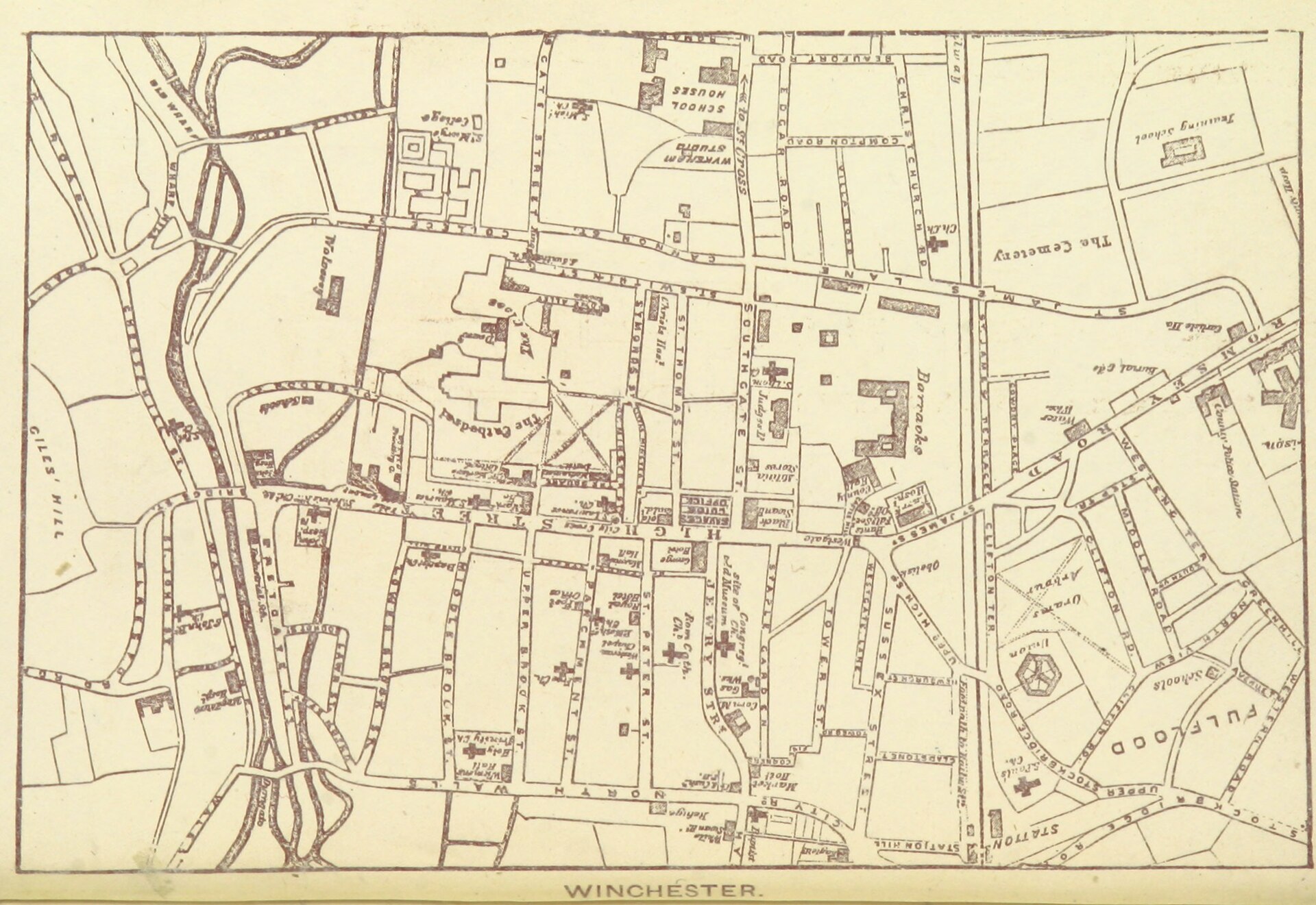
Plan of Winchester, from A Guide to the Cathedral and College of Winchester (10th ed.)
Shows Winchester Cathedral and its Close, the street grid of the old town, and the river and western approaches.
1733 · The British Library · Wikimedia Commons
No restrictions (plate dated 1733)
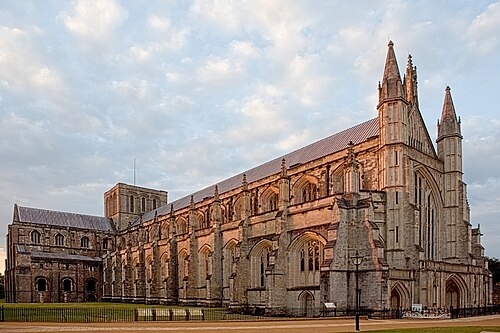

Castles of Winchester


More cities to explore
 EnglandOxfordExplore it in 1400 · 1670 · 1890
 EnglandBathExplore it in AD 100 · 1500 · 1790
 EnglandLondonExplore it in AD 200 · 1390 · 1600 · 1885
 EnglandYorkExplore it in AD 300 · AD 950 · 1420 · 1800
Castles of Europe · Landmarks of Europe · create your own reconstruction.