Historic Cities · England
Coventry through the ages
Coventry is a cathedral city and metropolitan borough in the West Midlands county, in England, on the River Sherbourne. Coventry had been a large settlement for centuries. Founded in the early Middle Ages, its city status was formally recognised in a charter of 1345. The city is governed by Coventry City Council, and the West Midlands Combined Authority.
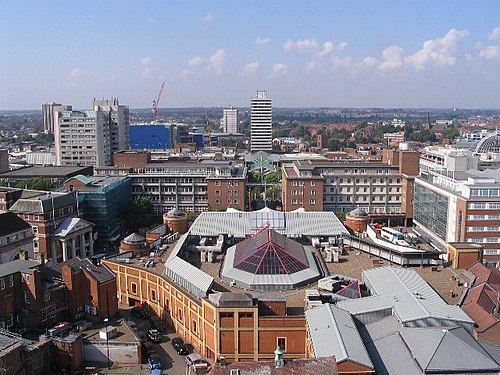
Coventry in 1450
The Wool and Thread City
Coventry in 1450 stands at its medieval height: a wealthy cloth town whose dyers, weavers and guilds send ‘Coventry blue’ across England and beyond. The walk traces the walled city's three spires, crowded markets, guildhall and the narrow lanes of craftsmen, from the outer approach and gatehouses through Broadgate and Bayley Lane to a broad view from the eastern parkland.
A compact medieval skyline of three soaring spires (St Michael's, Holy Trinity and the Greyfriars' tower) rises above a sea of timber-framed houses and tiled roofs. Red sandstone walls, crenellated and punctuated by gatehouses and towers, gird the town; narrow lanes open to market squares where cloth, dyers' skeins and wooden stalls crowd the pavements. Light favours the red and brown of stone and timber, with frequent mists in low-lying river hollows.
The route: 16 streets, squares and views
Warwick Road Approach → New Gate → Cooke Street Gate → Broadgate → Cross Cheaping Market → Bayley Lane → St Mary's Priory → St Mary's Guildhall → St Michael's Church → Holy Trinity → …
Step inside, 7 interiors
Cloth Hall under Timber Roof · Dyer's Vat-House and Drying Loft · Great Hall beneath the Angel Roof · Parish Nave and Aisles · Chancel with the Doom Painting · Top-Shop Loom Chamber · Cloister Walk and Garth
Planned from the Wikipedia record: History of Coventry.
Coventry in 1935
Motor City
Coventry in 1935 sits where medieval streets and timbered houses press close against the expanding motor factories that now shape daily life. The walk shows the city five years before the 1940 Blitz, moving from station approaches through the Bull Ring and Bayley Lane to motor yards and a skyline marked by three medieval spires.
The skyline remains dominated by three tall spires (St Michael's, Holy Trinity and Christ Church) rising from a dense patchwork of red brick roofs and blackened timber frames. Narrow lanes lined with overhanging gables and shopfronts open onto Broadgate and the Bull Ring, while factory sheds, brick chimneys and enamel signage have begun to crowd former market quarters. Street surfaces alternate between cobbles and early tarmac; cycles, lorries and a steady stream of small cars thread under soot-darkened eaves.
The route: 16 streets, squares and views
Station Approach → Coventry Station Forecourt → Broadgate Amid Change → The Council House → Bull Ring → Butcher Row → Bayley Lane → Ford's Hospital Courtyard → St Mary's Guildhall → Spon Street → …
Step inside, 9 interiors
Picture Palace Foyer · Bull Ring Market Hall · Butcher's Stall · Timbered Almshouse Chamber · Guildhall Great Hall · Tudor Inn Parlour · Works Yard Shiftroom · Motor Assembly Shed · Cathedral Nave
Planned from the Wikipedia record: History of Coventry.
Its story
The story of Coventry.
Cofa's Tree, the Monastery of 1043 and a Town Split in Two
Coventry rose on awkward ground. Earlier settlement in the district had gone to Corley and Baginton, on light soil clear of forest, while Coventry itself sat on heavy clay, marsh and woodland near the Forest of Arden, poorly suited to crops, so its Saxon settlers are thought to have cleared it and raised cattle and sheep instead, the choice that set the town's trade for centuries. A nunnery was founded here in about AD 700 by St Osburga; the name is usually read as "Cofa's tree", after an unknown Saxon and a tree that may have marked the settlement's boundary.
The first chronicled event in its history is destruction: in 1016 Canute's Danish army, laying waste to Warwickshire in a bid for control of England, left the nunnery in ruins. In 1043 Leofric, Earl of Mercia (appointed by Canute and one of the three most powerful men in the country), and his wife Godgifu, remembered as Lady Godiva, founded a Benedictine monastery on the remains for an abbot and twenty-four monks, built from the foundations out of their own patrimony. Papal authorisation turned it into a priory and cathedral in 1102. The story attached to Godiva, that she rode naked through the town to force her husband to remit his taxes on its people, is not corroborated by known facts and is regarded by modern historians as myth, but it has stayed fixed to the city's identity.
Leofric had given the monks the northern half of his Coventry estates, and the split hardened into a town governed as two: the Prior's-half and the Earl's-half, the latter passing to the Earls of Chester. Each half built its own church (Holy Trinity for the Prior's tenants, St Michael's for the Earl's), and a market grew at the monastery gates, the beginning of the town's trade.
Coventry Blue and the City Walls, 1150-1534
Three charters obtained from the Earls of Chester and from Henry II between 1150 and 1200 guaranteed that any merchant coming to the town could trade in peace, and that one who settled would pay no rent or dues for two years from the day he began to build. The grazing land around the town carried Coventry into the textile trades by the 13th century, and its wealth rested on the dyers, who produced a woad-dyed cloth known as Coventry blue, sought across Europe because it did not fade, believed to be the origin of the phrase "true blue". A Crown charter of 1273 opened export to "any places beyond the seas", another in 1334 freed the city's merchandise from toll throughout the realm, and in 1340 a merchant guild was licensed to enforce those privileges. By the 14th century Coventry held perhaps 10,000 people and ranked around fourth in England, though accounts disagree over which cities stood above it.
Work began on a circuit of city walls in 1355, paid for by local tolls and taxes. It was substantially finished around 1400, though the final form was not complete until 1534: about 2.2 miles of red sandstone over 8 feet thick and 12 feet high, with towers and twelve gatehouses. Coventry was described as the best-defended city in England outside London.
Charter, Parliaments and the Loss of the Priory, 1345-1570
Edward III granted Coventry a city charter in 1345, carrying the rights of self-government including the election of a mayor; its motto, Camera Principis or the Prince's Chamber, refers to his son Edward, the Black Prince. The city's money then made it briefly a seat of government: Henry IV summoned a parliament here in 1404 because he needed loans to fight rebellion, and during the Wars of the Roses Margaret of Anjou moved the royal court to Coventry, where parliament sat between 1456 and 1459 until Edward IV took the throne in 1461. Henry VI's charter of 1451 made Coventry a county in its own right, a status it held until 1842.
The 16th century took the trade and the priory together. Restrictive practices and monopolies among the guilds drove the cloth trade into decline and the city fell on hard times. Between 1539 and 1542 the dissolution of the monasteries sold off or dismantled the houses of the Carmelites, Greyfriars, Benedictines and Carthusians; the heaviest loss was St Mary's Priory and Cathedral, mostly demolished, the only English cathedral destroyed in the dissolution, and Coventry had none again until St Michael's was raised to that status in 1918. Most citizens appear to have favoured the new Protestant religion, and when Mary I's reign attempted to restore Roman Catholic authority many took punishment rather than recant: between 1510 and 1555 twelve Protestants were burned at the stake in Coventry, three of them in 1555. In 1569, after the Catholic Rising of the North, Mary, Queen of Scots was brought south to Coventry on Elizabeth I's instruction and held at St Mary's Hall until she was sent north again in May 1570.
Parliament's Stronghold and the Slighting of the Walls, 1635-1662
Relations with the Crown soured when the city protested in 1635 against Charles I's demand for a heavy contribution of ship money, and when the Civil War broke out Coventry held for Parliament. In late August 1642 the king appeared at the gates with 6,000 horse and was beaten back after a two-day fight; further Royalist attacks failed to breach the walls. The city was used to hold Royalist prisoners, and the phrase "sent to Coventry" may have grown out of the hostility of residents towards the Scottish prisoners confined there after the Battle of Preston. In 1662 Charles II ordered the walls slighted in revenge for the city's support of Parliament; only short sections and two gatehouses survive.
Ribbons, Watches and the Safety Bicycle, 1627-1890s
A silk weaving company was founded in Coventry in 1627, and around the start of the 18th century a ribbon weaving works was established by a Mr Bird, assisted by Huguenot refugees who brought silk and ribbon weaving skills with them. The trade grew until it was the basis of the city's economy: by 1818 there were 5,483 hand-looms and 3,008 engine looms in the city, employing nearly 10,000 people and peaking at about 25,000 around 1857. Watch and clock making grew alongside it until Coventry ranked with Prescot and Clerkenwell as one of the three main British centres of that trade. The city meanwhile lost its standing as the leading place of the Midlands to Birmingham, though its population rose from 16,000 in 1801 to 30,743 by 1841.
Both staple trades collapsed after 1860, when the Cobden-Chevalier free trade treaty admitted cheaper French silks and Swiss watches, and the city went into a severe slump. What survived it was the pool of skilled precision workers. James Starley set up a sewing machine business, the Coventry Machinists Company, in 1861, and from 1868 built bicycles, developing the French boneshaker into the penny-farthing; his nephew John Kemp Starley produced the Rover safety bicycle in 1885, the first with equal-sized wheels and a chain-driven rear wheel. By the 1890s Coventry had the largest bicycle industry in the world, with 248 manufacturers employing nearly 40,000 workers.
Motor City, the Broadgate Bomb and the Blitz of 1940-41
The first British motor car was built in Coventry in 1897 by the Daimler Motor Company. Within ten years the motor trade employed some 10,000 people, and by 1939 it employed 38,000, having largely displaced cycle manufacture, with Alvis, Humber, Jaguar, Rootes, Rover, Standard and Triumph all established here; the population doubled between 1901 and 1911. In the Great War the factories switched to military vehicles, armaments and ammunition; about 35,000 men from Coventry and Warwickshire served, so the skilled factory workforce was largely women drafted from across the country, and the city's war production made it a target for zeppelin raids. The War Memorial Park opened in June 1921 for the 2,587 men of the city killed.
Nine days before the Second World War began, on 25 August 1939, a bomb left in the carrier basket of a tradesman's bicycle outside a shop in Broadgate exploded at half past two in the afternoon. It killed five people (John Corbett Arnott, aged 15, Elsie Ansell, 21, Rex Gentle, 30, Gwilym Rowlands, 50, and James Clay, 82), and injured a hundred more. Two IRA members and three others were tried for Ansell's murder; three were acquitted and two convicted and hanged in February 1940, though the man who rode the bicycle to Broadgate was never identified.
On the night of 14 November 1940 the Luftwaffe attacked Coventry in an operation it called Moonlight Sonata. More than 500 aircraft bombed the city from seven in the evening for eleven hours into the morning of the 15th. The raid destroyed most of the city centre and the medieval cathedral, leaving its shell and spire; accounts of the death toll differ, giving figures between 380 and 568. More than 4,000 homes were destroyed and thousands more damaged, and around three-quarters of the city's industrial plants were hit, though war production was only briefly interrupted, much of it continuing in shadow factories elsewhere. The city was targeted for its concentration of armaments, munitions, aircraft and aero-engine works. A further heavy raid on 8 April 1941 brought the total killed by bombing to 1,236, with 1,746 injured.
Rebuilt, Twinned and De-industrialised, 1948-2022
After the bombing, most surviving historic buildings were demolished, some of them undamaged, by a council that saw no place for them in a modern city. Donald Gibson, appointed City Architect in 1938, rebuilt the centre with one of Europe's first traffic-free shopping precincts; the new Broadgate was opened by Princess Elizabeth in 1948, and Basil Spence's cathedral, built beside and incorporating the ruins of the old, was consecrated in 1962. Coventry and Stalingrad had become the world's first twin cities during the war, the link driven by ordinary Coventrians wanting to show support for the Red Army during the battle there; the city was later twinned with Dresden, bombed more heavily still. On 22 March 2022 the council voted unanimously to suspend the Volgograd twinning over the Russian invasion of Ukraine.
The motor trade carried the city through the 1950s and 1960s; in 1960 over 81,000 people worked in vehicle, tractor and aircraft production. Its industrial base drew Asian and Caribbean migrants arriving from Commonwealth colonies after 1948, and in 1950 a mosque opened on Eagle Street, among the first in Britain, for the city's growing Pakistani community. The population peaked in the late 1960s at around 335,000, and the University of Warwick opened to students in 1965. The reversal was abrupt: industrial disputes, quality problems, foreign competition and two recessions hit between 1973 and 1982, the Triumph factory at Canley closed in August 1980, and by 1981 one resident in six was out of work, the city's British Leyland workforce falling from 27,000 at its height to 8,000 by 1982.
Jaguar assembly ended at Browns Lane in 2004 and the Peugeot plant at Ryton-on-Dunsmore closed in 2006, ending volume car manufacture in Coventry. Engineering ceased to be a mass employer and the economy moved into services; by the 2010s its largest drivers were the two universities, Warwick and Coventry, with 60,000 students between them, and the city held the title of UK City of Culture in 2021. It is governed by Coventry City Council and, since 2016, sits within the West Midlands Combined Authority, and had 345,324 residents at the 2021 census, of whom 34.5 per cent belonged to an ethnic minority, with Sikhs at 5.0 per cent of the population, well above the English average.
From the archive
Coventry on paper: the old town as it was mapped.
A period plan or bird's-eye view of the old town, drawn between 1500 and 1850, the streets this page's reconstructions walk. Public domain, with its source named.
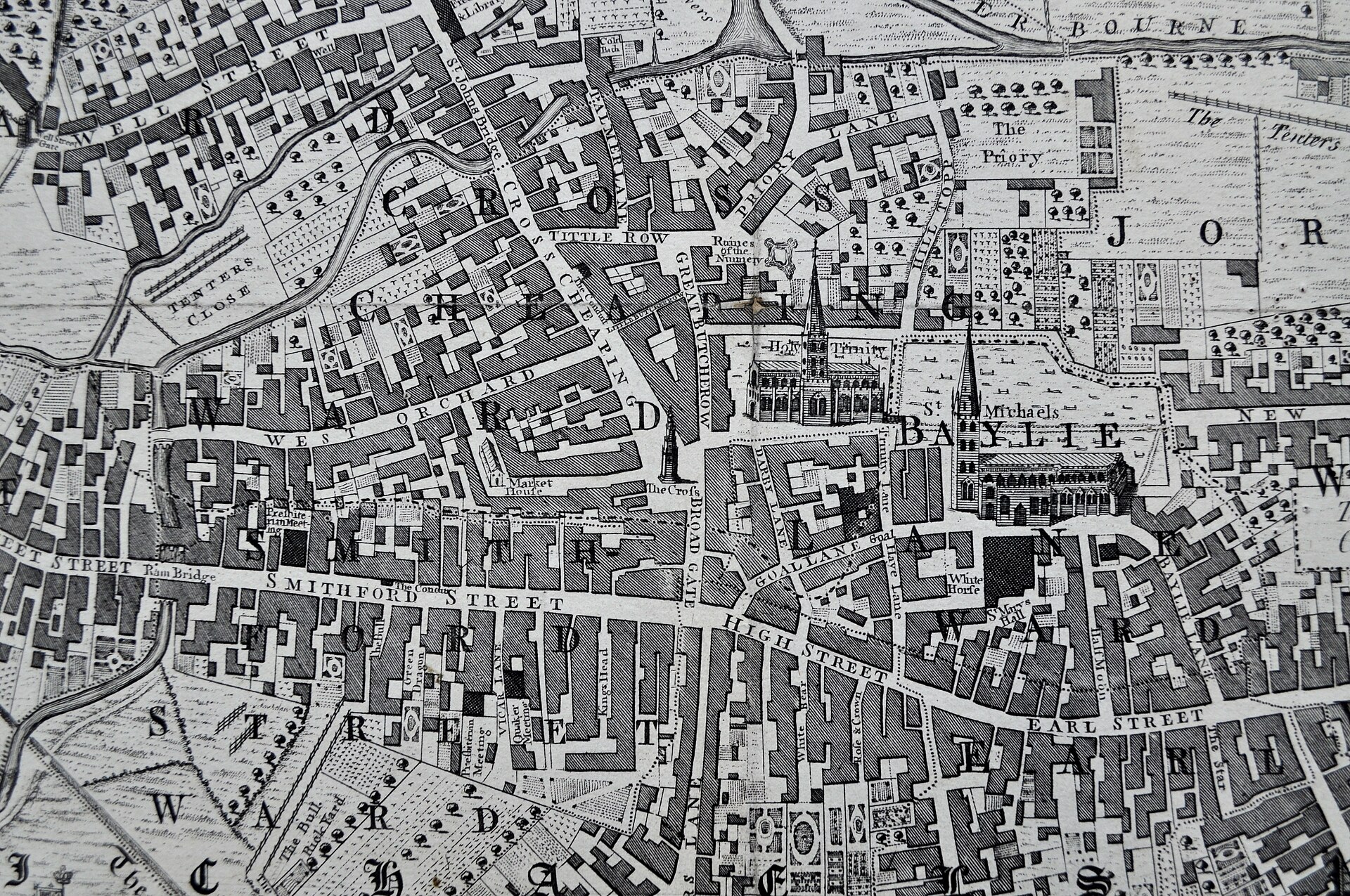
Detail of Coventry from Samuel Bradford's map, engraved by Thomas Jefferys (1748)
Shows Coventry's medieval street plan with High Street, Market House, Smithford Street, the spires of St Michael's and Holy Trinity, the Coventry Cross and the River Sherbourne.
1748 · Thomas Jefferys · Wikimedia Commons
CC BY-SA 3.0 (plate dated 1748)
In this city
Landmarks of Coventry, see each in its prime


Castles of Coventry


More cities to explore
 EnglandOxfordExplore it in 1400 · 1670 · 1890
 EnglandLincolnExplore it in 1320
 EnglandLondonExplore it in AD 200 · 1390 · 1600 · 1885
 EnglandYorkExplore it in AD 300 · AD 950 · 1420 · 1800
Castles of Europe · Landmarks of Europe · create your own reconstruction.