Historic Cities · England
Lincoln through the ages
Lincoln is a cathedral city and district in Lincolnshire, England, of which it is the county town. In the 2021 census, the city's district had a population of 103,813. The 2021 census gave the urban area of Lincoln, including Bracebridge Heath, North Hykeham, South Hykeham and Waddington, a recorded population of 127,540.

Lincoln in 1320
The Tallest Spire
Lincoln in 1320 is a prosperous wool staple and episcopal city, climbing a limestone ridge above the River Witham with its cathedral spire the tallest human-made structure of the age. The walk follows the river and the steep medieval climb to the close and castle, showing wool barges at Brayford, timbered shops on Steep Hill, Roman arches and the Stonebow gate.
A jagged skyline of pale oolitic limestone frames a compact city: three cathedral towers rise from the hill, the central tower topped by a tall, lead-clad wooden spire that dominates the plain. Sloping streets are lined with dark jettied timber houses, stacked shops and Norman stone dwellings; slate, lead and thatch roofs glint in sun or drizzle. Narrow, cobbled lanes pour down to the Witham where High Bridge bears houses across the river and Brayford Pool is crowded with wool barges and pack-horses.
The route: 16 streets, squares and views
Brayford Pool Shore → Newport Arch → Stonebow and High Street → High Bridge → Brayford Quay → Lower High Street → Steep Hill Lower Shops → The Jew's House → Norman Houses on the Climb → Bailgate → …
Step inside, 8 interiors
Stonebow Guildhall Chamber · Quayside Wool Hall · Steep Hill Shop-House Chamber · Upper Chamber of the Jew's House · Wool Merchant's Stone Undercroft · Angel Choir around St Hugh's Shrine · Chapter House under the Pillar · Castle's Great Hall
Planned from the Wikipedia record: Lincoln Cathedral.
Its story
The story of Lincoln.
Lindum Colonia and the Five Boroughs, 48–1068
Excavation in 1972 uncovered round wooden dwellings dated to the 1st century BCE beside Brayford Pool, the widening of the River Witham at the foot of the hill the Normans would later crown with castle and cathedral. The Romans conquered this part of Britain in 48 CE and built a legionary fortress on that hilltop, at the northern end of the Fosse Way. The Celtic name Lindon, thought to derive from a Brythonic word for the pool, was Latinised as Lindum, and the title Colonia added once army veterans settled there.
The conversion to a colonia followed the legion's move on to York in 71 CE. Colonia Domitiana Lindensium, named for the reigning emperor, was laid out inside the fortress walls and extended by roughly an equal area down the hillside to the water, giving it access to the sea by way of the Trent and the Witham. It is often taken to have been capital of the province of Flavia Caesariensis, though that rests on a patently corrupt list of British bishops said to have attended the Council of Arles in 314. The town and its waterways then declined, and by the close of the 5th century the place was largely deserted, though some occupation continued under a Praefectus Civitatis: Saint Paulinus visited a man holding that office at Lincoln in 629.
Germanic settlers reached Lincolnshire in the 5th and 6th centuries, and Lindum Colonia shrank in Old English to Lindocolina and then Lincylene. After the first Viking raids the place recovered its overseas trading ties and ran a mint that was by far the most important in Lincolnshire and, by the end of the 10th century, comparable in output to York's. The Danelaw, established in 886, made Lincoln one of the Five East Midland Boroughs, and excavation at Flaxengate found ground deserted since Roman times taking timber-framed buildings along a new street system in about 900. By 950 the Witham banks were built up, the lower city resettled and Wigford emerging as a trading suburb. In 1068 William I ordered a castle raised on the old Roman site, to control the road the Romans had controlled.
The Cathedral and the Diocese, 1092–1430s
The first cathedral, built within a walled close facing the castle after the see was moved from Dorchester-on-Thames, was completed in 1092. It was rebuilt after a fire and then brought down by the East Midlands earthquake of 1185. The minster raised in its place carried a spire reputedly the highest in Europe at 525 ft (160 m); when complete it is widely accepted to have taken from the Great Pyramids of Egypt the standing of tallest man-made structure in the world.
The Diocese of Lincoln was the largest in England and held more monasteries than the rest of England put together, and its bishops sat among the magnates of the realm: Robert Bloet, justiciar to Henry I; Hugh of Avalon, the cathedral builder canonised as St Hugh of Lincoln; the 13th-century intellectual Robert Grosseteste; and Thomas Wolsey, lord chancellor to Henry VIII. When Magna Carta was drawn up in 1215 one of the witnesses was Hugh of Wells, Bishop of Lincoln, and one of only four surviving originals is kept in Lincoln Castle. Diocesan administration ran from the Bishop's Palace, built in the late 12th century by Hugh of Lincoln and reckoned one of the most important buildings in England; Bishop William of Alnwick modernised it in the 1430s, adding the chapel range and entrance tower.
Lincoln Green: Cloth, Wool and Civic Rights, 1130–1409
Lincoln's weavers set up a guild in 1130 to produce Lincoln Cloth, above all the fine dyed scarlet and green whose reputation was later carried further by the legendary Robin Hood and his woollens of Lincoln green. By 1150 the town was among the wealthiest in England, on an economy of cloth and wool exported to Flanders.
That wealth made it worth fighting over. During the Anarchy, in 1141, King Stephen met the forces of Empress Matilda under her illegitimate half-brother Robert, 1st Earl of Gloucester; after fierce fighting in the streets Stephen's men were beaten and the king himself captured and carried off to Bristol. Thirteenth-century Lincoln was England's third largest city and a favourite of more than one king, and in the First Barons' War it was caught between the crown and rebel barons allied with the French. The French and rebel army was defeated here and at Dover, after which the town was pillaged for having taken Prince Louis's side.
In 1409 Lincoln became a county corporate, the County of the City of Lincoln, having belonged to the West Riding of Lindsey since at least the time of Domesday Book, and successive monarchs added further rights, including those of an assay town controlling metal manufacturing. Historians divide over the later Middle Ages: some date the city's decline from the 14th century, others argue its trade and communications remained buoyant well into the 15th.
The Jew's House and the Libel of Lincoln, 1154–1290
Lincoln held one of the five main Jewish communities in England, well established before it was officially noted in 1154. In 1190 anti-Jewish rioting that had started at King's Lynn in Norfolk spread to Lincoln; the community took refuge with royal officials, and their homes were plundered. The so-called House of Aaron has a two-storey street frontage that is essentially 12th century, and the nearby Jew's House likewise survives from that population.
In 1255 came the affair known as the Libel of Lincoln: prominent Lincoln Jews were accused of the ritual murder of a Christian boy, remembered in medieval folklore as Little Saint Hugh of Lincoln, and were sent to the Tower of London and 18 executed. In the Second Barons' War of 1266 the disinherited rebels attacked the Jews of Lincoln, ransacked the synagogue and burned the records that registered debts. The Jews of England were all expelled in 1290. Lincoln Synagogue now occupies Jews' Court on Steep Hill, believed to be the site of the medieval synagogue.
Dissolution, the Fallen Spire and a One-Street Town
The dissolution of the monasteries cut off Lincoln's main source of diocesan income and dried up the network of patronage the bishop controlled. Seven monasteries closed in the city alone, along with several abbeys nearby, diminishing the region's political weight further. In 1549 the cathedral's great spire, rotted through, collapsed and was not replaced. The comparative poverty of the centuries that followed did preserve pre-medieval structures that would probably have been lost had the city prospered.
Between 1642 and 1651 Lincoln lay on the frontier between Royalist and Parliamentary forces and changed hands several times, with many buildings badly damaged. The Bishop's Palace, where both Henry VIII and James I had been entertained, was sacked by royalist troops in 1648. With no major industry and no easy access to the sea, the city went on suffering while the rest of the country began to prosper in the early 18th century, travellers remarking on what had essentially become a one-street town.
The Foss Dyke, the Foundries and the First Tanks
Recovery came in the Georgian era, owing partly to the Agricultural Revolution and partly to the reopening of the Foss Dyke canal, which eased imports of coal and other raw materials. With the railway, Lincoln boomed again through the Industrial Revolution: Ruston's, Clayton's, Proctor's and William Foster's built locomotives, steam shovels and heavy machinery, and the city came to specialise in heavy engineering.
From November 1904 to August 1905 typhoid spread through the city from polluted drinking water drawn from Hartsholme Lake and the River Witham. Over 1,000 people contracted the disease and 113 died, among them Liam Kirk of Baker Crescent, the man responsible for the city's water supply. Near the start of the epidemic Dr Alexander Cruickshank Houston fitted a chlorine disinfection system just ahead of the poorly operating slow sand filter (an early use of chlorine to disinfect a water supply), and chlorination continued until a new supply was brought in during 1911.
In the First World War the works switched to war production, and the first tanks were invented, designed and built at Lincoln by William Foster & Co., tested on ground now covered by Tritton Road.
War Work, Bombing and the Turn to the University
In the Second World War Lincoln turned out tanks, aircraft, munitions and military vehicles. Over five occasions 26 high-explosive bombs and around 500 incendiaries were dropped on the city, killing eight people and destroying 50 houses. At nine in the evening on Friday 15 January 1943 Avondale Street and Thomas Street were hit, with other bombs in Saltergate, and a phosphorus bomb struck a bus in St Mary's Street outside the railway station, killing a woman who worked at a nearby NAAFI; the Dornier Do 217 responsible was shot down near Boothby Graffoe and its crew all burned to death; three of the five were 21 and one was 23. Accidents killed civilians too: two Hurricanes of 121 Squadron collided over the city on 27 July 1941, one crashing into a row of houses and shops and killing three people, and an Avro Lancaster came down on Highfield Avenue on 11 June 1943, killing four.
After the war Ruston & Hornsby built diesel engines for ships and locomotives, then in the early 1950s, working with former colleagues of Frank Whittle from Power Jets Ltd, opened the first production line for gas turbine engines for land- and sea-based power generation. At over 5,000 jobs it was the city's largest single employer and a rich takeover target: English Electric absorbed it in November 1966, GEC bought English Electric in 1968, and diesel engine work moved to Newton-le-Willows. Heavy industry declined towards the end of the century, and much of the redevelopment since has followed the University of Lincoln's Brayford Campus, opened in 1996. Lincoln remains the county town of Lincolnshire, with a district population of 103,813 at the 2021 census.
From the archive
Lincoln on paper: the old town as it was mapped.
A period plan or bird's-eye view of the old town, drawn between 1500 and 1850, the streets this page's reconstructions walk. Public domain, with its source named.
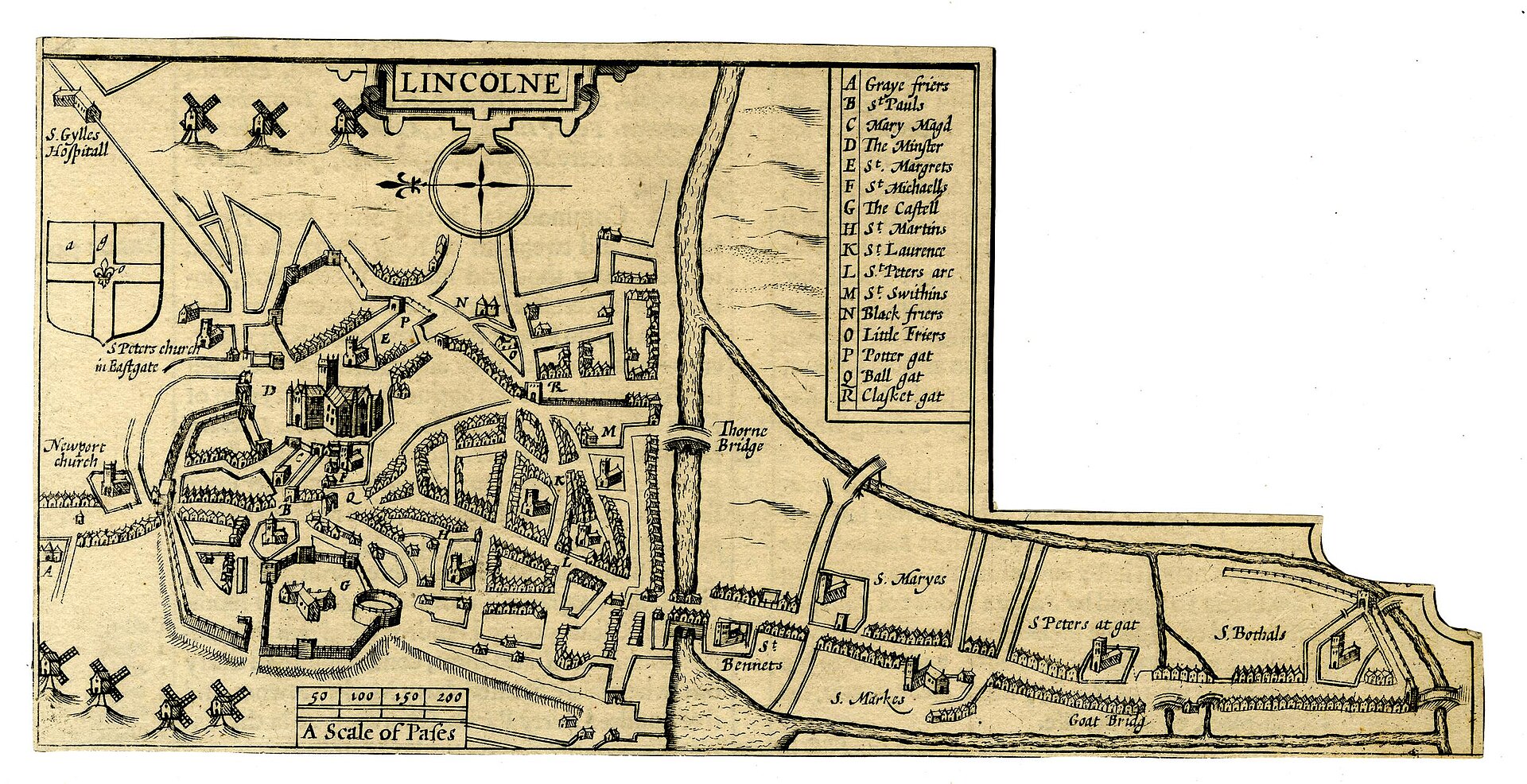
Town plan of Lincolne, 1650
Shows walled streets and blocks, Lincoln Cathedral at the centre, city gates and walls, the River Witham with bridges, and named parish churches.
1650 · Wikimedia Commons
Public domain (plate dated 1650)


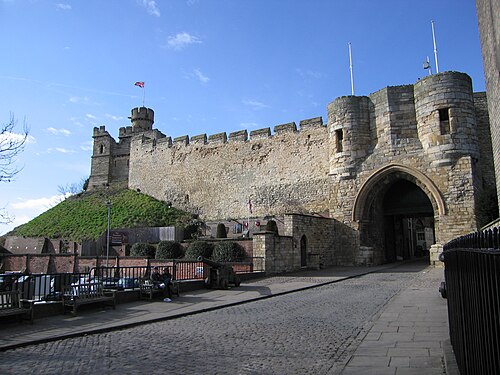
Castles of Lincoln

More cities to explore
 EnglandYorkExplore it in AD 300 · AD 950 · 1420 · 1800
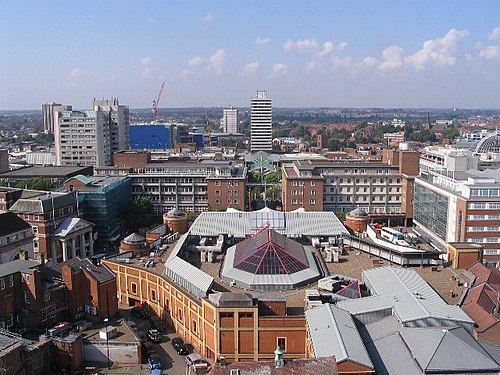 EnglandCoventryExplore it in 1450 · 1935
 EnglandLondonExplore it in AD 200 · 1390 · 1600 · 1885
 EnglandBathExplore it in AD 100 · 1500 · 1790
Castles of Europe · Landmarks of Europe · create your own reconstruction.