
England · Restored
Lincoln Castle
Lincoln Castle is a major medieval fortress in Lincoln, England, built by the Normans on a Roman fort site and notable for having two mottes. The castle retains a long stone curtain wall, multiple towers and an arched west gate and remains a well-preserved scheduled monument open to visitors.
First raised
1068
Its prime
1220
Today
Restored
As it stood in 1220
What Lincoln Castle looked like in its prime.
A long pale limestone curtain wall with continuous crenellated parapet runs along a raised Roman fort plateau, broken at the south by two grassy mottes. A large arched west gate is flanked by twin cylindrical drum towers; a square tower stands atop the south‑east motte and the Lucy Tower crowns the south‑west mound. The wall follows the slope of the land, with steep grassy revetments to the south, and the battlements and towers present a complete medieval silhouette.
Its story
The story of Lincoln Castle.
The Conqueror's Castle at Lindum Colonia, 1068
After William the Conqueror defeated Harold Godwinson at Hastings on 14 October 1066 he still faced resistance in the north, and his position remained insecure for years. To push his influence into the Danelaw, the country once settled by the Scandinavians, he built a series of major castles across the North and Midlands: Cambridge, Huntingdon, Nottingham, Warwick, York and Lincoln among them. At Lincoln he found a Viking commercial and trading centre of 6,000 to 8,000 people, and above it the remains of the Roman walled fortress of Lindum Colonia, which gave the city its name and stood 60 metres above the countryside. The site commanded a crossroads: Ermine Street, England's main north–south road between London and York; the Fosse Way running south-west to Leicester; and the Witham, linked to the Trent by the Fossdyke canal and to the North Sea through the Wash.
Clearing the ground cost the city 166 "unoccupied residences", pulled down to make room; of the 48 castles the Domesday Survey of 1086 records in England, thirteen came with such references. Work was completed in 1068. The keep was probably timber at first and replaced later in far stronger stone. On the south side, where the Roman wall ran along the edge of a steep slope, it was kept partly as curtain wall and partly as a revetment holding back the mounds; on the more level west side it was buried inside an earth rampart and built up to make the Norman wall. The stone outer walls that enclose the site date from before 1115.
Two Mottes and the Battles of 1141 and 1217
Lincoln is unusual in having two mottes, the only other surviving castle of that design being Lewes in East Sussex. The south-east mound, probably an original feature of William's castle, carries the square Observatory Tower, which rises above the outer walls to dominate the city. The castle was the focus of attention during the First Battle of Lincoln on 2 February 1141, fought in the struggle between King Stephen and the Empress Matilda over who should rule England. A new tower, the Lucy Tower, was raised on the second mound in the south-west corner; it probably dates from the 12th century and is named after Lucy of Bolingbroke, Countess of Chester until 1138. Thorngate Castle, which formed the south-east corner of the city walls near the river, existed in 1141 and was demolished ten years later, and earth banks thrown up for one of the sieges once stood west of the castle where the Lawns now are.
The castle was besieged again before the Second Battle of Lincoln on 20 May 1217, in the reign of Henry III and in the course of the First Barons' War, the political struggle that followed the sealing of Magna Carta on 15 June 1215. After that fighting a new barbican was built onto the west and east gates.
The Gaol, the Separate System and the Long Drop
As at Norwich and elsewhere, the castle's security made it a site for a gaol. In 1375 Agatha Lovel, "notoriously suspect" in the murder of her master Sir William de Cantilupe, was awaiting trial here when she bribed her gaolers and got away; the bailiffs Thomas Thornhaugh and John Bate were arrested and tried for letting her escape justice, and were either pardoned or acquitted.
A gaol was built within the castle in 1787 and extended in 1847. Debtors were allowed some social contact, but criminals were held under the separate system, designed to keep each man isolated: the chapel seating encloses every prisoner individually, so that the preacher could see them all while each could see only him. By 1878 the system was discredited and the inmates were moved to a new gaol on the eastern outskirts of Lincoln, leaving the prison without a use until the Lincolnshire Archives were housed in its cells. Until 1868 prisoners were hanged in public on the mural tower at the north-east corner of the curtain wall, above the upper town. The hangman William Marwood carried out his first execution at Lincoln, using the long drop (meant to break the neck rather than strangle) on Fred Horry in 1872.
King John's Charter and the Court That Still Sits
The castle holds one of only four surviving exemplars of the 1215 Magna Carta, sealed by King John after his meeting with the barons at Runnymede. In 2012 the three-year "Lincoln Castle Revealed" programme began, building an exhibition centre for the charter and opening parts of the prison to visitors; it was finished in April 2015, in time for the 800th anniversary of the sealing. The castle stayed in use as prison and court into modern times; the Crown Court still sits in the building raised on the west side of the site in 1823 as the assize courts.
Step inside
8 places to explore in 1220.
The record describes 8 distinct spots at Lincoln Castle, including 1 interior: gate passage under the west arch. Create your own photoreal reconstruction and explore every one, more scenes means more rooms, more angles, and more of the place to stand in.
Build Your Own Castle
Recreate Lincoln Castle with AI to explore it.
The artist rebuilds it as it stood in 1220, a photoreal reconstruction that belongs to you alone. Pay with coins, no subscription needed.
Recreate this castle →Defend this castle →From the archive
Lincoln Castle on paper: the measured plan and period views.
The survey plan and photographs below are the ground truth this page's reconstructions are checked against, drawn and photographed while the castle was still a working garrison. Every image is public-domain or openly licensed, with its source named.
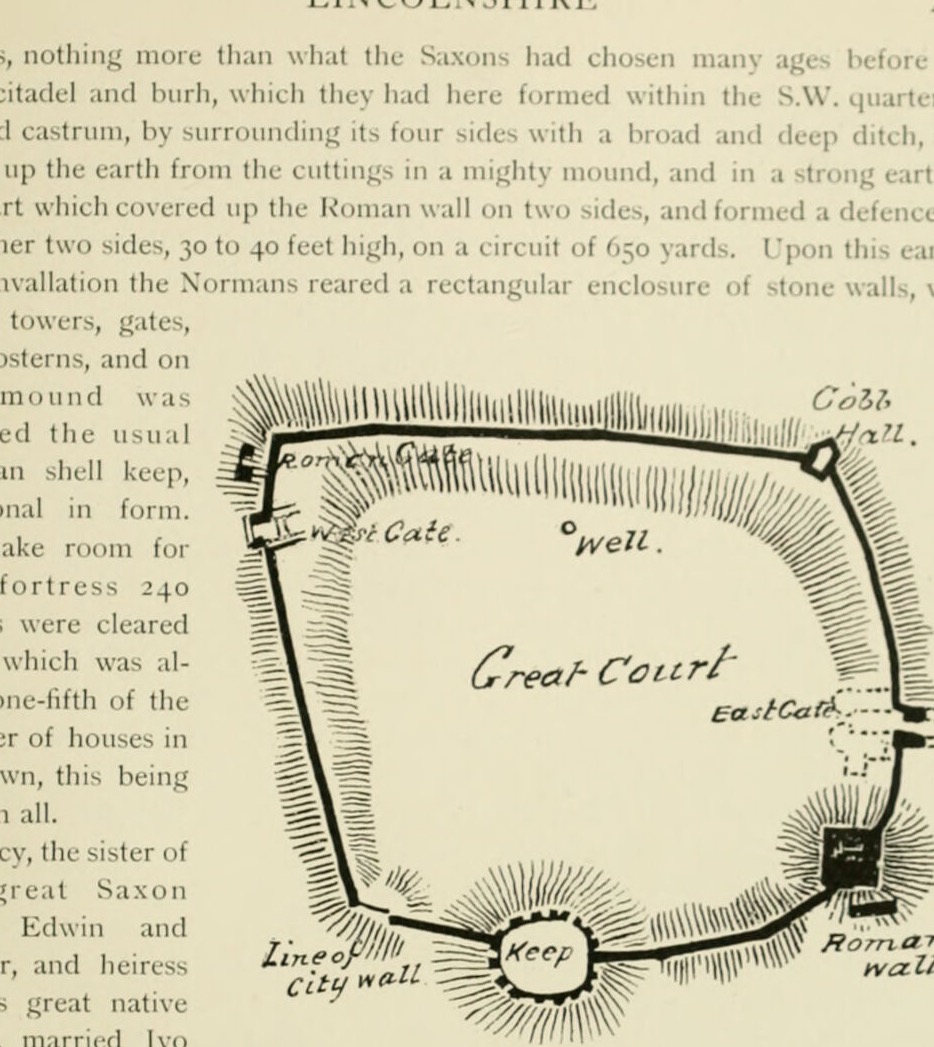
LINCOLN
1897 · J. D. Mackenzie, The Castles of England, vol. 1 (1897)
Public domain
Nearby
Landmarks within reach of Lincoln Castle.


Questions about Lincoln Castle
What is the history of Lincoln Castle?
What is inside Lincoln Castle?
Who owns Lincoln Castle now?
Why was Lincoln Castle built, and what was it used for?
Where is Lincoln Castle?
When was Lincoln Castle built?
Was Lincoln Castle ever attacked or besieged?
What did Lincoln Castle look like in its prime?
Is Lincoln Castle still standing, or is it a ruin?
Can you visit Lincoln Castle?
More castles of England


Explore the city


