
England · Restored
Broughton Castle
Broughton Castle is a medieval fortified manor house in the village of Broughton, Oxfordshire, long held by the Fiennes family (Barons Saye and Sele). It stands on an artificial island surrounded by a wide moat with a small bridge to the parish church, and combines medieval, Tudor/Elizabethan and later alterations; it is a Grade I listed building and is open to the public in summer.
Its prime
1610
Today
Restored
As it stood in 1610
What Broughton Castle looked like in its prime.
A compact, irregular Elizabethan manor-house silhouette with a crenellated 1406 gatehouse at one end and a larger Elizabethan block to the centre and right; tall mullioned windows and a long facade-facing great hall; steep stone-tiled roofs pierced by multiple tall brick chimneys; built of warm honey-coloured ashlar stone. The house sits on an artificial island with a broad surrounding moat, a short causeway/bridge to the church, and formal gardens to the rear; at its prime it was complete and occupied.
Its story
The story of Broughton Castle.
The Romano-British Villa on the Site
Long before the moat, the ground carried a Roman villa. A lead-lined sarcophagus holding the burial of a wealthy Romano-British woman was found and partly investigated here in the 1960s, and the wider site was discovered by the metal detectorist and amateur archaeologist Keith Westcott. Geophysical survey indicated a large winged or courtyard villa rustica comparable with the one at nearby North Leigh, and limited excavation by Time Team in 2021 showed that at least two wings existed. The villa was occupied and developed from the first to the fourth century AD, with large adjoining terraced ponds used to manage water flows. Mosaic tesserae and hypocaust flue tiles, together with the sarcophagus, suggested a villa of high status.
Sir John de Broughton's Moat and the Wykeham Inheritance
Sir John de Broughton built the manor house in 1300 where the confluence of three streams made a natural site for a moated manor, about two miles south-west of Banbury. The house was sold in 1377 to William of Wykeham, Bishop of Winchester, and has stayed in the same family ever since. Sir Thomas Wykeham crenellated the original house in 1406, the year from which the gatehouse dates, and in 1451 Broughton passed by inheritance to the Fiennes family, Barons Saye and Sele.
From 1550 Richard Fiennes transformed the medieval manor into a Tudor house, expanding the building significantly. James I stayed at Broughton on several occasions, and Anne of Denmark used the chamber still known as the Queen's Bedroom.
Old Subtlety and the Room With No Ears
The 1st Viscount Saye and Sele, known as "Old Subtlety", was one of the leading activists against Charles I, and in the decade before the Civil War his house served Parliamentarian sympathisers such as John Pym and John Hampden as a meeting place. A room at roof level is believed to be the one "with no ears", where the viscount plotted with the Parliamentary leaders in those years.
The 1st Viscount raised troops to fight the king at the inconclusive Battle of Edgehill in 1642. In the days that followed, Royalist troops besieged Broughton, quickly overcame the defenders and occupied the house for a time; once hostilities ended, work was needed to repair the damage done by Royalist cannon. Lord Saye and Sele had evaded signing Charles I's death warrant, and was able to make his peace with the Crown after the Restoration.
Decay, Gilbert Scott and the Fiennes Since
Broughton fell into decay in the 19th century and was rescued by the Venerable Frederick Fiennes, 16th Baron Saye and Sele and Archdeacon of Hereford, who brought in Sir George Gilbert Scott. At the turn of the century the house was rented by the Edwardian socialite Lady Algernon Gordon-Lennox, who transformed the gardens and hosted Edward VII; it was also the childhood home of Ivy Cavendish-Bentinck, Duchess of Portland.
The Fiennes family live there still. In August 1981 Fairport Convention held their annual reunion concert at Broughton rather than at the usual Cropredy, and the recording was released as Moat on the Ledge in 1982. William Fiennes, youngest son of the 21st Baron Saye and Sele, made the house the setting of his 2009 memoir The Music Room, describing it throughout without ever naming it.
Step inside
13 places to explore in 1610.
The record describes 13 distinct spots at Broughton Castle, including 8 interiors: great hall (interior), chapel (14th-century decorated gothic), long gallery (overlooking the gardens) and more. Create your own photoreal reconstruction and explore every one, more scenes means more rooms, more angles, and more of the place to stand in.
Build Your Own Castle
Recreate Broughton Castle with AI to explore it.
The artist rebuilds it as it stood in 1610, a photoreal reconstruction that belongs to you alone. Pay with coins, no subscription needed.
Recreate this castle →Defend this castle →Whose castle
Clans who held Broughton Castle.
The families that held Broughton Castle for a decade or more across its history, follow a name to its clan.
Wykeham
Bought by William of Wykeham, Bishop of Winchester, in 1377; the house has remained in the same family line since.
Fiennes
Passed by inheritance to the Fiennes family, Barons Saye and Sele, in 1451, still their home today.
From the archive
Broughton Castle on paper: the measured plan and period views.
The survey plan and photographs below are the ground truth this page's reconstructions are checked against, drawn and photographed while the castle was still a working garrison. Every image is public-domain or openly licensed, with its source named.
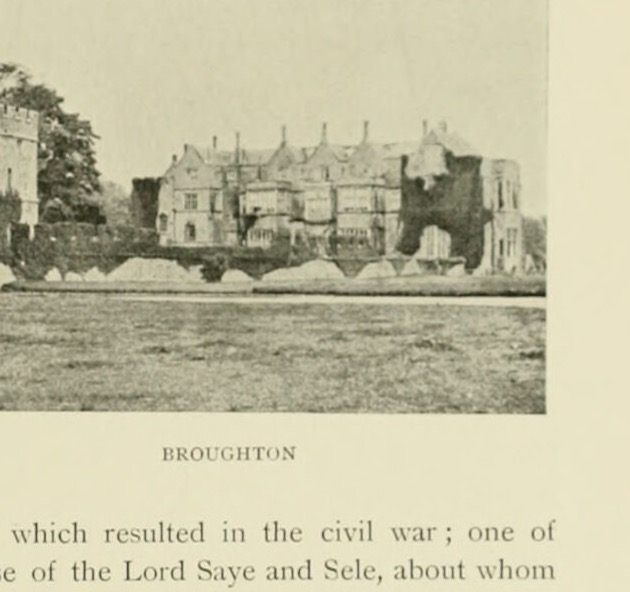
BROUGHTON
1897 · J. D. Mackenzie, The Castles of England, vol. 1 (1897)
Public domain
Nearby


