England · Ruin
Warkworth Castle
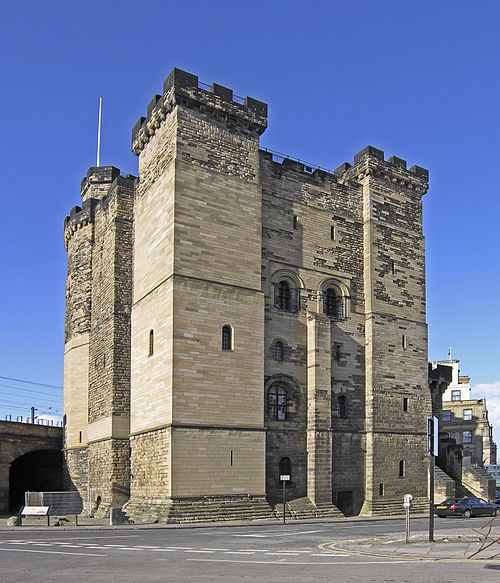
Warkworth Castle is a medieval fortress on a loop of the River Coquet in Northumberland, England, long held by the Percy family. The site centres on a large multi-storey rectangular keep and an inner bailey surrounded by curtain walls and towers; later additions include a 15th-century Montagu Tower and unfinished collegiate church foundations. The castle is now a ruined historic monument cared for by English Heritage.
Its prime
1470
Today
Ruin
As it stood in 1470
What Warkworth Castle looked like in its prime.
A dominant, multi-storey rectangular keep with crenellated parapet stands at the heart of a broad inner bailey, built of pale, weathered sandstone; lower curtain walls with battlements and several round and rectangular towers enclose the courtyard. The site sits within a looping bend of the River Coquet, with grassy bailey and visible foundations of domestic ranges and an arched vaulted undercroft at the keep's base. Roofs of ancillary ranges and the unfinished church are absent in places.
Its story
The story of Warkworth Castle.
A “Feeble” Castle on the Coquet, 1157–1213
The castle sits at the south end of the village, guarding the narrow neck of a loop of the River Coquet. Who founded it is uncertain: tradition credits Prince Henry of Scotland, Earl of Northumbria from 1139, but charters show he still controlled Bamburgh afterwards, and it may instead have been raised by Henry II in 1157, when Malcolm of Scotland surrendered England's northern counties to him.
It first appears in a charter of 1157–1164 granting castle and manor to Roger fitz Richard. Its defences were called “feeble”, and when the Scots invaded Northumberland in 1173 the garrison left it undefended. Roger's son Robert fitz Roger paid the Crown 300 marks in 1199 to confirm his ownership, and substantial building work is attributed to him; a favourite of King John, he hosted the king in 1213.
Scottish Sieges and the Percy Inheritance, 1319–1345
The Anglo-Scottish wars that followed Edward I's claim on the Scottish throne put Warkworth in the front line. In 1319 Edward II paid for four men-at-arms and eight hobilars to reinforce the twelve already in garrison, and in 1327 Scottish forces besieged the castle twice without success. Henry de Percy, 2nd Baron Percy, had been promised the Clavering estates in 1328 for leading a company of men-at-arms for Edward III; John de Clavering died in 1332 and his widow in 1345, and Warkworth passed to the Percys. Alnwick was reckoned the more prestigious of the family's castles, but Warkworth was their preferred home.
The Keep, and the Rebellion of 1405
In 1377 the fourth baron, another Henry, was made first Earl of Northumberland, the first family from northern England granted an earldom, and the keep is credited to him. Laid out as a Greek cross, it was probably designed by the master mason John Lewyn, on its likeness to Bolton Castle; a lion of the Percy arms overlooked the town from its north face.
The earl helped depose Richard II for Henry IV, then fell out with him. After his eldest son, Henry “Hotspur” Percy, was killed at Shrewsbury in 1403, the earl fled to Warkworth, submitted at York and was arrested. Pardoned in 1404, the earl rebelled again in 1405 with Richard Scrope, Archbishop of York. Warkworth was well provisioned and the garrison at first refused to yield, but by Henry IV's own letter, written from the castle after its fall, seven shots from his cannon brought them out. Henry V restored the castle to the Percys in 1416 and made Hotspur's son the second earl.
Towton, Attainder and the Rising of the North
The Percys held for Lancaster in the Wars of the Roses: the second earl was killed at St Albans in 1455, the third at Towton in 1461. Edward IV attainted the family and in August 1464 gave the earldom, and the castle with it, to the Yorkist Marquess of Montagu. A twenty-five-foot rectangular tower with arrow slits in its three outer walls, probably his work, still carries his name. His brother the Earl of Warwick used Warkworth as the base for attacks on the Lancastrian-held castles of Alnwick, Bamburgh and Dunstanburgh. The estates returned to the Percys in 1470, and the fourth earl remodelled the bailey buildings and began a collegiate church inside the walls, abandoned when he was murdered in 1489.
Thomas Percy, granted the earldom in 1557, joined the Rising of the North in 1569; rebels gathered at Alnwick and Warkworth until Sir John Forster, Warden of the March, ordered them out and took both castles for the Crown. Forster stripped Warkworth of its timbers and furnishings, moving Lord Hunsdon to write that “it is a great pity to see how Alnwick Castle and Warkworth are spoiled by him”. Percy was executed without trial on 22 August.
Civil War Damage and Salvin's Keep
Warkworth's part in the Civil War is unclear, but the war damaged it. Held at first for the King, it mattered enough that the invading Scots forced its surrender in 1644, though the tenth earl's support for Parliament may have spared it worse. Parliamentarian forces took it in 1648 and on withdrawing removed its doors and ironwork so it could not be reused.
The last Percy earl died in 1670, and two years later his widow allowed the keep's materials to be carted off to build Chirton Hall, 272 cart-loads. In 1750 the property came to Lady Elizabeth Seymour, whose husband Hugh Smithson took the name Percy and founded the Dukes of Northumberland. The fourth duke contracted Anthony Salvin, whose work of 1853–58 fell short of his plans: a partial refacing of the keep's exterior and new floors and roofs for two chambers the duke used for picnics. The eighth duke handed custody to the Office of Works in 1922, and English Heritage has cared for the site since 1984.
Step inside
9 places to explore in 1470.
The record describes 9 distinct spots at Warkworth Castle, including 3 interiors: vaulted undercroft beneath the keep, principal residential range, chambers, foundations / unfinished collegiate church. Create your own photoreal reconstruction and explore every one, more scenes means more rooms, more angles, and more of the place to stand in.
Build Your Own Castle
Recreate Warkworth Castle with AI to explore it.
The artist rebuilds it as it stood in 1470, a photoreal reconstruction that belongs to you alone. Pay with coins, no subscription needed.
Recreate this castle →Defend this castle →Whose castle
Clans who held Warkworth Castle.
The families that held Warkworth Castle for a decade or more across its history, follow a name to its clan.
Clavering
Granted by Henry II to Roger fitz Richard in 1157–1164; his descendants held it in the family line until John de Clavering's widow died in 1345.
The 2nd Baron Percy of Alnwick took control in 1345; possession descended through the Percys and the Percy Dukes of Northumberland until custody passed to the Office of Works in 1922.
From the archive
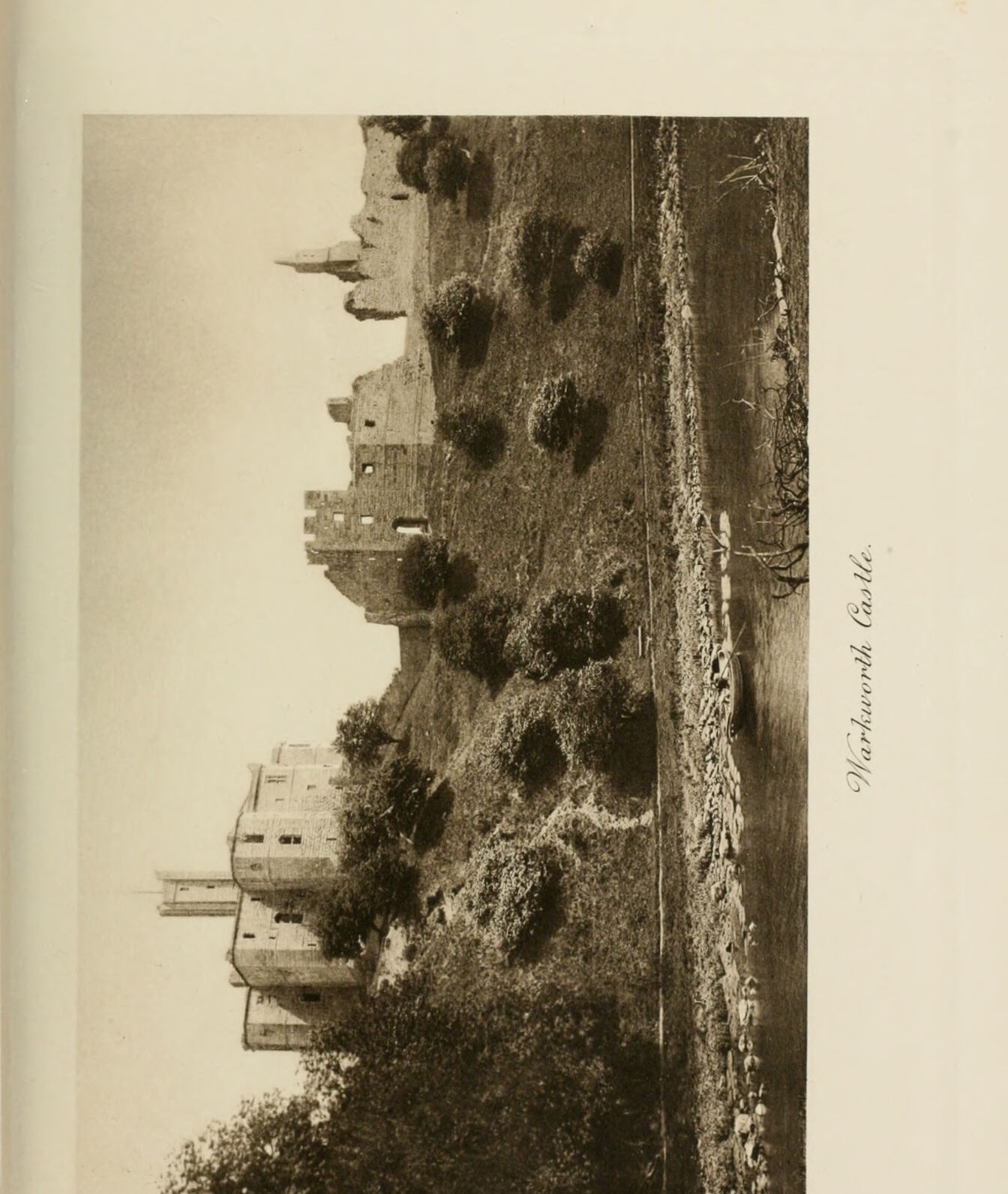
Warkworth Castle on paper: the measured plan and period views.
The survey plan and photographs below are the ground truth this page's reconstructions are checked against, drawn and photographed while the castle was still a working garrison. Every image is public-domain or openly licensed, with its source named.
Warkworth Castle
1897 · J. D. Mackenzie, The Castles of England, vol. 2 (1897)
Public domain
Warkworth Castle.
1897 · J. D. Mackenzie, The Castles of England, vol. 2 (1897)
Public domain
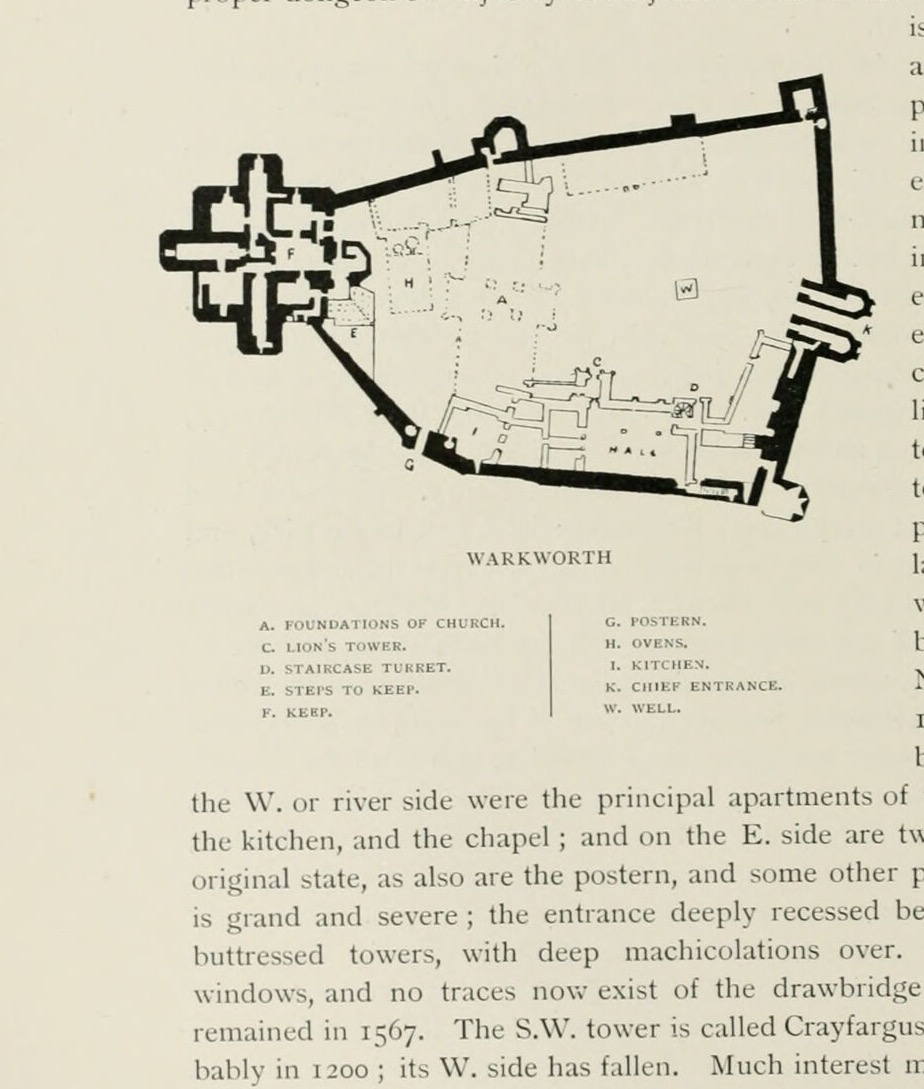
WARKWORTH
1897 · J. D. Mackenzie, The Castles of England, vol. 2 (1897)
Public domain