Historic Cities · England
Liverpool through the ages
Liverpool is a port city and metropolitan borough in Merseyside, England. It is situated on the eastern side of the Mersey Estuary, near the Irish Sea, 178 miles (286 km) north-west of London. It had an estimated population of 508,961 in 2024. The city is within the larger Liverpool City Region, a combined authority area with a population of over 1.5 million.

Liverpool in 1850
Emigrants' Liverpool
Liverpool in 1850 is a global emigration port at the height of transatlantic crossings, its docks full of sailing packets and steamers bound for New York. The walk threads the waterfront warehouses, Albert Dock's iron colonnades, the markets and lodging houses that outfit emigrants, and the civic terraces around Lime Street where St George's Hall rises.
The city’s rim is a hard edge of stone quays, red-brick bonded warehouses and black ironwork; beyond them a forest of masts and funneled steamers fills the Mersey. The Pier Head is marked by the Custom House dome and the low line of merchants’ offices; inland, ashlar townhouses and civic terraces rise in pale stone. Streets are crowded with horse vans, porters, hawkers and emigrant families in heavy cloaks and bonnets under a brisk, often grey Atlantic light.
The route: 22 streets, squares and views
Birkenhead Shore → Pier Head Landing → Custom House Dome → Royal Albert Dock → The Strand → Salthouse Dock → Canning Dock → Prince's Dock → Stanley Dock → Water Street → …
Step inside, 13 interiors
Mersey Ferry Saloon · Custom House Long Room · Bonded Warehouse Cotton Floor · Dockside Cooperage · Stanley Dock Cotton Floor · Merchant's Counting-House · St Nicholas Nave · Town Hall Assembly Room · Exchange News Room · Outfitter's Front Room · Station Waiting Room · Boarding‑House Dormitory · Emigrant Lodging Room
Planned from the Wikipedia record: History of Liverpool.
Liverpool in 1910
Edwardian Liverpool
Liverpool in 1910 is an immense working port still expanding into the age of steam and electricity, its docks crowded with transatlantic liners, warehouses and an elevated railway. This walk follows the riverfront and the civic heart, past tobacco warehouses and tram-lined streets to the scaffolds of the new Anglican cathedral on St James's Mount, showing commerce, industry and public grandeur in steady motion.
The city reads as brick and stone against the Mersey: low-lying red-brick warehouses and towering tobacco stores, pale sandstone civic buildings with domes and columns, the raw iron lattice of an elevated railway threading the docks, and the dark funnels and white hulls of transatlantic liners at the landing stage. Streets are narrow and paved, electric trams run along main routes, and coal smoke, sea mist and sharp winter light blur distant outlines.
The route: 24 streets, squares and views
River Mersey Approach → Pier Head Landing Stage → Pier Head → The Strand → Royal Albert Dock → Salthouse Dock → Dockside Overhead Railway → Stanley Dock Tobacco Warehouse → Wapping → Water Street → …
Step inside, 14 interiors
First-class Dining Saloon · Bonded Warehouse Counting Room · Salthouse Customs Office · Overhead Station Booking Hall · Tobacco Warehouse Floor · Merchant Bankers' Counting Room · Exchange News Room · Train Shed beneath Glass Roof · Philharmonic Concert Room · Tiled Saloon Bar · Grand Picture Gallery · Picton Reading Room · St George's Concert Hall · Cathedral Stonecutters' Workshop
Planned from the Wikipedia record: History of Liverpool.
Its story
The story of Liverpool.
King John's Borough, 1207-1650s
The name is first recorded around 1190 as Liuerpul, from the Old English lifer, thick or muddy water, and pol, a pool or creek; the Cambridge Dictionary of English Place-Names takes the original reference to be a tidal creek, since filled in, into which two streams drained. The borough dates from 28 August 1207, when King John issued letters patent advertising a new borough at “Livpul” and inviting settlers to take up holdings. There is no evidence the place had been a centre of any trade before that: the King is thought to have wanted a port free of the Earl of Chester's control, and one convenient for embarking men and supplies for his Irish campaigns, in particular that of 1209.
Liverpool Castle was built by about 1235 and stood until it was demolished in the 1720s; St Nicholas Church was standing by 1257, at first a chapel within the parish of Walton-on-the-Hill. A market grew up on the site of the later town hall, and the place settled into a small fishing and farming community run by burgesses and, a little later, a mayor, with some coastal trade around the Irish Sea and occasional ferries across the Mersey. Its population was no more than 1,000 in the mid-fourteenth century. By the early fifteenth century decline had set in and the county gentry tightened their grip; by the middle of the sixteenth century the population had fallen to around 600, and the port was reckoned subordinate to Chester until the 1650s.
"Her Majesty's Poor Decayed Town", 1571-1715
In 1571 the townspeople petitioned Elizabeth I for relief from a subsidy they said they could not bear, styling themselves in the memorial “her majesty's poor decayed town of Liverpool”. The recovery, when it came, owed much to a rival's misfortune: as the River Dee silted up, maritime trade out of Chester grew steadily harder and shifted to the Mersey. By the end of the sixteenth century Liverpool was winning trade with Ireland, the Isle of Man and elsewhere, mostly at Chester's expense, and Charles I granted a new and improved charter in 1626.
The English Civil War brought three sieges. The Roundheads took the town in 1643; in June 1644 Prince Rupert of the Rhine arrived with 10,000 men, camped at Everton and captured both town and castle for the King, only for the Roundheads to retake Liverpool later the same year. The first cargo from the Americas was recorded in 1648, and development accelerated after the Restoration of 1660 as trade with America and the West Indies grew, Lancashire and Cheshire cloth, coal and salt going out and sugar and tobacco coming back. In 1699 an Act of Parliament made Liverpool a parish in its own right, with its own customs authority independent of Chester, and the world's first commercial wet dock, holding 100 ships, was completed in 1715.
The Slave Trade, 1699-1862
The first known slave ship to sail from Liverpool departed in 1699, its name and the number of its victims unrecorded. The Liverpool Merchant set out for Africa on 3 October that year, reached Barbados with 220 Africans aboard and returned on 18 September 1700. By the close of the eighteenth century slave ships sailing from the Liverpool docks accounted for 40 per cent of the world's and 80 per cent of Britain's activity in the Atlantic slave trade; in the peak year of 1799 they carried over 45,000 enslaved people from Africa. Merchants such as Foster Cunliffe and his apprentice William Bulkeley co-owned voyages for slaves, for Greenland whaling and, especially during the Seven Years' War, for privateering. The profits made Liverpool a financial centre exceeded only by London and rivalled by Bristol, another slaving port.
The town's members of parliament defended the trade in the Commons. Richard Pennant, later Lord Penrhyn, is reported to have made more than thirty speeches between 1784 and 1790 in defence of Liverpool trade or the West Indies; in May 1788 he and Bamber Gascoyne the younger were the only two members who ventured to justify the slave trade, and on 12 May 1789 he told the House that a vote of abolition would strike at seventy millions of property and ruin the colonies. Banastre Tarleton, who succeeded him in 1790, thwarted a further abolition bid in 1796 and argued in 1805 that Liverpool's growth depended on the trade.
Abolitionist opinion was voiced in the town as well. William Rathbone, William Roscoe and Edward Rushton were at the forefront of the local movement, and Roscoe, member for Liverpool in 1806-07, was able to vote for abolition in 1807. The fines that Act imposed did little to deter: 29 avowed slaving voyages left Liverpool in 1808, none in 1809, two in 1810 and two more in 1811. Henry Brougham's Slave Trade Felony Act 1811 made slave traders liable to penal transportation for up to fourteen years, after which the trade continued in illicit forms supplying markets still open in Brazil and elsewhere. Of 4,973 slaving voyages out of Liverpool in all, the last recorded sailed in 1862.
Cotton, Canals and the Rocket, 1721-1901
Through the eighteenth century the town's population grew from some 6,000 to 80,000, and its links inland improved steadily: a canal to Manchester in 1721, to the St Helens coalfield in 1755, and to Leeds in 1816. In 1830 the Liverpool and Manchester Railway opened, the world's first inter-urban rail link between cities, carrying Stephenson's Rocket on its maiden journey. Between 1824 and 1858 more than 140 acres of new docks with ten miles of quay space were opened, and Liverpool became the leading world market for cotton, supplying the textile mills of Manchester and Lancashire.
Cotton also bound the town to the American South. During the American Civil War, in the words of the historian Sven Beckert, Liverpool was “the most pro-Confederate place in the world outside the Confederacy itself”: its merchants ran cotton out of Union-blockaded ports, built warships for the Confederacy and supplied it with equipment and credit. The CSS Alabama was built at Birkenhead on the Mersey, and the CSS Shenandoah surrendered there in the final surrender of the war.
For periods during the century the wealth of Liverpool exceeded that of London, and its Custom House was the single largest contributor to the British Exchequer. The city was granted city status in 1880 and its university was established the following year. By 1901 the population had passed 700,000 and the boundaries had taken in Kirkdale, Everton, Walton, West Derby, Toxteth and Garston.
The Famine Port and the Communities It Left, 1730s-1919
Liverpool was a major departure point for English and Irish emigrants to North America, and the Great Famine turned that traffic into a flood. Almost 300,000 Irish people arrived in 1847 alone; in the decade during and after the famine up to two million passed through the port, many going on to the United States, others settling in the city or moving to the industrial towns of Lancashire, Yorkshire and the Midlands. By 1851 more than a fifth of the population was Irish-born. Liverpool was the only place outside Ireland to elect a member of the Irish Parliamentary Party to Westminster: T. P. O'Connor held Liverpool Scotland from 1885 to 1929. Scheduled transatlantic passenger sailings began in the 1810s with American lines such as the Black Ball Line and the Collins Line, and in the 1840s the Liverpool-based Cunard Line and White Star Line emerged.
In 1813 a tenth of the population was Welsh, and the city came to be called the capital of North Wales. Between 1851 and 1911 it drew at least 20,000 people from Wales every decade, the flow peaking in the 1880s; one of the first Welsh-language journals, Yr Amserau, was founded there by William Rees, and more than fifty Welsh chapels were built. The Deutsche Kirche, the Greek Orthodox Church of St Nicholas, the Gustav Adolf Church and the Princes Road Synagogue were established in the 1800s to serve German, Greek, Nordic and Jewish congregations.
Liverpool is home to the UK's oldest black community, dating to at least the 1730s, with some Liverpudlians able to trace their black ancestry in the city back ten generations; early settlers included seamen, the children of traders sent to be educated, and freed slaves, since those entering the country after 1722 were deemed free men. The first residents of the city's Chinatown, the oldest Chinese community in Europe, arrived as seamen in the nineteenth century. After the Great War, colonial soldiers and sailors from Africa and India who had served with the British forces settled in Liverpool and other port cities; in June 1919 they were attacked by whites in racial riots, residents of the port competing with them for jobs and housing.
The Battle of the Atlantic and the May Blitz, 1939-1945
Liverpool was the control centre for the Battle of the Atlantic, which was planned, fought and won from the city, and its strategic importance was recognised by both Hitler and Churchill. There were eighty air raids on Merseyside, with an especially concentrated series in May 1941 that interrupted work at the docks for almost a week. Some 2,500 people were killed, almost half the homes in the metropolitan area were damaged and about 11,000 destroyed outright, leaving over 70,000 homeless. John Lennon was born in the city during an air raid on 9 October 1940.
Thousands of Chinese sailors were recruited to aid the war effort and came to Liverpool, and many formed relationships with local women. Once the war ended they were mostly forcibly repatriated.
Containers, Militant and Regeneration since 1946
Rebuilding after the war included large housing estates and the Seaforth Dock, the largest dock project in Britain, but from the 1950s the city was losing employers. The Overhead Railway and its fourteen stations were closed and demolished in 1956; the last tram ran in 1957. In 1956 a private bill sponsored by Liverpool City Council went before Parliament to build a reservoir in the Tryweryn Valley, drowning Capel Celyn; taking authority by Act of Parliament meant the council needed no planning consent from the Welsh local authorities, and it passed a public apology for the flooding in October 2005. The docks and manufacturing declined sharply from the 1970s: containerisation made the docks obsolete as a major employer, and CP Ships became the last transatlantic line to operate from Liverpool in 1972. In 1974 Liverpool became a metropolitan district in the new county of Merseyside, and by 1985 the population had fallen to 460,000.
The 1980s were the lowest postwar point. Factory closures came without end, an average of 12,000 people left the city each year, and 15 per cent of its land lay vacant or derelict. The Toxteth riots of July 1981 saw tear gas used by police against civilians for the first time in the United Kingdom outside Northern Ireland, and the Tate and Lyle sugar works closed the same year. By 1985 unemployment exceeded 20 per cent, about double the national average. The city council, dominated by the Militant group under the de facto leadership of Derek Hatton, sank into debt fighting central government cuts, and 49 councillors were removed from office for refusing to cut the budget. On 15 April 1989 and afterwards, 97 Liverpool supporters died in the Hillsborough disaster in Sheffield; a verdict of accidental death recorded in March 1991 was replaced by one of unlawful killing at a fresh inquest 25 years later.
From the early 1960s the city was internationally known for the Merseybeat sound and the Beatles, all four of whom were born there during the war, and from the mid-1990s a general economic revival was under way. The regenerated Albert Dock reopened in the late 1980s and drew further redevelopment after it, and the Liverpool ONE scheme opened in May 2008, the year Liverpool held the title of European Capital of Culture. Several areas were declared a UNESCO World Heritage Site in 2004 as the Liverpool Maritime Mercantile City, for the city's part in the development of international trade and docking technology; the status was revoked in July 2021, UNESCO holding that developments including the Bramley-Moore Dock stadium and Liverpool Waters had caused the “serious deterioration” of the area's significance. The estimated population in 2024 was 508,961.
From the archive
Liverpool on paper: the old town as it was mapped.
A period plan or bird's-eye view of the old town, drawn between 1500 and 1850, the streets this page's reconstructions walk. Public domain, with its source named.
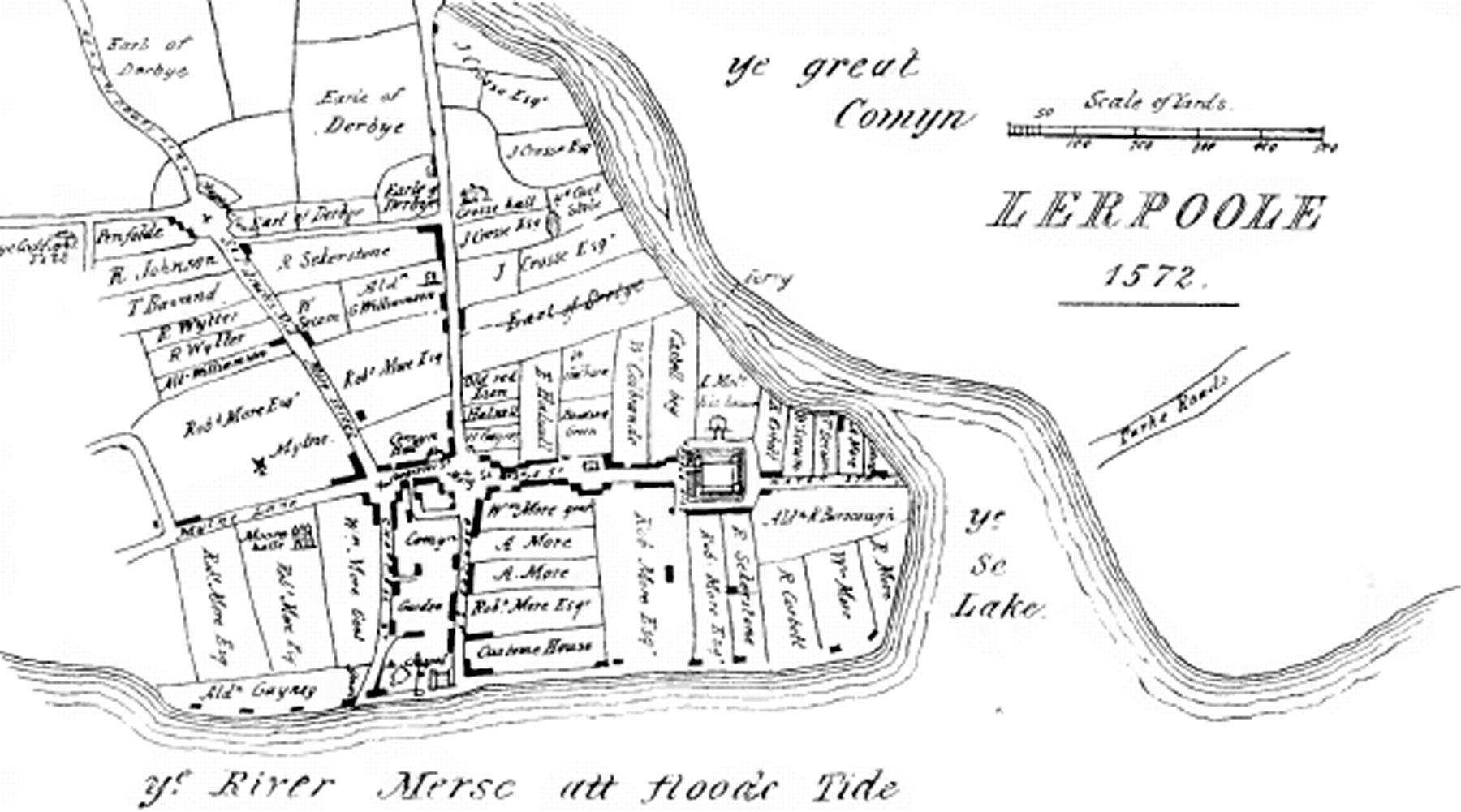
Plan of Liverpool, 1572 (engraved town plan)
Shows Liverpool's walled town with streets and burgage plots, a central castle, town gates and the River Mersey at flood tide.
1572 · William Ashton · Wikimedia Commons
Public domain (plate dated 1572)
In this city
Landmarks of Liverpool, see each in its prime


Ships tied to Liverpool
- HMHS Britannic: Declared fit for hospital-ship service at Liverpool in December 1915
- HMS Warrior: Rescued the crew of a Mersey flat sunk in a collision off Liverpool
- RMS Aquitania: Left Liverpool on her maiden voyage on 30 May 1914
- RMS Baltic: Worked the Liverpool-New York run from her 1904 maiden voyage until 1933
- RMS Carpathia: Sailed from Liverpool on her 1903 maiden voyage and on her last in July 1918
- RMS Lusitania: Left the Liverpool landing stage in 1907 watched by a crowd of 200,000
- RMS Mauretania: Left Liverpool on her maiden voyage on 16 November 1907
- SS Great Britain: Left Liverpool in July 1845, the first iron steamer to cross the Atlantic
- SS Great Eastern: Began her maiden voyage at Liverpool on 17 June 1860
- Titanic: Memorials to her dead stand in Liverpool, where White Star had offices
- Varyag: Overhauled by Cammell Laird at Liverpool in February 1917
Castles of Liverpool

More cities to explore
 EnglandChesterExplore it in AD 100 · 1600
 WalesCaernarfonExplore it in AD 120 · 1330
 EnglandLondonExplore it in AD 200 · 1390 · 1600 · 1885
 EnglandYorkExplore it in AD 300 · AD 950 · 1420 · 1800
Castles of Europe · Landmarks of Europe · create your own reconstruction.