
Cathedral · England · Restored
Lincoln Cathedral
Lincoln Cathedral (the Cathedral Church of the Blessed Virgin Mary of Lincoln) is the Church of England cathedral in Lincoln and the seat of the Bishop of Lincoln. The large medieval cathedral was built and rebuilt across Norman and Gothic phases and is notable for its tall central tower, paired western towers, major rose windows and extensive interior choir and chapels.
First raised
1201
Its prime
1311
Today
Restored
As it stood in 1311
What Lincoln Cathedral looked like in its prime.
A vast cruciform Gothic cathedral of warm honey-coloured Lincolnshire limestone, dominated by a massive central tower (in 1311 surmounted by a tall lead-encased wooden spire) and two square western towers framing a deeply carved west façade of blind arcades and pointed portals. Long Early English nave with clustered columns, ribbed vaults and a high clerestory, steep lead roofs and flying buttresses along the aisles, and large tracery-filled rose windows on the transepts; the cathedral rises above a low red-brick town.
Its story
The story of Lincoln Cathedral.
Remigius's Church, 1072–1092, and the Earthquake of 1185
Lincoln became a cathedral city when Remigius de Fécamp, its first bishop, moved his seat there from Dorchester-on-Thames some time between 1072 and 1092. Remigius is recorded as laying the foundations in 1072 and, being a Norman himself, probably employing Norman masons to superintend the building. It was finished in 1092 (one account holds he did not live to complete the whole), and Remigius died on 7 May that year, two days before its consecration.
The timber roofing burned in 1124, and Bishop Alexander (1123–48) rebuilt and enlarged the cathedral. About forty years later it was mostly destroyed by an earthquake, dated by the British Geological Survey to 15 April 1185 and estimated at a magnitude above 5, among the largest felt in Britain. The building was described as split from top to bottom, and of the pre-earthquake cathedral only the lower part of the west end and its two attached towers remain.
St Hugh's Rebuilding and the Towers, 1192–1548
The bishop appointed after the earthquake was Hugh de Burgundy of Avalon, later known as St Hugh of Lincoln, who began a vast programme of rebuilding and expansion. Work started with St Hugh's Choir and the eastern transepts between 1192 and 1210, and the nave followed in Early English Gothic. The Dean's Eye rose window in the north transept, begun in the 1192 rebuild, was completed in 1235.
In 1237 the main tower collapsed, mistakes in its support being thought responsible. In 1255 the cathedral petitioned Henry III for leave to pull down part of the town wall so as to enlarge the cathedral, rebuild the central tower and spire, and replace St Hugh's small rounded chapels with a larger east end for the growing numbers of pilgrims coming to his shrine. Between 1307 and 1311 the central tower was raised to its present 271 feet (83 m), carrying a lead-cased wooden spire that a storm brought down in 1548.
The Blood Libel of 1255 and Little Saint Hugh, to 1955
In August 1255 the body of an eight-year-old boy, missing for nearly a month, was found in a well in Lincoln. The death became the source of a blood libel in the city: Jews were accused of his abduction, torture and murder, many were arrested and eighteen were hanged. The boy became known as Little Saint Hugh, to distinguish him from Bishop Hugh, but he was never canonised. The cathedral benefited from the affair, as he was seen as a martyr and devotees came to the city and the cathedral to venerate him; Chaucer refers to the case in "The Prioress's Tale". In 1955 a plaque was placed near the remains of the shrine of Little St Hugh decrying the "trumped up stories of 'ritual murders' of Christian boys by Jewish communities".
The Lincoln Magna Carta, from Hugh of Wells to Lincoln Castle
Hugh of Wells, Bishop of Lincoln, was one of the signatories to Magna Carta, and for hundreds of years the cathedral held one of the four surviving copies of the original. It was shown at the 1939 New York World's Fair, and in March 1941 the Foreign Office proposed giving it to the United States, citing the many thousands of Americans who had queued to see it. It was lent to the Ronald Reagan Presidential Library in California in 2009, and is now displayed in Lincoln Castle.
Bomber County, Restoration and the Quarry, 1939–2025
Lincolnshire's Bomber Command airfields gave the county the nickname Bomber County, and the station badge of nearby RAF Waddington shows the cathedral rising through the clouds. Until the RAF Bomber Command Memorial opened in 2012, the cathedral held the only memorial in the United Kingdom to Bomber Command's heavy losses of aircrew. During the war, British treasures were stored in a chamber sixty feet beneath the cathedral.
A major renovation of the West Front was undertaken from 2000. The flying buttresses at the east end were found to be no longer connected to the adjoining stonework and were repaired to prevent collapse, and the crumbling Dean's Eye was rebuilt entirely, its stonework needing to shift only 5 mm for the whole window to collapse. The work was completed by April 2006 at a cost of £2 million. Scaffolding at the west front came down in 2022, after 36 years.
The cathedral is the seat of the Bishop of Lincoln and the mother church of the diocese, governed by its dean and chapter, and was listed grade I in October 1953. It is one of the few English cathedrals built from the rock on which it stands; it has owned its Lincolnshire limestone quarry on Riseholme Road since 1876; its masons use more than 100 tonnes of stone a year, and in 2025 it secured a long-term agreement with Dunston Quarry to continue essential maintenance. The nave can be seen free of charge, but visitors are asked to pay to explore further.
Step inside
9 places to explore in 1311.
The record describes 9 distinct spots at Lincoln Cathedral, including 6 interiors: nave looking east toward the choir (interior), st hugh's choir (eastern choir, interior), angel choir and carved stalls (interior) and more. Create your own photoreal reconstruction and explore every one, more scenes means more photos, more angles and more of the immersive experience.
Build Your Own Castle
Recreate Lincoln Cathedral with AI to explore it.
The artist rebuilds it as it stood in 1311, a photoreal reconstruction that belongs to you alone. Pay with coins, no subscription needed.
Recreate Cathedral to Explore →Nearby
Castles within reach of Lincoln Cathedral.
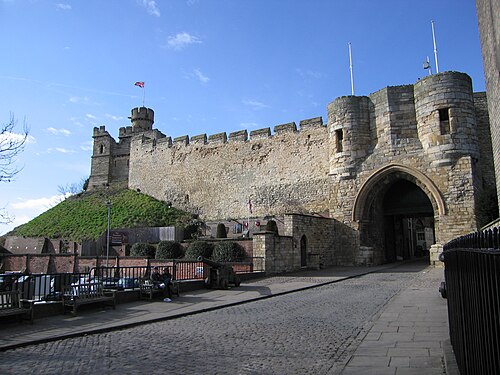

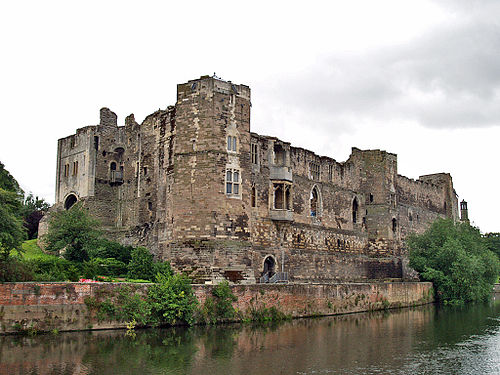
Landmarks within reach of Lincoln Cathedral.


More landmarks of England


Explore the city


