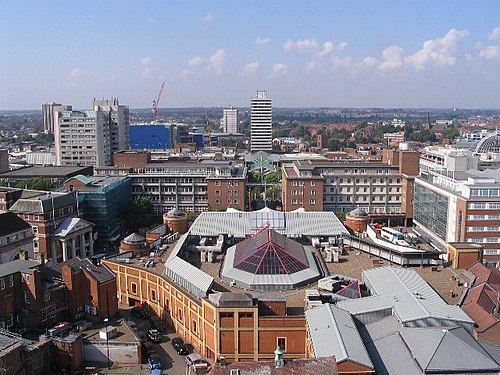
England · Partial ruin
Coventry Castle
Coventry Castle was an early 12th-century motte-and-bailey fortress in the centre of Coventry, built by Ranulf de Gernon. The castle was demolished in the late 12th century; Caesar's Tower is thought to be the surviving fragment incorporated into St Mary's Guildhall. The tower was later rebuilt after Second World War bombing and contains rooms historically named the Treasury and the 'Mary Queen of Scots' chamber.
Its prime
1147
Today
Partial ruin
As it stood in 1147
What Coventry Castle looked like in its prime.
A compact motte-and-bailey complex dominated by a squat rectangular stone tower (Caesar's Tower) standing on an earthen motte; the tower is built of warm sandstone ashlar with a base of larger, roughly coursed blocks and narrow vertical slit windows with diamond leaded panes. Timber-framed service ranges and low wooden buildings occupy the surrounding bailey, while a larger stone hall stands adjacent; the tower and bailey are intact and functional in plan and use.
Its story
The story of Coventry Castle.
Ranulf de Gernon's Motte and the Death of Robert Marmion
Coventry Castle was a motte-and-bailey fortress raised in the early 12th century by Ranulf de Gernon, 4th Earl of Chester, in the city of Coventry. Its first known use came during the Anarchy, when Robert Marmion, 1st Baron Marmion of Tamworth, a supporter of King Stephen, expelled the monks from the adjacent priory of Saint Mary and converted it into a fortress, from which he waged a battle against the earl. Marmion perished in that battle.
Ranulf's Siege and Stephen's Destruction of the Castle, 1146–1182
Stephen took Ranulf prisoner in 1146 and forced him to hand over his castles. The earl gave up only some of them, Coventry among those he did surrender. In 1147 he came back for it: those loyal to the king fell back on the castle's defences while Ranulf besieged them, trying to recapture what he had given away. The siege was lifted, and Stephen then destroyed the castle. It was probably repaired afterwards, since it was described as a viable fortification in 1182.
St Mary's Guildhall on the Site and the Queen of Scots in Caesar's Tower
The castle was demolished in the late 12th century and St Mary's Guildhall was built on part of the site. By November 1569, when Mary, Queen of Scots was detained in Caesar's Tower, the guildhall had been built onto it. Which room held her is disputed: one nicknamed the 'Mary Queen of Scots' room was long taken to be the place because of its cell-like appearance, though she was more likely kept in the Old Mayoress's Parlour.
Caesar's Tower, thought to be all that remains of the castle, still survives as part of St Mary's Guildhall, and was rebuilt after bombing in the Second World War. The Cathedral Lanes Shopping Centre was built over part of the castle.
Step inside
6 places to explore in 1147.
The record describes 6 distinct spots at Coventry Castle, including 3 interiors: tower ground floor, the treasury, upper chamber (later 'mary queen of scots' room / old mayoress's parlour), adjacent stone hall facing the bailey. Create your own photoreal reconstruction and explore every one, more scenes means more rooms, more angles, and more of the place to stand in.
Build Your Own Castle
Recreate Coventry Castle with AI to explore it.
The artist rebuilds it as it stood in 1147, a photoreal reconstruction that belongs to you alone. Pay with coins, no subscription needed.
Recreate this castle →Defend this castle →Whose castle
Clans who held Coventry Castle.
The families that held Coventry Castle for a decade or more across its history, follow a name to its clan.
Gernon
Built in the early 12th century by Ranulf de Gernon, 4th Earl of Chester, who besieged it in 1147 to win it back from King Stephen.
Nearby
Landmarks within reach of Coventry Castle.


Questions about Coventry Castle
What is the history of Coventry Castle?
What is inside Coventry Castle?
Why was Coventry Castle built, and what was it used for?
Where is Coventry Castle?
When was Coventry Castle built?
Was Coventry Castle ever attacked or besieged?
Which family or clan held Coventry Castle?
What did Coventry Castle look like in its prime?
Is Coventry Castle still standing, or is it a ruin?
More castles of England


Explore the city