Cathedral · England · Still standing
St Paul's Cathedral
St Paul's Cathedral is the Anglican cathedral in London and the seat of the Bishop of London. Designed by Sir Christopher Wren in the English Baroque style and completed in 1710, the building is dominated by a large central dome and serves as the mother church of the Diocese of London.
First raised
1675
Its prime
1710
Today
Still standing
As it stood in 1710
What St Paul's Cathedral looked like in its prime.
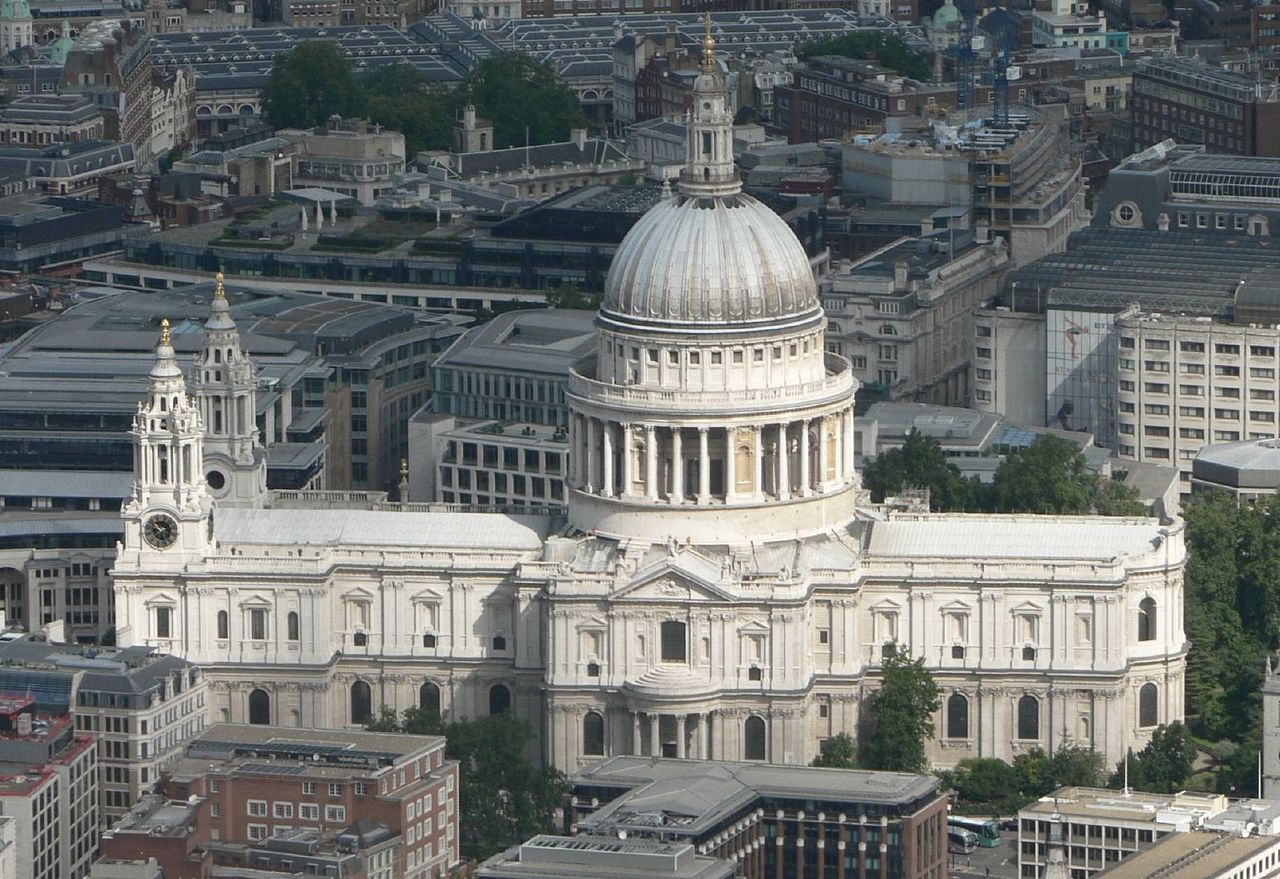
A broad, pale Portland-stone cathedral dominated by a massive lead-covered central dome on a columned drum topped by a lantern and gilded finial. The long east–west nave and transepts present a classical façade with a pedimented west portico and twin lower towers (one with a clock). Low balustrades, round-arched windows and repeating pilasters articulate the long exterior; the cathedral sits amid dense city streets and low commercial buildings, its dome rising well above the surrounding roofs.
Its story
The story of St Paul's Cathedral.
Mellitus, Æthelberht and the Saxon Cathedral, 604–1087
Bede records that in 604 Augustine of Canterbury consecrated Mellitus as first bishop to the East Saxons; Æthelberht of Kent built a church dedicated to St Paul in London as the new bishop's seat. When Sæberht died in about 616 his pagan sons expelled Mellitus, and the fate of that first building is unknown. Erkenwald, bishop from 675, was buried in the cathedral in 693; Æthelred the Unready was buried there in 1016. The Anglo-Saxon Chronicle records the cathedral burning with much of the city in 1087.
Old St Paul's, the New Work and the Great Fire, 1087–1666
The Normans began the fourth cathedral after the 1087 fire. Another fire in 1135 disrupted the work and it was not consecrated until 1240. An enlargement known as the New Work began in 1256, was consecrated in 1300 and finished in 1314; excavations in 1878 put it at 585 feet long.
The Reformation stripped the interior of chapels, shrines and relics: images were destroyed in November 1547, a workman being killed by falling items, and in 1550 the high altar was taken down overnight, provoking a fight in which a man died. Lightning destroyed the spire in 1561, and the cost of a proper repair proving too great, only the roof was mended. Inigo Jones was commissioned to build a west portico in 1631, unfinished when civil war began in 1642, the year Parliament ordered St Paul's Cross demolished. The nave served for a time as a cavalry barracks, and by 1658 the south transept had collapsed. Christopher Wren, one of Charles II's restoration commissioners of 1663, proposed a classical rebuilding in May 1666; the Great Fire gutted the cathedral that September.
Wren's Design and the Coal Tax, 1669–1716
Wren was formally given the task of designing a replacement on 30 July 1669. Of five successive designs, a Greek cross was judged by the clergy unfit for Anglican liturgy; the oak-and-plaster Great Model of 1673 is still kept in the cathedral. Contemporary accounts put the laying of the first stone on 21, 25 or 28 June 1675.
The dome was set on eight piers, with a brick cone hidden between inner and outer shells to carry the stone lantern. Nicholas Hawksmoor joined as principal assistant in 1684. Financed by a tax on coal, the cathedral was consecrated on 2 December 1697, when Bishop Henry Compton preached on Psalm 122. The lantern's final stone was set on 26 October 1708 by Wren's son; Parliament declared the building complete on Christmas Day 1711, and by 1716 costs had reached £1,095,556.
Suffragette Bombs, Subsidence and the Blitz, 1913–1941
On 8 May 1913 a bomb of potassium nitrate in a mustard tin was heard ticking and found as people entered for a sermon; a second suffragette device was discovered on 13 June 1914 before it could explode. Churches were deliberately targeted in the Women's Social and Political Union campaign, which attacked 32 across Britain.
Reports in 1913 and 1914 confirmed that the dome and its piers were settling, and a Dangerous Structures Notice followed on Christmas Eve 1924. From March 1925 concrete and more than 250 steel bars were driven into the piers and a steel chain was embedded around the dome. The rededication service of 25 June 1930, attended by George V and Queen Mary, was the first act of worship broadcast from the cathedral.
Bombs struck on 10 October 1940, destroying the high altar, and on 17 April 1941, holing the floor above the crypt. On 12 September 1940 a time-delayed bomb was defused and removed by Royal Engineers under Temporary Lieutenant Robert Davies, who with Sapper George Cameron Wylie was awarded the George Cross.
State Funerals, Occupy and the Cathedral Today
Wren was the first person interred in the crypt, in 1723, beneath a Latin inscription telling the reader who seeks his monument to look around. Nelson's state funeral was held on 9 January 1806 and Wellington's on 18 November 1852; both lie in the crypt. Churchill's followed on 30 January 1965 and Margaret Thatcher's ceremonial funeral on 17 April 2013. Charles and Diana married here on 29 July 1981, having chosen St Paul's over Westminster Abbey because it offered more seating.
A fifteen-year restoration was completed on 15 June 2011. That October an Occupy London camp was set up in front of the cathedral; the cathedral closed, Canon Chancellor Giles Fraser and Dean Graeme Knowles resigned, and the camp was cleared without violence at the end of February 2012 under a court order won by the City of London Corporation. The cathedral is owned by the Diocese of London and has been Grade I listed since 1950; sightseers pay an admission charge, £25 for adults in 2024, because it receives little regular funding from Crown, church or state, while worshippers enter free.
From the sea
Ships that came to St Paul's Cathedral.
- HMS Victory: Carried Nelson's body home for burial in St Paul's on 9 January 1806
Step inside
8 places to explore in 1710.
The record describes 8 distinct spots at St Paul's Cathedral, including 2 interiors: nave looking east toward the crossing, beneath the dome at the crossing. Create your own photoreal reconstruction and explore every one, more scenes means more photos, more angles and more of the immersive experience.
Build Your Own Castle
Recreate St Paul's Cathedral with AI to explore it.
The artist rebuilds it as it stood in 1710, a photoreal reconstruction that belongs to you alone. Pay with coins, no subscription needed.
Recreate Cathedral to Explore →Nearby
Castles within reach of St Paul's Cathedral.


Landmarks within reach of St Paul's Cathedral.


More landmarks of England


Explore the city


