
Stadium · England · Still standing
White Hart Lane & Tottenham Hotspur Stadium
Tottenham Hotspur Stadium is a multi-purpose football stadium in London that serves as the home ground of Tottenham Hotspur Football Club. It opened in 2019 with a seated capacity of 62,850 and is also configured to host American football, concerts and other events using a retractable, dividing synthetic turf system.
Its prime
2019
Today
Still standing
As it stood in 2019
What Tottenham Hotspur Stadium looked like in its prime.
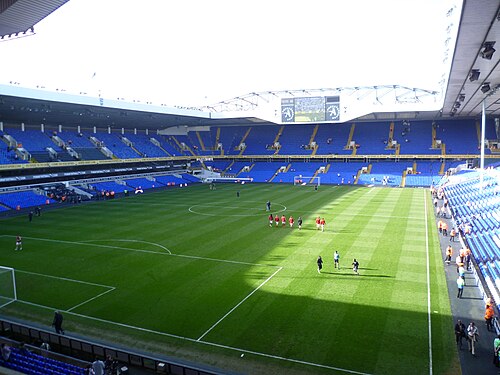
An oval, bowl-shaped stadium with a continuous ring roof and a large central oval opening exposing the tiered seating and pitch; the exterior is clad in a patterned 'veil' of light-coloured decorative tiles, perforated metal panels and bands of glass. One curved end is a multi-storey glass façade looking onto a broad paved forecourt with tall flagpoles. Inside the bowl are steep, multi-tier stands on three sides and a single-tier, steel-framed south stand, all surrounding a level playing surface.
Its story
The story of Tottenham Hotspur Stadium.
From Tottenham Marshes to the All-Seater Lane, 1882-1998
Tottenham Hotspur was formed in 1882 and played its early matches on public land at Tottenham Marshes. Growing crowds took it to an enclosed ground where it could charge admission: Asplins Farm by Northumberland Park in 1888, then in 1899 land held by the brewers Charringtons behind the White Hart pub. From 1909 a new stadium with stands designed by Archibald Leitch went up over two and a half decades, reaching a capacity of nearly 80,000 by 1934. Seating later replaced the standing areas, and the all-seater requirement of the 1989 Taylor Report left the ground holding around 36,000 when the work finished in 1998, lower than the grounds of other major English clubs.
The Northumberland Development Project, 2008-2016
The Northumberland Development Project was announced in October 2008. A 56,000-seat design by KSS Design Group, submitted in October 2009, required demolishing eight locally listed and two nationally listed buildings and was criticised by English Heritage; a revised plan retaining some of them was accepted by Haringey Council on 30 September 2010. After a riot in a deprived part of Tottenham in August 2011 the council, keen to keep the economically important club in the community, issued planning permission on 20 September 2011 and a week later dropped the community infrastructure payments usually required.
Having lost its bid for the Olympic Stadium to West Ham United, Tottenham committed in January 2012 to staying in North Tottenham. A compulsory purchase order for the last plots on Paxton Road was confirmed by Eric Pickles on 11 July 2014, Archway Sheet Metal Works failed in the High Court to have it quashed, and the plots were acquired on 31 March 2015. On 8 July 2015 the club announced a ten-year agreement to stage at least two NFL games a year, together with a redesign by Populous led by Christopher Lee, which the Mayor of London formally approved in February 2016.
Built Around a Living Ground, 2015-2019
Foundation work by Morrisroe began in autumn 2015, and the build ran in two phases so that White Hart Lane could stage the 2016-17 season: the north, west and east stands first, then the single-tier South Stand. Demolition began the day after the last home match of 2016-17 and every visible remnant was cleared by early August 2017; the cable-net roof was raised in March 2018. A 4.5-metre fibreglass replica of the cockerel first made in 1909 for the West Stand roof, dents from Paul Gascoigne's air rifle included, was placed above the South Stand on 6 November 2018.
Faulty electrical wiring in the critical safety systems delayed completion, pushing test events from August 2018 to March 2019 and forcing the club to extend its tenancy at Wembley. An under-18 fixture against Southampton on 24 March 2019 drew 28,987 and gave J'Neil Bennett the first goal scored there. The stadium opened with a ceremony on 3 April 2019 before a Premier League match against Crystal Palace, won 2-0, with Son Heung-min taking the first official goal.
Paying for the Build, 2015-2021
An early estimate put this phase at £305 million; by July 2018 the stadium alone was projected at £350-400 million, the increase put down to import costs up at least 15 per cent after the Brexit vote's effect on the exchange rate. Chairman Daniel Levy gave the figure as of the order of £1 billion as it opened, and £1.2 billion in November 2020. In June 2020 the club borrowed £175 million from the Bank of England after matches and events were cancelled during the COVID-19 pandemic. By February 2021 the greater part of an estimated £1.177 billion debt, the largest of any European club, was attributed to the build.
NFL, Boxing and a Stadium Still Awaiting a Name, 2019-2025
Owned and operated by Tottenham Hotspur, the ground was built for more than football. The first NFL game came on 6 October 2019, the Oakland Raiders beating the Chicago Bears 24-21 before 60,463. Oleksandr Usyk beat Anthony Joshua on points in front of 65,000 on 25 September 2021. Beyonce's five Renaissance shows in 2023 drew 240,330 and breached the stadium's licensing agreement, after which Haringey Council approved in 2024 a limit of 30 major non-football events a year; her 2025 residency brought 275,399. Four group matches and a round-of-16 tie at UEFA Euro 2028 are allocated to it.
The name was meant as a placeholder until naming rights were sold, the club seeking upwards of £20 million a year, and it has still not been renamed. Visitors arrive through the Tottenham Experience on the High Road, where the club museum and, from 23 July 2021, the OOF art gallery occupy the Grade II listed Warmington House; a Dare Skywalk onto the roof opened on 31 August 2020.
Step inside
8 places to explore in 2019.
The record describes 8 distinct spots at Tottenham Hotspur Stadium, including 6 interiors: upper tier view looking down the bowl, pitchside at centre of field, south stand single-tier interior and more. Create your own photoreal reconstruction and explore every one, more scenes means more photos, more angles and more of the immersive experience.
Build Your Own Castle
Recreate White Hart Lane with AI to explore it.
Rebuilds stop at 1945, so the artist raises White Hart Lane, the historic ground that came before it, as a photoreal reconstruction that belongs to you alone. Pay with coins, no subscription needed.
Recreate Stadium to Explore →Nearby
Castles within reach of Tottenham Hotspur Stadium.


Landmarks within reach of Tottenham Hotspur Stadium.


More landmarks of England


Explore the city


