Morgan
The name that named a kingdom, Morgannwg's enduring patronym.
- Origin
- Morgannwg, Wales
- Famous bearer
- Sir Henry Morgan (c.1635–1688), privateer, Lieutenant Governor of Jamaica
- Register
- Welsh family
Ranked of all time
The 10 Most Powerful Welsh Houses of All Time
The Morgan arms and country

Coat of armsMorgan (of Mapperton, Dorset) armsBorne by the Mapperton line, one branch of the name rather than all of it.Lobsterthermidor · CC BY-SA 3.0 
Coat of armsMorgan (of Broadwindsor, Dorset) armsBorne by the Broadwindsor line, one branch of the name rather than all of it.Lobsterthermidor · CC BY-SA 3.0
_arms.svg)
_arms.svg)
- Coat of arms: Granted to an individual and inherited down that one documented line. These are the arms of particular families of the name, not of everyone who shares the surname.
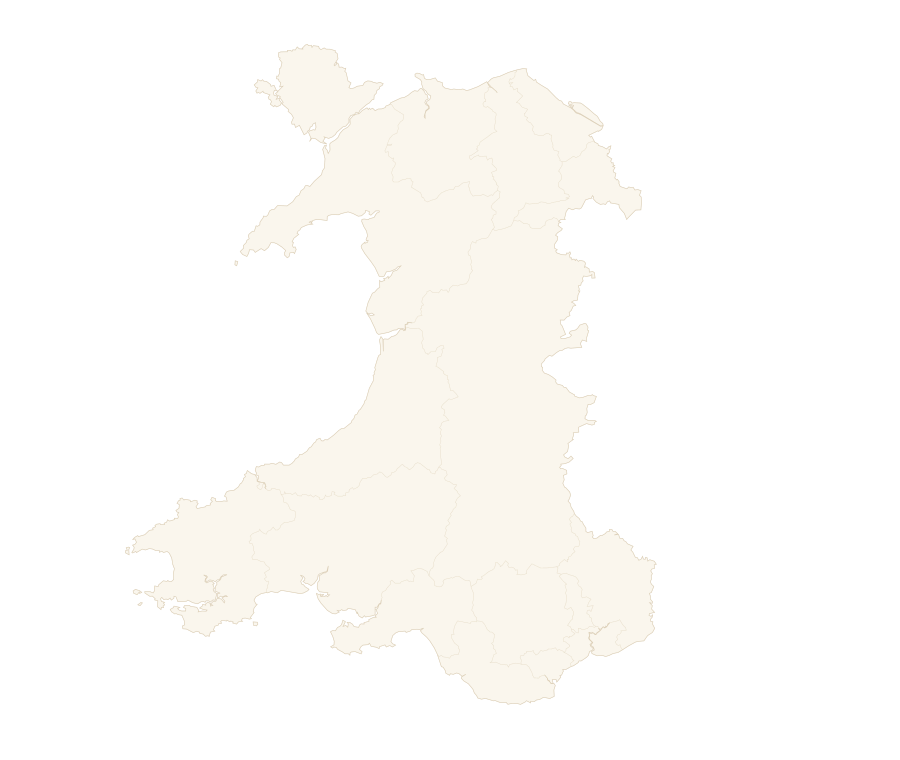
CoreHistoric reach
The seat of Morgan
Seat vacantChief
No one leads the Morgan community yet. When the movement opens, you can stand for its leadership, or help elect whoever does.
Current mission
No shared goal set yet. Once Morgan has leadership, it sets the public focus: a restoration, a gathering, a real-world project that helps its own.
The Morgan clan is being rebuilt. Join the waiting list for the movement today, and you help decide who leads it and what it does.
Help rebuild the Morgan clan →What does the Morgan name mean?
From an Old Welsh personal name, Morcant in Old Welsh, perhaps from 'môr' (sea) + 'cant' (circle, host), or 'great and bright' in another reading. It was the name of an early king of Glamorgan whose realm, Morgannwg, took his name in turn. The surname Morgan is the personal name carried hereditarily without an 'ap' prefix.
The history of Morgan
Morcant: the name that named a kingdom
Most Welsh surnames began as somebody's father's name. Morgan began as a name in its own right. It descends from the Old Welsh personal name Morcant, whose sense has never been finally settled: one reading takes it from môr, sea, and cant, circle or host; another gives it as 'great and bright'. What is not in doubt is that it was borne by an early king of Glamorgan, and that his realm took its name from him: Morgannwg, the land of Morgan. The county of Glamorgan still carries the Morgan princes of south Wales in its name.
The oldest layer of the name is Brythonic, the language spoken across Britain before the Roman invasion and the ancestor of Welsh itself. Other explanations have attached themselves over the centuries (one tradition links the name to the Cornovii, recorded in the Severn valley near the Wrekin and in the north of Scotland), but they are possible rather than proven. The name is older than Wales, and it gave its own name to a piece of it.
The Welsh name that never needed an ap
Before fixed surnames a Welshman carried his descent rather than a family name. His baptismal name was tied by ap, or ab before a vowel, to his father's: Evan son of Thomas was Evan ap Thomas, Evan's son John was John ab Evan, John's son Rees was Rees ap John. Nothing was inherited, and the chain could run back seven generations: Llewelyn ap Dafydd ab Ieuan ap Gruffudd ap Meredydd was an unremarkable way to be known. In 1292, forty-eight per cent of recorded Welsh names were patronymics, and over seventy per cent in some parishes.
Fixed surnames came in from the fifteenth century. Under Henry VIII they became hereditary among the Welsh gentry and spread slowly to commoners, earliest in the towns and where English influence was strongest. Most Welsh surnames still show the join. Some kept the ap in shortened form at the front: Powell from ap Hywel, Price from ap Rhys, Pugh from ap Hugh, Pritchard from ap Richard, Bowen from ab Owen. Most dropped the ap and took an English genitive s, which is why Jones, Roberts and Edwards are the commonest names in Wales.
Morgan did neither. It is one of the few Welsh surnames that is not a patronymic in the ap sense at all: the old personal name was carried hereditarily, unaltered, with nothing bolted on at either end. A Morgan is not the son of Morgan. He is Morgan. The usual Welsh warning still applies: the stock of Welsh surnames is small, and two families of the name in one valley cannot be assumed to share an ancestor.
Morgan ap Llewelyn and the making of Tredegar
The great landed house of the name was established about 1330 by Morgan ap Llewelyn, son of Llewelyn ap Ifor, Lord of St Clere, and of Angharad, daughter and heiress of Sir Morgan ap Maredudd, Lord of Tredegar. That marriage is the hinge: Tredegar came to the family through an heiress, and the Morgans held it for the next six centuries. It is the moment a personal name became a house.
By about 1470 the Morgans of Tredegar held Pencoed at Llanmartin in Gwent. Sir Thomas Morgan (c.1453–1510), thought likely to have fought at Bosworth in 1485, was probably the first of the family to settle there, and parts of the surviving building were likely raised by him before 1510. His grandson, another Sir Thomas, added the main range and a three-storey Tudor gatehouse between 1542 and 1565. The antiquary John Leland, riding through about 1545, called Pencoed 'a fair maner place'.
Ruperra: a king's two nights and a long fall
In 1626 Sir Thomas Morgan, steward to the Earl of Pembroke, built Ruperra at Lower Machen in what is now Caerphilly, one of the first mock castles raised in Wales, a country house dressed as a fortress. In 1645, shortly after the disaster at Naseby, Charles I spent two nights under its roof. The royal arms were added to the south porch in consequence, and the footpath from Rudry to the castle is still called the King's Drive.
It was bought for £12,400 by the wealthy John Morgan, known as 'the merchant'; he died unmarried in 1715 and the house passed into the Tredegar estates. Fire took it in 1785 and it was rebuilt as the home of the heir. Godfrey Morgan, second son of the first Baron Tredegar, was born there and survived the Charge of the Light Brigade, and in 1826 he threw an iron bridge across the Rhymney so the household could drive to church at Lower Machen.
The end came within three generations. Courtenay Morgan, first Viscount Tredegar, spent heavily on the place, then moved to Tredegar House in 1913; his son Evan preferred London and let Ruperra decay. In 1935, the fortune failing, the three-thousand-acre estate went to sale and its contents to a three-day auction. The army took the empty house in the war and fire destroyed it again in 1941. In 1956 John Morgan, sixth and last Baron Tredegar, sold castle and land during the liquidation of the estates.
The rector who kept a language alive
The most consequential Morgan who ever lived never held an acre. William Morgan (c.1545–1604) was rector of Llanrhaeadr-ym-Mochnant, on the Welsh side of the Shropshire border. Wales had been given a Welsh New Testament by William Salesbury and Bishop Richard Davies in 1567, but its Welsh was over-Latinised and a farmer could not read it aloud without stumbling. Morgan set himself to translate the whole Bible, working at it through ten winters in the parsonage.
In 1587 he carried the manuscript to London and stayed better than a year at the press, correcting every sheet himself. The book came off in 1588. He was afterwards Bishop of Llandaff and then of St Asaph, but the Bible is the monument: read aloud in the same words in every parish, Sunday after Sunday, it made Welsh a written vernacular ordinary people could hold. Cornish and Manx, which had no such book, died as community languages. Welsh did not.
Privateer, rifleman, banker: the name overseas
Sir Henry Morgan (c.1635–1688) of Llanrhymny in Glamorgan became the most successful privateer of the Caribbean wars against Spain, sacker of Portobelo, Maracaibo and Panama City. Charles II knighted him in 1674 and made him Lieutenant Governor of Jamaica. The rum bottle keeps the buccaneer; the man died a planter and a magistrate.
Daniel Morgan (c.1736–1802), born in Hunterdon County, New Jersey, to a family of Welsh descent, made himself on the Virginia frontier as a wagoner and a rifleman. His corps' fire helped break the British at Saratoga in 1777. At the Cowpens on 17 January 1781 he turned his militia's known weakness into his plan: two volleys, a deliberate withdrawal that Tarleton read as a rout, and a British charge that ran onto the waiting Continental line while the cavalry closed both flanks. Tarleton's command was destroyed in under an hour.
The banking dynasty started quietly. Miles Morgan, born at Llandaff in Glamorgan in 1616, son of the lawyer and Member of Parliament William Morgan, sailed for America at twenty and landed in the Massachusetts Bay Colony in April 1636, settling at Springfield. Five generations of farmers and militia officers followed before Joseph Morgan III went into finance at Hartford in 1812. His son Junius Spencer Morgan (1813–1890) renamed George Peabody's London house J. S. Morgan and Company in 1864, and Junius's son John Pierpont Morgan (1837–1913) became the most influential banker in America.
Ó Muireagáin, the Reay country, and where Morgans lie thickest
Not every Morgan is Welsh, and the difference matters to anyone tracing a line. In Ireland, Morgan is an anglicised form of the Gaelic Ó Muireagáin, descendant of Muireagán, a family who were lords of Teffia, in what is now County Westmeath and County Longford. That is a wholly separate descent that reached the same modern spelling by a different road, as Gaelic names generally did when they were written in English. In Scotland, Clan Morgan is the designation used for the Mackays of the Reay country, and the name is long established in Aberdeenshire, where the Pictish form is Morgunn.
The Welsh heartland is unmistakable in the record. At the census of 1881 the name was densest in Brecknockshire, at over sixteen times the national average, then Monmouthshire, Glamorgan, Carmarthenshire, Radnorshire, Montgomeryshire, Cardiganshire and Pembrokeshire, spilling over the border into Herefordshire and Shropshire. That is the old kingdom of Morgannwg and the country around it, still holding the name that named it.
Then came the coal. Glamorganshire grew from 71,000 people in 1801 to 232,000 in 1851 and 1,122,000 by 1911, and the valleys drew Morgans down from the hill parishes to Merthyr, the Rhondda and the docks at Cardiff and Newport. From those valleys they went further: to Liverpool, to Pennsylvania and Jackson County in Ohio, which was known as Little Wales, to Canada, Patagonia, Australia and New Zealand. A 2016 study for the Welsh Government counted 16.3 million people carrying a name of Welsh origin across the countries it examined. Morgan is one of the very few that was a name long before it was ever a surname.
Champions of the Morgan name
The bearers whose lives are inseparable from this surname. Each has their own page, biography, achievements, geography, connection to the family.
Historic Places, Rebuilt
Explore the streets and seats the Morgan name knew, rebuilt with AI as they stood in history.
Historic Places, Rebuilt · New
The grandest castle-palace in Wales at its height, the moated Yellow Tower, fountain courts and long gallery, on the eve of the siege.
Historic Places, Rebuilt · New
The greatest coal port on earth at its peak, the hoists and colliers, the Coal Exchange and the streets of Tiger Bay.
Castles the Morgan held
Strongholds this name held for a decade or more, look one up, or rebuild it to explore.
- Ruperra Castle
Built by Sir Thomas Morgan in 1626; held within the Morgan family's Tredegar estates until sold in 1956.
- Pencoed Castle
Held by the Morgans of Tredegar from about 1470; Sir Thomas Morgan (c.1453–1510) was probably the first of the family to settle at Pencoed.
The castles of the homeland
The great strongholds of the homeland, look one up, see what it looked like in its prime, and recreate it to explore.
 Caernarfon CastleRestored · prime 1330
 Conwy CastleRuin · prime 1287
 Pembroke CastleRestored · prime 1280
All castles in Wales → · Strongest castles in Wales → · Castles of Europe
Play As Your Clan
Hold a real castle against whatever you choose to send at it, take a ship out in her own service years, or stand at the shoulder of someone the record remembers. The chronicler sets the scene; the deeds are yours.
Notable bearers of the Morgan name
- Sir Henry Morgan (c.1635–1688), privateer, Lieutenant Governor of Jamaica
- William Morgan (c.1545–1604), Bishop, translator of the Welsh Bible (1588)
- J. P. Morgan (1837–1913), American financier of distant Welsh-Glamorgan ancestry