Bevan
also ab Evan
ab Evan, the contracted patronymic that built the National Health Service.
- Origin
- Morgannwg, Wales
- Famous bearer
- Aneurin 'Nye' Bevan (1897–1960), founder of the National Health Service
- Register
- Welsh family
Where the Bevan name comes from
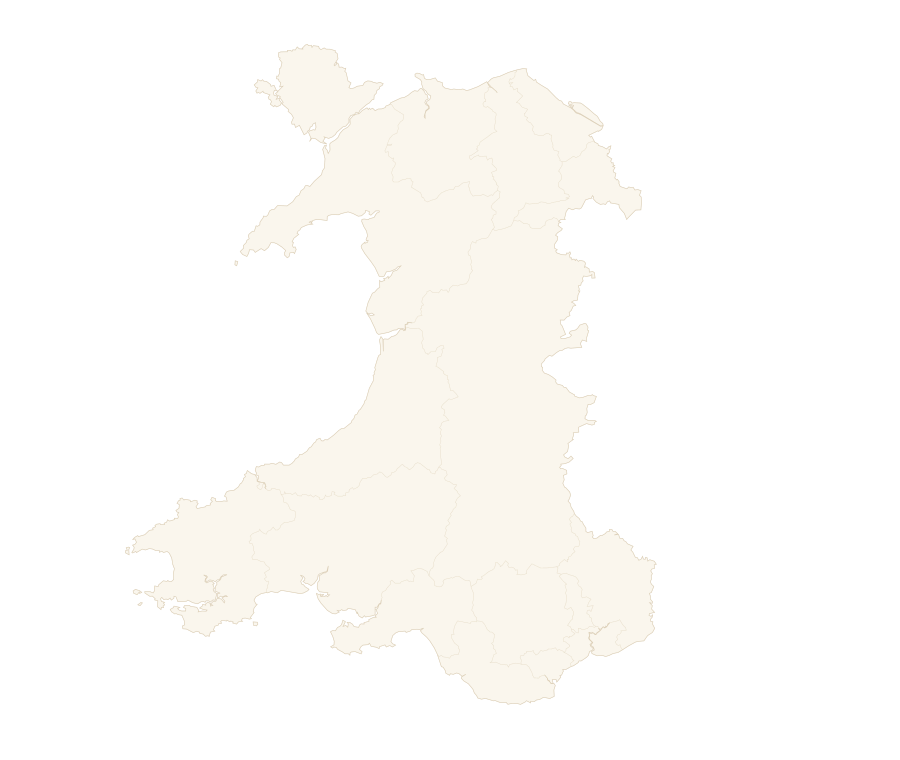
CoreHistoric reach
The seat of Bevan
Seat vacantChief
No one leads the Bevan community yet. When the movement opens, you can stand for its leadership, or help elect whoever does.
Current mission
No shared goal set yet. Once Bevan has leadership, it sets the public focus: a restoration, a gathering, a real-world project that helps its own.
The Bevan clan is being rebuilt. Join the waiting list for the movement today, and you help decide who leads it and what it does.
Help rebuild the Bevan clan →What does the Bevan name mean?
ab Evan, son of Evan (Welsh Ifan, Evan being the anglicised form). 'Ab' is the form the patronymic prefix takes before a vowel; 'ap' is used before a consonant. The 'a' elides in spoken Welsh and the surviving 'b-' attaches to the personal name as a hereditary surname. By the same mechanism Bowen comes from ab Owain, Bythel from ab Ithel, and so on. The full set of B- and P- patronymics in Welsh is the spoken contraction made permanent by Tudor-era surname compression.
The history of Bevan
The letter that used to be a whole word
Bevan begins with a fossil. The b at the head of it was never part of Evan; it is what survives of ab, the Welsh for 'son of'. The prefix took two shapes, ap before a consonant and ab before a vowel, and because Evan opens with a vowel, the son of a man called Evan was John ab Evan. Said quickly, the a wore away and the b slid forward onto the name behind it until the two words closed into one. Bevan is that closure, caught at the moment Welsh families stopped renaming themselves every generation.
Most Welsh names went the other way: when fixed surnames came in the ap was usually dropped, and the commonest forms in the country became those built by adding an s to a father's name, Jones, Roberts, Edwards. A smaller set kept the prefix, reduced to the consonant it had worn to, and lines up one for one with the forenames behind it: ap Hywel to Powell, ap Rhys to Price, ap Richard to Pritchard, ap Hugh to Pugh, ab Owain to Bowen. Bevan is the plainest of them. An Evans is Evan's son with an English possessive on the end; a Bevan is Evan's son with the Welsh word for son still attached at the front.
Evan ap Thomas, John ab Evan, Rees ap John
Before the surnames froze, Wales ran a patronymic system and ran it deep. A baptismal name was linked by ap, ab or ferch ('daughter of') to the father's baptismal name, so Evan, son of Thomas, was Evan ap Thomas; Evan's son John was John ab Evan; and John's son Rees was Rees ap John. Nothing was inherited: each generation's second name was the last generation's first. The standard example of the system produces John ab Evan at its middle link, which is Bevan one step before it hardened.
The generation in which the name stopped moving
Fixed surnames were taken up in Wales from the fifteenth century onwards, hereditary among the gentry in the reign of Henry VIII and spreading slowly to commoners. The change did not reach everywhere at once: town families, the wealthy and the districts under strong English influence had given up patronymics earlier, while some rural districts were still using them in the early nineteenth century.
That unevenness is the story of a name like Bevan. Which surname a family ended with was an accident of the generation in which its naming stopped. A household still calling itself ab Evan when the freeze reached it carried Bevan out of that century and never lost it; one whose freeze fell a generation later, or to a clerk with the other habit, came out as Evans. Where the old system lasted longest the name went on being newly made for centuries after the gentry had settled theirs.
Why two Bevans are usually not cousins
The stock of Welsh surnames is famously small, partly because the pool of baptismal names shrank after the Protestant Reformation: fewer forenames feeding a system that turns forenames into surnames produces very few surnames. Welsh communities contain families of the same surname who are not related at all, and it cannot be assumed that two people of one Welsh name, even in a single village, took it from a common ancestor.
Bevan is subject to that rule exactly. It was minted independently wherever a man named Evan had a son at the moment the naming froze, in as many parishes as there were Evans; two Bevan lines should be treated as unrelated until documents actually join them.
Gwent, the Sirhowy and the coal country
Bevan is one of the smaller B-family patronymics, densest in the south Welsh valleys and in Gwent. The ground it holds runs from Torfaen and Newport across to Cardiff and Swansea and up into Powys, coal country by the nineteenth century, with Cardiff one of the world's largest coal-exporting ports. That is the district the name came out of, and it is where the one Bevan everybody has heard of was born.
32 Charles Street, Tredegar
Aneurin Bevan was born at 32 Charles Street in Tredegar, in the Sirhowy Valley of Monmouthshire, on 15 November 1897, sixth of the ten children of David Bevan, a hewer at the Pochin colliery and a Baptist Sunday-school superintendent, and Phoebe Prothero, daughter of a Tredegar blacksmith. He left Sirhowy Elementary School at thirteen with a poor reading record and a severe stammer, and in his fourteenth year was bound apprentice to the haulier section at the Ty-Tryst colliery.
What he did with his evenings decided the rest. At the Tredegar Workmen's Institute Library he read his way through the Marxism, the syndicalism and the Christian socialism circulating in the South Wales coalfield. He took a scholarship to the Central Labour College in London from 1919 to 1921, came back to Tredegar as a checkweighman and union official, and was elected to Tredegar Urban District Council in 1922 and Monmouthshire County Council in 1928.
The member for Ebbw Vale
At the general election of May 1929, in his thirty-second year, he was elected Labour member for Ebbw Vale, and held the seat for the next thirty-one years. He sat through the first Labour government of 1929 to 1931, the National Government decade of the 1930s and the wartime coalition, and became the most powerful platform orator on the Labour benches and the principal parliamentary champion of the South Wales mining communities.
He was also the leading parliamentary opponent of Winston Churchill's conduct of the home front and of press censorship. Their exchanges at the despatch box between 1940 and 1945 are central documents of British wartime parliamentary scrutiny: a collier's son from the Sirhowy questioning the wartime prime minister and being answered.
The fifth of July 1948
In July 1945 Labour won its first majority government in British history under Clement Attlee, and on 26 July, in his forty-seventh year, Bevan was appointed Minister of Health and Minister of Housing. He set out from the first day on the thing he had come into Parliament to do: a universal, tax-funded health service free at the point of use to every resident of the United Kingdom. The National Health Service Act was drafted through 1945 and 1946 and steered by him through the Commons.
It brought the voluntary and municipal hospitals, some 2,700 of them, into unified state ownership, and every doctor, dentist, nurse, midwife and pharmacist into one national service providing every form of medical care free of charge. The doctors resisted for eighteen months and he negotiated them in, with a line he never troubled to disown: 'I stuffed their mouths with gold.' The service came into operation across the United Kingdom on 5 July 1948, the largest single act of social provision in British history.
He stayed at Health until January 1951, took the Ministry of Labour for three months, and resigned from the Cabinet that April rather than accept charges for NHS spectacles and dental treatment. He was Deputy Leader of the Labour Party from 1959 and died at Asheridge Farm near Chesham in Buckinghamshire on 6 July 1960. His widow Jennie Lee, Baroness Lee of Asheridge, went on as Minister for the Arts under Wilson to found the Open University. The service has run without interruption since: its English component alone employs over one and a half million people and treats roughly a million patients every thirty-six hours. That is a considerable thing for one small Welsh patronymic to be attached to, and the name carrying it is still, letter for letter, ab Evan.
Champions of the Bevan name
The bearers whose lives are inseparable from this surname. Each has their own page, biography, achievements, geography, connection to the family.
Historic Places, Rebuilt
Explore the streets and seats the Bevan name knew, rebuilt with AI as they stood in history.
Historic Places, Rebuilt · New
The grandest castle-palace in Wales at its height, the moated Yellow Tower, fountain courts and long gallery, on the eve of the siege.
Historic Places, Rebuilt · New
The greatest coal port on earth at its peak, the hoists and colliers, the Coal Exchange and the streets of Tiger Bay.
The castles of the homeland
The great strongholds of the homeland, look one up, see what it looked like in its prime, and recreate it to explore.
 Caernarfon CastleRestored · prime 1330
 Conwy CastleRuin · prime 1287
 Pembroke CastleRestored · prime 1280
All castles in Wales → · Strongest castles in Wales → · Castles of Europe
Play As Your Clan
Hold a real castle against whatever you choose to send at it, take a ship out in her own service years, or stand at the shoulder of someone the record remembers. The chronicler sets the scene; the deeds are yours.
Notable bearers of the Bevan name
- Aneurin 'Nye' Bevan (1897–1960), founder of the National Health Service
- Jennie Lee, Baroness Lee of Asheridge (1904–1988), founder of the Open University
Stories of Bevan
Frequently asked
What does the surname Bevan mean?
Where does the Bevan family come from?
Where did the Bevan family historically hold territory?
Is Bevan Welsh or English?
How old is the Bevan surname?
What is the Bevan family known for?
Is there a Bevan family crest or coat of arms?
Who is the most famous Bevan?
Who are some famous Bevans?
What stories are told about the Bevan family?
What is the story of Tredegar to the NHS?
Is ab Evan the same family as Bevan?
Where is the Bevan surname found today?
What does the Clan Rising page for the Bevan family cover?
Who is the head of the Bevan family today?
Neighbouring clans
- JonesSon of John, and roughly one in twenty Welsh-descended people in the world.
- LewisLlywelyn anglicised, a princely name carried into common use across the Marches and the south.
- MorganThe name that named a kingdom, Morgannwg's enduring patronym.
- Powellap Hywel, the contracted patronymic that descends from Hywel Dda, the king who wrote Welsh law.