Jones
Son of John, and roughly one in twenty Welsh-descended people in the world.
- Origin
- Morgannwg, Wales
- Famous bearer
- Mary Jones (1784–1864), walked twenty-six miles barefoot to buy a Welsh Bible at Bala, prompting the founding of the British and Foreign Bible Society
- Register
- Welsh family
The Jones arms and country

Coat of armsEscutcheon of the Jones baronets of Treeton (1919)Borne by the Treeton line, one branch of the name rather than all of it.Charles Matthews · CC BY-SA 4.0 
Coat of armsEscutcheon of the Jones baronets of Albemarlis (1643)Borne by the Albemarlis line, one branch of the name rather than all of it.Charles Matthews · CC BY-SA 4.0
.svg)
.svg)
- Coat of arms: Granted to an individual and inherited down that one documented line. These are the arms of particular families of the name, not of everyone who shares the surname.
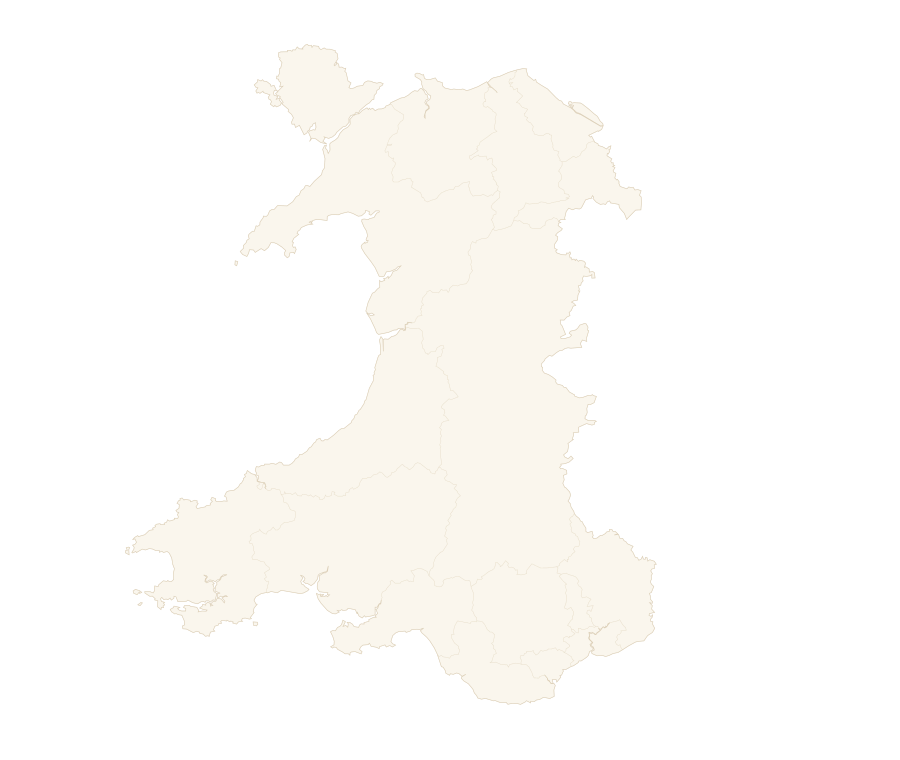
CoreHistoric reach
The seat of Jones
Seat vacantChief
No one leads the Jones community yet. When the movement opens, you can stand for its leadership, or help elect whoever does.
Current mission
No shared goal set yet. Once Jones has leadership, it sets the public focus: a restoration, a gathering, a real-world project that helps its own.
The Jones clan is being rebuilt. Join the waiting list for the movement today, and you help decide who leads it and what it does.
Help rebuild the Jones clan →What does the Jones name mean?
Son of John. The Welsh patronymic 'ap' (or 'ab' before a vowel) means 'son of', and 'ferch' means 'daughter of'. A man's name was rebuilt every generation, Dafydd ap John ap Hywel, until the Acts of Union of 1536–1543 and the Tudor administration that followed it forced single hereditary surnames on every household. Sons of John, of whom there were a great many, became Joneses overnight, the genitive 's' added in the English fashion.
The history of Jones
Dafydd ap John: a name rebuilt every generation
Before the Tudors a Welshman carried no family name. He carried his ancestry. His baptismal name was linked by ap, or ab before a vowel, to his father's: Evan, son of Thomas, was Evan ap Thomas; Evan's son John was John ab Evan; John's son Rees was Rees ap John. A daughter was ferch, daughter of. Nothing was inherited. In 1292 forty-eight per cent of recorded Welsh names were patronymics, over seventy per cent in some parishes.
The chain did not stop at the father. Names like Llewelyn ap Dafydd ab Ieuan ap Gruffudd ap Meredydd were unremarkable, running back perhaps seven generations, a genealogy of the male line spoken aloud. Under Welsh law, standing and entitlement ran through descent from a common ancestor, so a man's name was the legal document he carried in his mouth. As that law decayed, so did the reason for the chain.
The clerk, the Act, and the death of the ap
Fixed surnames were adopted in Wales from the 15th century onwards, and under Henry VIII they became hereditary among the gentry before spreading slowly to commoners. What settled it was paperwork. Around the Laws in Wales Acts of 1536 to 1543 English was the official language of the state, every official document had to be in English, and a clerk needed one fixed name per household, not a recital of grandfathers. So ap Siôn was written as Jones, ap Dafydd as Davies, ap Gwilym as Williams.
The Jones spelling already existed across the border, from Jone, a variant of John, plus the English genitive s; a Matilda Jones is on record as early as 1273. Welsh fathers named John were poured into a mould already cut. Not every ap vanished (Powell is ap Hywel, Price is ap Rhys, Pugh is ap Hugh, Bowen is ab Owen), and in remote parishes patronymics were still in use in the early 19th century.
Why so few names cover so many people
The stock of Welsh surnames is small, and that is a consequence rather than an accident. The names were built from baptismal names, and after the Protestant Reformation the variety of baptismal names shrank. A narrow pool of first names, frozen across a country within a few generations, made a narrow pool of surnames: Evans, Jones, Williams, Davies and Thomas were all still in the top ten recorded in England and Wales in 2000.
For anyone tracing a line the consequence is blunt: two people named Jones, even in the same village, cannot be assumed to share an ancestor. Around 200,000 people in Wales carry the name, 5.75 per cent of the population, and about 450,000 in England. Jones is not a house or a clan. It is the signature of a nation being registered.
Jones the Bread, Jones the Post
Industry concentrated the name. The population of Wales rose from 587,000 in 1801 to 2,421,000 by 1911, most of it in the coal districts. Carmarthenshire and the South Wales coalfield, drawing labour out of every parish in the country, became the densest Jones country on earth, and by the 1850s roughly a sixth of the Welsh population bore the name.
Census-takers in Merthyr Tydfil answered the problem by writing the trade into the name (Jones the Bread, Jones the Post, Jones the Coal) because there was no other way to tell one household from the next, and the convention survives in speech.
Bala, a barefoot girl, and a colony on the Chubut
Two Joneses changed what the Welsh language could reach. In 1800 Mary Jones (1784 to 1864), sixteen years old and six years saving, walked twenty-six miles barefoot from her hill farm to Bala to buy a Welsh Bible from the Reverend Thomas Charles. What he did that afternoon led four years later to the founding of the British and Foreign Bible Society, and within a generation to scripture printed in more than two hundred languages.
Michael Daniel Jones (1822 to 1898) of Llanuwchllyn watched the Welsh of Cincinnati lose the language within a generation. Principal of the Bala Independent College from 1855, he concluded from 1858 that Welsh needed ground of its own, and negotiated with the Argentine government for the Chubut Valley in Patagonia. The tea-clipper Mimosa left Liverpool on 25 May 1865 with a hundred and fifty-three settlers and landed on 28 July. He never sailed himself; he raised the money and kept the near-failing colony alive from the chapels of north Wales. Welsh has been spoken on the Chubut ever since.
Joneses in stone, and Joneses abroad
Inigo Jones (1573 to 1652) gave England its classical vocabulary, above all in the Banqueting House on Whitehall, completed in 1622 and now the principal surviving fragment of the Palace of Whitehall. The name took land as well. Fonmon Castle in the Vale of Glamorgan is believed to have had only two owning families in its history: the St Johns from Norman times, and from 1656 the Parliamentarian Colonel Philip Jones and his descendants, who held it until 1917.
The name went out with the ships and the pit work, to Pennsylvania, to Jackson County in Ohio once called Little Wales, to the chapel cities of the diaspora. A study commissioned by the Welsh Government found 718,000 people in Wales, nearly 35 per cent, carrying a family name of Welsh origin, against 4.7 per cent in New Zealand, 4.1 per cent in Australia and 3.8 per cent in the United States: 16.3 million people across the countries studied. If your name is Jones you are in that number, and the reason is a clerk with an English form and a country that would not stop speaking Welsh.
Champions of the Jones name
The bearers whose lives are inseparable from this surname. Each has their own page, biography, achievements, geography, connection to the family.
Historic Places, Rebuilt
Explore the streets and seats the Jones name knew, rebuilt with AI as they stood in history.
Historic Places, Rebuilt · New
Edward I's walled bastide and mighty castle in North Wales, a generation after the conquest, the banded towers still rising.
Historic Places, Rebuilt · New
Owain Glyndŵr's mountain fortress and court at the high tide of Welsh independence, the English siege lines gathering below.
Historic Places, Rebuilt · New
The grandest castle-palace in Wales at its height, the moated Yellow Tower, fountain courts and long gallery, on the eve of the siege.
Historic Places, Rebuilt · New
The greatest coal port on earth at its peak, the hoists and colliers, the Coal Exchange and the streets of Tiger Bay.
Castles the Jones held
Strongholds this name held for a decade or more, look one up, or rebuild it to explore.
- Fonmon Castle
Held by Colonel Philip Jones and his descendants, 1656–1917.
The castles of the homeland
The great strongholds of the homeland, look one up, see what it looked like in its prime, and recreate it to explore.
 Caernarfon CastleRestored · prime 1330
 Conwy CastleRuin · prime 1287
 Pembroke CastleRestored · prime 1280
All castles in Wales → · Strongest castles in Wales → · Castles of Europe
Play As Your Clan
Hold a real castle against whatever you choose to send at it, take a ship out in her own service years, or stand at the shoulder of someone the record remembers. The chronicler sets the scene; the deeds are yours.
Notable bearers of the Jones name
- Mary Jones (1784–1864), walked twenty-six miles barefoot to buy a Welsh Bible at Bala, prompting the founding of the British and Foreign Bible Society
- Inigo Jones (1573–1652), architect of the Banqueting House at Whitehall
Stories of Jones
Mary Jones and her Bible
1800In 1800, a sixteen-year-old girl from a hill farm in Snowdonia walked twenty-six miles barefoot to a Welsh market town to ask the local minister for a Bible in her own language. She had spent six years saving for it. Welsh-language Bibles in that decade were almost unobtainable; what few existed were the property of chapels and the gentry. The minister, the Reverend Thomas Charles of Bala, had three left, and three families had already spoken for them. What he decided to do that afternoon led, four years later, to the founding of the British and Foreign Bible Society, and within a generation to the printing of scripture in over two hundred languages worldwide.
Read the story →
Michael D. Jones and Welsh Patagonia
1865On the twenty-eighth of July 1865, the converted tea-clipper Mimosa dropped anchor in the open bay of Puerto Madryn on the Atlantic coast of Patagonia, in the southern Argentine territory of Chubut, after a fifty-eight-day voyage from Liverpool. On board were one hundred and fifty-three Welsh-speaking emigrants, principally from Carnarvon, Bala, and the south-Wales mining valleys, together with a Patagonian-Spanish navigator and a Welsh Calvinistic Methodist minister. The expedition was the founding settlement of Y Wladfa, the colony, the deliberate establishment of a Welsh-speaking polity outside Britain in a country where the Welsh language and the Welsh chapel might be free of English administrative pressure. The architect of the project was the Reverend Michael Daniel Jones (1822–1898), Principal of the Calvinistic Methodist seminary at Bala, son of the Mary Jones minister Thomas Charles's successor, who had spent eight years (1858–1865) lecturing, fundraising and negotiating with the Argentine government to secure the colonisation grant. The colony was a precarious near-failure for a decade, then took root, and by the early twentieth century was a thriving bilingual community of about ten thousand. By the early twenty-first century, Welsh remains a language of about five thousand inhabitants of the lower Chubut valley, the small towns of Trelew, Gaiman, Trevelin, and the Andean foothills around Esquel.
Read the story →
Frequently asked
What does the surname Jones mean?
Where does the Jones family come from?
Where did the Jones family historically hold territory?
Is Jones Welsh or English?
How old is the Jones surname?
What is the Jones family known for?
Is there a Jones family crest or coat of arms?
Who is the most famous Jones?
Who are some famous Joneses?
What stories are told about the Jones family?
What is the story of Mary Jones and her Bible?
Where is the Jones surname found today?
What does the Clan Rising page for the Jones family cover?
Who is the head of the Jones family today?
Neighbouring clans
- DaviesSon of David, born of the patron saint's name and densest in his own corner of Wales.
- ThomasThe fifth Welsh surname, son of Thomas, on the same Tudor-era road as Jones and Williams.
- MorganThe name that named a kingdom, Morgannwg's enduring patronym.
- Bevanab Evan, the contracted patronymic that built the National Health Service.