Thomas
The fifth Welsh surname, son of Thomas, on the same Tudor-era road as Jones and Williams.
- Origin
- Morgannwg, Wales
- Famous bearer
- Edward Thomas (1878–1917), poet, killed in action at Arras
- Register
- Welsh family
The Thomas arms and country

Coat of armsThomas of Macclesfield EscutcheonBorne by the Macclesfield Escutcheon line, one branch of the name rather than all of it.Robin S. Taylor · CC BY-SA 4.0 
Coat of armsArmorial Bearings of the THOMAS family of Cowarne Court, HerefordshireBorne by the Cowarne Court line, one branch of the name rather than all of it.Rs-nourse · CC BY-SA 4.0


- Coat of arms: Granted to an individual and inherited down that one documented line. These are the arms of particular families of the name, not of everyone who shares the surname.
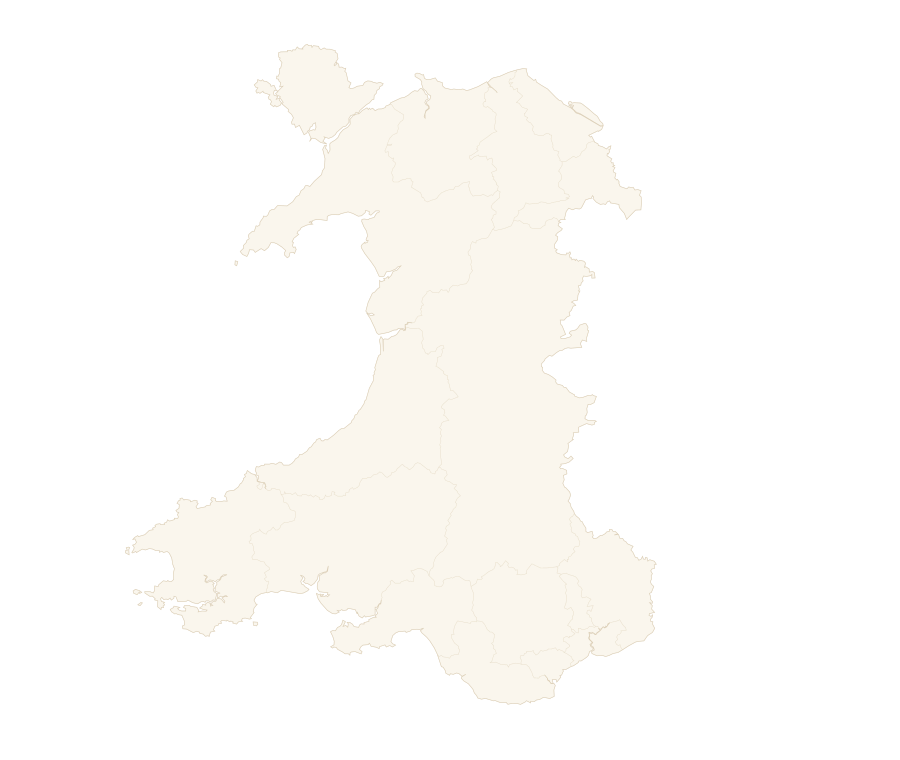
CoreHistoric reach
The seat of Thomas
Seat vacantChief
No one leads the Thomas community yet. When the movement opens, you can stand for its leadership, or help elect whoever does.
Current mission
No shared goal set yet. Once Thomas has leadership, it sets the public focus: a restoration, a gathering, a real-world project that helps its own.
The Thomas clan is being rebuilt. Join the waiting list for the movement today, and you help decide who leads it and what it does.
Help rebuild the Thomas clan →What does the Thomas name mean?
Son of Thomas. The Welsh patronymic 'ap Tomas' compressed without taking the English genitive 's'. Thomas as a baptismal name spread across Wales through the medieval church, particularly through the Cistercian houses of Strata Florida and Strata Marcella, and the patronymic followed.
The history of Thomas
The twin, and the doubt
Thomas comes from a medieval personal name of Biblical origin, from the Hebrew t'om'a, a byname meaning 'twin'. It was borne by one of the disciples of Christ, and that disciple is remembered above all for his scepticism about the resurrection, the refusal to believe until he had put his hand in the wound, set down in the twentieth chapter of John. Of the twelve, he is the one who asked for evidence.
The spelling is a fossil of two journeys. The th- exists because the first letter of the name in the Greek New Testament is a theta, copied into the Latin alphabet. The English pronunciation as a plain t rather than a dental fricative comes from French influence at an early date: Norman mouths, saying the name the way France still says it. The surname on the mailbox in Ohio or Otago was spelled by Greeks and pronounced by Frenchmen before a single Welshman ever wrote it down.
How an apostle's name reached the Welsh font
No patronymic surname exists until the baptismal name behind it is common, and Thomas became common in Wales because the medieval church made it so. It spread through the Welsh dioceses with the religious houses, particularly the Cistercian foundations of Strata Florida in Ceredigion and Strata Marcella in Powys, whose reach over the surrounding parishes ran far beyond their own walls. Priests named children; children grew into fathers; fathers became the second half of their sons' names.
Wales was not doing anything unusual. Across Latin Christendom the name had become standard among the educated and the well born. Thomas Aquinas (1225-1274), the Italian Dominican friar and philosopher, was made a Doctor of the Church; the first known Bishop of Finland, who died in 1248, was a Thomas, as was the Earl of Mar (1330-1377) in Aberdeen, and the Saint Thomas Christian families of Kerala in southern India carry the same apostle's name to this day. So Thomas is not the badge of one household that rose. It is the mark of a name so ordinary in the parish register, for so many centuries, that when Wales was finally forced to freeze its names there were Thomases waiting in every valley.
ap Tomos, and the s that never came
Before fixed surnames a Welshman's name was a genealogy, his baptismal name linked by ap, or ab before a vowel, to his father's: Evan, son of Thomas, was Evan ap Thomas. In 1292, forty-eight per cent of recorded Welsh names were patronymics, over seventy per cent in some parishes, and the chains could run seven generations deep, because under Welsh law descent from a common ancestor decided what a man was entitled to.
Fixed surnames were adopted from the fifteenth century onwards, became hereditary among the Welsh gentry under Henry VIII, and spread slowly to everyone else after Wales was brought into union with England in 1536. Where the ap survived it fused to the front of the name (Powell from ap Hywel, Price from ap Rhys, Bowen from ab Owen) and where it did not, it was dropped.
Here is where Thomas parts company with its neighbours. The commonest modern Welsh surnames were made by adding an English genitive s to the father's name: Jones, Roberts, Edwards, Williams, Davies. Thomas mostly did not take it. ap Tomos compressed to the bare baptismal name and stopped, leaving Welsh Thomases with a surname spelled exactly like the English and Cornish one, one reason the name is spread right across Britain rather than banked up behind Offa's Dyke, and is especially common in Cornwall as well as Wales.
Five names for a nation, and no shared grandfather
The stock of Welsh surnames is famously small, for a reason beyond the patronymic system: after the Protestant Reformation the variety of baptismal names in use fell sharply. A narrow pool of first names, frozen into surnames within a few generations, gave a narrow pool of surnames: Evans, Jones, Williams, Davies and Thomas were all still in the top ten recorded across England and Wales in 2000, and Thomas remains the ninth most common surname in the United Kingdom.
The consequence for anyone tracing a line is blunt. Because most Welsh surnames come from a handful of baptismal names, Welsh communities contain families of the same surname who are not related at all: two Thomases in one parish cannot be assumed to share an ancestor. Your line is real, but it has to be found in registers, not deduced from the name.
Wales felt the crowding itself: in the nineteenth century a fashion began for double surnames, prefixing a house, a parish or the mother's family to the patronymic to tell people apart, as the Welsh politician Dafydd Elis-Thomas (1946-2025) still shows.
West of the Landsker: where the Thomases are thickest
Thomas is one of the top five Welsh surnames and it is not spread evenly. Its density is highest in west and south-west Wales (Carmarthenshire, Ceredigion, Pembrokeshire and the Swansea country), the ground that has held the language hardest. In Pembrokeshire the Norman settlement even left a border inside the county, the Landsker Line dividing the English-speaking Englishry of the south from the Welsh Welshry of the north. In the census, the highest proportions writing themselves in as Welsh were in Gwynedd at twenty-seven per cent, Carmarthenshire at twenty-three, Ceredigion at twenty-two and Anglesey at nineteen.
Then industry pulled the name east and south. Glamorganshire grew from 71,000 people in 1801 to 232,000 by 1851 and 1,122,000 by 1911, most of that in the coal districts, drawing labour out of every rural parish in Wales. Thomas families came down from the west into the Valleys and Cardiff, and it is from that industrial spine that most of the name's later emigration ran.
Wenvoe and Pen-y-bryn: the Thomases who took land
A patronymic surname rarely anchors to a house, which makes the Glamorgan Thomases worth knowing. In 1553 Rhys Thomas and his wife Jane acquired Pen-y-bryn from the Crown, in the years when Welsh families were turning Tudor land settlements into estates of their own.
Seven years later the name attached itself to Wenvoe Castle in the Vale of Glamorgan, held by the Thomas family from 1560 until debts forced its sale in 1774: two hundred and fourteen years, from the reign of Elizabeth to the eve of the American Revolution. The name sat in politics through the Civil War century too, with Edmund Thomas (1633-1677) remembered as a Welsh parliamentarian.
Three poets, none of them related
No other Welsh surname did to twentieth-century poetry in English what Thomas did, and the three men who did it shared nothing but the name. Dylan Thomas (1914-1953), born in Swansea, wrote Fern Hill and the 1951 villanelle Do Not Go Gentle into That Good Night; Deaths and Entrances (1946) put a fresh lyric voice in front of the post-war reader, and his radio play Under Milk Wood, broadcast in 1954, is one of the central works of the BBC Third Programme. More than any other writer, he fixed the image of Welsh Nonconformist village life in the English literary imagination.
R. S. Thomas (1913-2000), born in Cardiff, was the counter-image: an Anglican priest in upland parishes who became, in the second half of his life, a militant Welsh-language nationalist, and who wrote (in English, and under a permanent sense of linguistic loss) the Wales of hill farms and emptying chapels. Between the two of them, the pretty Wales and the bare one, sits most of what the world thinks it knows about the country.
Before either of them there was Edward Thomas (1878-1917), who came to poetry late and was killed in action at Arras. Three men, one surname, no common ancestor, which is the whole point of a patronymic name, and no small thing to inherit.
The name that left: Thomas beyond Wales
Thomas is a surname of English, Welsh, Irish, Scottish, French, German, Dutch and Danish origin, because the apostle's name was baptised into every one of those churches. In France it is the third most widespread surname of all, after Martin and Bernard, carried by more than a hundred thousand people, and it gave the opera composer Ambroise Thomas (1811-1896). In the 1990 United States Census it was the twelfth most common surname in the country, held by 0.3 per cent of the population.
The Welsh line of it travelled its own routes. Families went to Pennsylvania and to Y Wladfa in Patagonia; in 1819 the ship Albion sailed from Cardigan for New Brunswick with twenty-seven Cardiganshire families aboard, most of them farmers, out of the very county where the name is thickest; later in the century contract miners from Wales settled in the coal towns of the Pas-de-Calais and clustered around their own chapels. Around 1.75 million Americans now report Welsh ancestry, along with 458,705 Canadians in the 2011 census, against 2.9 million people living in Wales itself.
The bearers went with them. Morgan Thomas (1824-1903) became a surgeon and public benefactor in Australia; Algernon Thomas (1857-1937) an academic in New Zealand; Sir George Thomas (1881-1972) was a chess champion and badminton player. At home the name kept filling the national teams, from the rugby internationals Clem Thomas (1929-1996) and Delme Thomas (born 1942) to the cyclist Geraint Thomas (born 1986).
That is the inheritance: an apostle's name carried into Wales by monks, worn as ap Tomos through centuries when a name was a genealogy spoken aloud, frozen bare when the clerks came, thickened in the west, poured into the coalfield and shipped to four continents. Not one family. A country's worth of them.
Champions of the Thomas name
The bearers whose lives are inseparable from this surname. Each has their own page, biography, achievements, geography, connection to the family.
Historic Places, Rebuilt
Explore the streets and seats the Thomas name knew, rebuilt with AI as they stood in history.
Historic Places, Rebuilt · New
Edward I's walled bastide and mighty castle in North Wales, a generation after the conquest, the banded towers still rising.
Historic Places, Rebuilt · New
Owain Glyndŵr's mountain fortress and court at the high tide of Welsh independence, the English siege lines gathering below.
Historic Places, Rebuilt · New
The grandest castle-palace in Wales at its height, the moated Yellow Tower, fountain courts and long gallery, on the eve of the siege.
Historic Places, Rebuilt · New
The greatest coal port on earth at its peak, the hoists and colliers, the Coal Exchange and the streets of Tiger Bay.
Castles the Thomas held
Strongholds this name held for a decade or more, look one up, or rebuild it to explore.
- Wenvoe Castle
Held by the Thomas family from 1560 until debts forced its sale in 1774.
- Pen y Bryn
Rhys Thomas and his wife Jane acquired the house from the Crown in 1553.
The castles of the homeland
The great strongholds of the homeland, look one up, see what it looked like in its prime, and recreate it to explore.
 Caernarfon CastleRestored · prime 1330
 Conwy CastleRuin · prime 1287
 Pembroke CastleRestored · prime 1280
All castles in Wales → · Strongest castles in Wales → · Castles of Europe
Play As Your Clan
Hold a real castle against whatever you choose to send at it, take a ship out in her own service years, or stand at the shoulder of someone the record remembers. The chronicler sets the scene; the deeds are yours.
Notable bearers of the Thomas name
- Edward Thomas (1878–1917), poet, killed in action at Arras
- Dylan Thomas (1914–1953), poet
- R. S. Thomas (1913–2000), priest and poet
- Sir George Thomas (1881–1972), chess champion and badminton player
Stories of Thomas
Frequently asked
What does the surname Thomas mean?
Where does the Thomas family come from?
Where did the Thomas family historically hold territory?
Is Thomas Welsh or English?
How old is the Thomas surname?
What is the Thomas family known for?
Is there a Thomas family crest or coat of arms?
Who is the most famous Thomas?
Who are some famous Thomases?
What stories are told about the Thomas family?
What is the story of Edward Thomas at Arras?
Where is the Thomas surname found today?
What does the Clan Rising page for the Thomas family cover?
Who is the head of the Thomas family today?
Neighbouring clans
- JonesSon of John, and roughly one in twenty Welsh-descended people in the world.
- DaviesSon of David, born of the patron saint's name and densest in his own corner of Wales.
- ReesFrom Rhys, the name of the most consequential prince of 12th-century Wales.
- RichardsSon of Richard, the -s patronymic that crossed the Marches.