Richards
also Richardes
Son of Richard, the -s patronymic that crossed the Marches.
- Origin
- Morgannwg, Wales
- Famous bearer
- Henry Brinley Richards (1817-1885), composer of God Bless the Prince of Wales
- Register
- Welsh family
The Richards arms and country

Coat of armsArms of Richards of Brambletye HouseBorne by the Brambletye House line, one branch of the name rather than all of it.Aergia · CC BY-SA 4.0

- Coat of arms: Granted to an individual and inherited down that one documented line. These are the arms of particular families of the name, not of everyone who shares the surname.
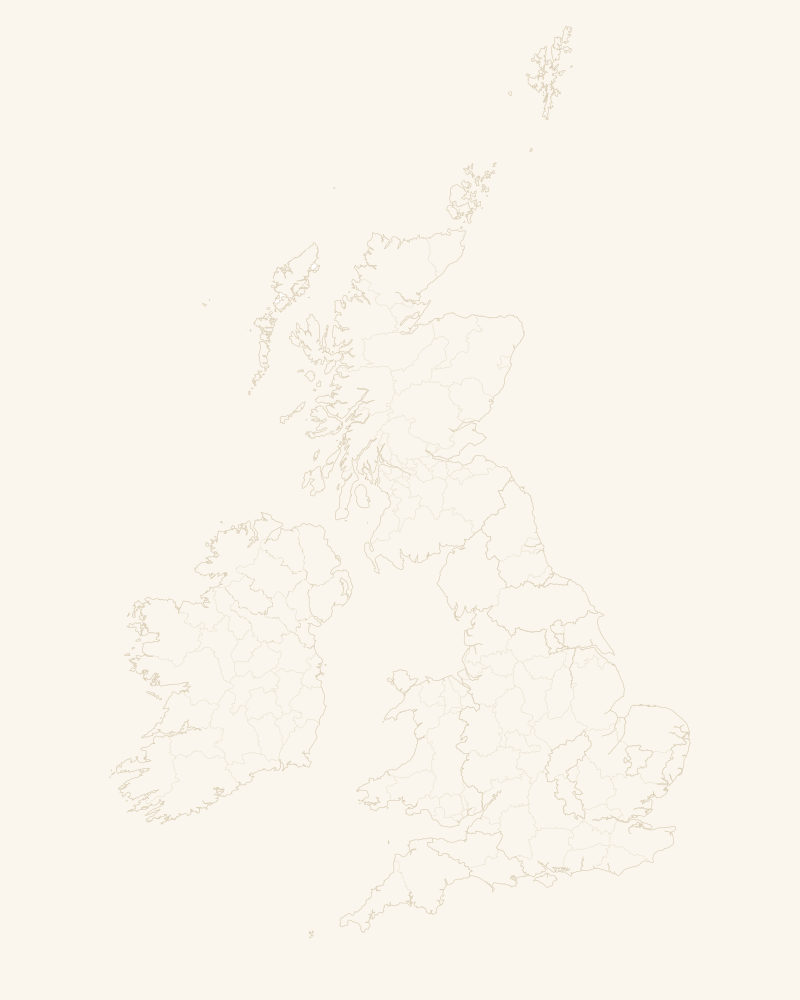
This name is thick on both sides of the border, so the map shows the whole of Britain and Ireland with every region it touches highlighted. It is a regional pattern for the surname, not proof that your branch lived in each place.
CoreHistoric reach
The seat of Richards
Seat vacantChief
No one leads the Richards community yet. When the movement opens, you can stand for its leadership, or help elect whoever does.
Current mission
No shared goal set yet. Once Richards has leadership, it sets the public focus: a restoration, a gathering, a real-world project that helps its own.
The Richards clan is being rebuilt. Join the waiting list for the movement today, and you help decide who leads it and what it does.
Help rebuild the Richards clan →What does the Richards name mean?
Son of Richard, in the genitive -s patronymic form ('Richard's', meaning Richard's son), frozen by Tudor-era surname compression. The same first name in its native Welsh ap-contraction yields Pritchard (ap Richard); the -s form is its Anglicised cousin, dominant in the southern Welsh parishes and across the West Country and the Welsh Marches, where Welsh and English surname conventions overlapped after the 1536-1543 Acts of Union. Richard itself is a Norman-French personal name (rīc-hard, strong-ruler) imported with the Conquest, made universal across Latin Christendom by Richard I Coeur-de-Lion (reigned 1189-1199), and carried into the parish registers of every English-speaking county in his wake.
The history of Richards
Llewelyn ap Dafydd ab Ieuan ap Gruffudd: the chain the Tudor clerks cut
In 1292 some 48 per cent of Welsh names were patronymics, and in certain parishes the figure passed 70 per cent. A man carried a chain rather than a surname: Evan ap Thomas fathered John ab Evan, who fathered Rees ap John, and the chain could be extended through grandfathers to a seventh generation. A name such as Llewelyn ap Dafydd ab Ieuan ap Gruffudd ap Meredydd was a working genealogy of the male line, and the Encyclopaedia of Wales surmises that the system may have been Welsh law, in which it was essential to know how a man descended from an ancestor.
Those laws were decaying by the later Middle Ages, and in the reign of Henry VIII fixed surnames became hereditary among the Welsh gentry before spreading slowly to commoners. Where England's influence was strongest, in the towns, among the wealthy and along the Marches, the ap went first. Some households welded it to the front of the name and produced Powell from ap Hywel, Price from ap Rhys, Pugh from ap Hugh and Pritchard from ap Richard. Others dropped the ap altogether and took the English parish-register habit of adding a single s.
Richards stands on that fork. It is the same Richard as Pritchard, taken down the English road instead of the Welsh one, and the two forms run side by side in the same southern registers. The s was not always filial: in England the ending could be fixed on a servant as readily as a son, so that Roberts might descend from either the son or the servant of a man called Robert. Because the stock of Welsh baptismal names shrank after the Protestant Reformation, a handful of surnames came to cover a nation, and two Richards households in one village cannot be assumed to share an ancestor.
The Landsker, the Marches and the map of 1881
The country that produced an English-form name inside a Welsh parish had been divided long before the Tudors. Normans encouraged settlement on their new Welsh lands after the Conquest, and the Landsker Line separating the Pembrokeshire Englishry from the Welshry is still detectable on the ground; the same pair of terms was used of Gower. Along that seam, and along the Marches from Shropshire and Herefordshire down through Monmouthshire, Welsh and English naming habits shared the same registers, which is where the -s patronymic took hold.
By 1881 the name was concentrated in Wales, in Cornwall and in the adjacent south-western counties of England, a distribution that makes Richards a Welsh name and a Cornish one at once. The pattern held until industry and then the cities pulled it apart: by 1998 large numbers of Welsh and Cornish bearers had moved into the English cities nearest to their old counties, which is how a parish surname became a city one.
The composer, the painter and the invention of New Criticism
Henry Brinley Richards (1817-1885), born at Carmarthen, was the foremost Welsh composer-pianist of the mid-nineteenth century, a gold medallist of the Royal Academy of Music and a friend of Chopin and Mendelssohn, and in 1862 he wrote God Bless the Prince of Wales for the investiture of the future Edward VII. Ceri Richards (1903-1971), born at Dunvant near Swansea, became one of the most distinguished British painters of the mid-twentieth century, a Royal Academician whose late series on the poetry of Dylan Thomas is now held by the Tate.
The name's largest mark on the study of literature was made by I. A. Richards (1893-1979), the Cambridge literary critic who founded New Criticism. Welsh letters kept their own bearers: Alun Richards (1929-2001) wrote as a Welsh novelist, Melville Richards (1910-1973) worked as a Welsh scholar, and Nansi Richards was a Welsh harpist. Kathleen Richards was a British composer, pianist and musicologist, and Frances Richards (1903-1985) a British artist.
Chapel, the dry Sunday and a pacifist in the pulpit
Wales built its public life on nonconformism and Methodism, with the Presbyterian Church of Wales and the Church in Wales holding the ground between them, and the chapel's temperance wing won a rare legislative victory: the Sunday Closing (Wales) Act 1881 banned the sale of alcohol on Sundays and was the first legislation issued specifically for Wales since the Middle Ages. From the early 1960s districts could vote every seven years on going wet or dry, and the last, Dwyfor in the north west, held out into the 1980s.
The name is in the pulpits that record grew from. Leyton Richards (1859-1948) was an English Congregational minister and a pacifist. Abroad, Emma Richards (1927-2014) served as an American Mennonite minister, J. Havens Richards as an American Jesuit educator, and Willard Richards and LeGrand Richards as leaders of the Latter-day Saints. Malad City in Idaho, which began as a Welsh Mormon settlement, claims a greater proportion of inhabitants of Welsh descent than anywhere outside Wales and flies the Welsh flag as its high school colours.
The Albion out of Cardigan
The leaving started at home. During the Industrial Revolution thousands of Welsh people moved into England, to Liverpool and to Ashton-in-Makerfield, and in the late nineteenth and early twentieth centuries contract miners from Wales took their skills to the coal towns of the Pas-de-Calais, clustering around their own churches. The sea routes ran further. In 1819 the ship Albion left Cardigan for New Brunswick carrying 27 Cardiganian families, many of them farmers, and in 1852 Thomas Benbow Phillips of Tregaron planted about a hundred Welsh people in Rio Grande do Sul in Brazil.
The largest destinations were the United States, Canada and Y Wladfa in Patagonia. Pennsylvania drew Welsh settlement above all others, and Matthias Richards sat in Congress for that state, while Henry Melchior Muhlenberg Richards (1848-1935) served as a United States Army and Navy officer. Jackson County in Ohio was known as Little Wales, one of several communities where the language was widely spoken until y Drych, the last Welsh-language newspaper, began printing in English by the late 1940s. Around 1.75 million Americans now report Welsh ancestry.
The flying ace, the coachbuilder and the chemist
Australia took the name early and put it to work. Cecil Roy Richards (1893-1973) flew as an Australian flying ace in the First World War. T. J. Richards built coaches in a business that became Chrysler Australia Limited. Lou Richards played Australian rules football, Ann Richards (1917-2006) acted, and Dig Richards (1940-1983) sang Australian rock and roll. New Zealand carried it too, in Rhys Richards the historian and ethnographer, Anna Richards (born 1964) the rugby union international and Merv Richards (1930-2018) the pole vaulter.
In the United States the name attached itself to laboratories. Ellen Swallow Richards (1842-1911) worked as an American chemist, Dickinson W. Richards as a physiologist, Lorenzo A. Richards as a soil physicist and Esther Loring Richards (1885-1956) as a psychiatrist. Laura E. Richards wrote, Alma Richards (1890-1963) competed as an athlete and Vincent Richards played tennis. Names of Welsh origin account for 4.7 per cent of surnames in New Zealand, 4.1 per cent in Australia and 3.8 per cent in the United States.
The quarterdeck, the laboratory and a Rolling Stone
The earliest firmly dated bearer on the family's own roll is Solomon Richards, an Irish soldier who died in 1691. The sea followed. Frederick Richards (1833-1912) served as a Royal Navy officer; Francis Richards (1873-1955) sailed for Britain at the Olympic Games; Francis Richards (born 1945) went from the diplomatic service to the governorship of Gibraltar; and Emma Richards took the name back onto blue water as a British yachtswoman.
On land the name's largest public figure was Sir Gordon Richards (1904-1986), born at Donnington Wood in Shropshire on the English side of the Marches and the foremost British flat-racing jockey of the twentieth century: fourteen times British Champion Jockey, knighted in the 1953 Coronation Honours as the first jockey in English racing history to be so honoured, and winner of the Derby that June on Pinza at his twenty-eighth and final attempt. Beyond him the modern record is broad rather than narrow. Keith Richards plays guitar for the Rolling Stones. Dean Richards played rugby union for England. Denis Richards worked as a British historian, Owain Richards as a British entomologist, Graham Richards as an English chemist and both Julian C. Richards and Julian D. Richards as British archaeologists. It is a spread that suits a surname made not by one family but by a whole country's worth of Richard's sons.
Also found in
The Richards name has substantial historical presence beyond Wales. See it on England.
Historic Places, Rebuilt
Explore the streets and seats the Richards name knew, rebuilt with AI as they stood in history.
Historic Places, Rebuilt · New
The grandest castle-palace in Wales at its height, the moated Yellow Tower, fountain courts and long gallery, on the eve of the siege.
Historic Places, Rebuilt · New
The greatest coal port on earth at its peak, the hoists and colliers, the Coal Exchange and the streets of Tiger Bay.
The castles of the homeland
The great strongholds of the homeland, look one up, see what it looked like in its prime, and recreate it to explore.
 Caernarfon CastleRestored · prime 1330
 Conwy CastleRuin · prime 1287
 Pembroke CastleRestored · prime 1280
All castles in Wales → · Strongest castles in Wales → · Castles of Europe
Play As Your Clan
Hold a real castle against whatever you choose to send at it, take a ship out in her own service years, or stand at the shoulder of someone the record remembers. The chronicler sets the scene; the deeds are yours.
Notable bearers of the Richards name
- Henry Brinley Richards (1817-1885), composer of God Bless the Prince of Wales
- Sir Gordon Richards (1904-1986), fourteen-time British Champion Jockey, 1953 Derby winner
- Ceri Richards (1903-1971), painter, Royal Academician
- I. A. Richards (1893-1979), Cambridge literary critic, founder of New Criticism
Stories of Richards
Frequently asked
What does the surname Richards mean?
Where does the Richards family come from?
Where did the Richards family historically hold territory?
Is Richards Welsh or English?
How old is the Richards surname?
What is the Richards family known for?
Is there a Richards family crest or coat of arms?
Who is the most famous Richards?
Who are some famous Richardses?
What stories are told about the Richards family?
What is the story of Sir Gordon Richards at the Coronation Derby?
Is Richardes the same family as Richards?
Where is the Richards surname found today?
What does the Clan Rising page for the Richards family cover?
Who is the head of the Richards family today?
Neighbouring clans
- JonesSon of John, and roughly one in twenty Welsh-descended people in the world.
- DaviesSon of David, born of the patron saint's name and densest in his own corner of Wales.
- ThomasThe fifth Welsh surname, son of Thomas, on the same Tudor-era road as Jones and Williams.
- LewisLlywelyn anglicised, a princely name carried into common use across the Marches and the south.