Davies
also Davis
Son of David, born of the patron saint's name and densest in his own corner of Wales.
- Origin
- Deheubarth, Wales
- Famous bearer
- Howell Davis (c.1690–1719), Welsh pirate captain of the Golden Age of Piracy
- Register
- Welsh family
The Davies arms and country

Coat of armsArmorial Bearings of the DAVIES of Moor Court, Pembridge, HerefsBorne by the Moor Court line, one branch of the name rather than all of it.Rs-nourse · CC BY-SA 4.0

- Coat of arms: Granted to an individual and inherited down that one documented line. These are the arms of particular families of the name, not of everyone who shares the surname.
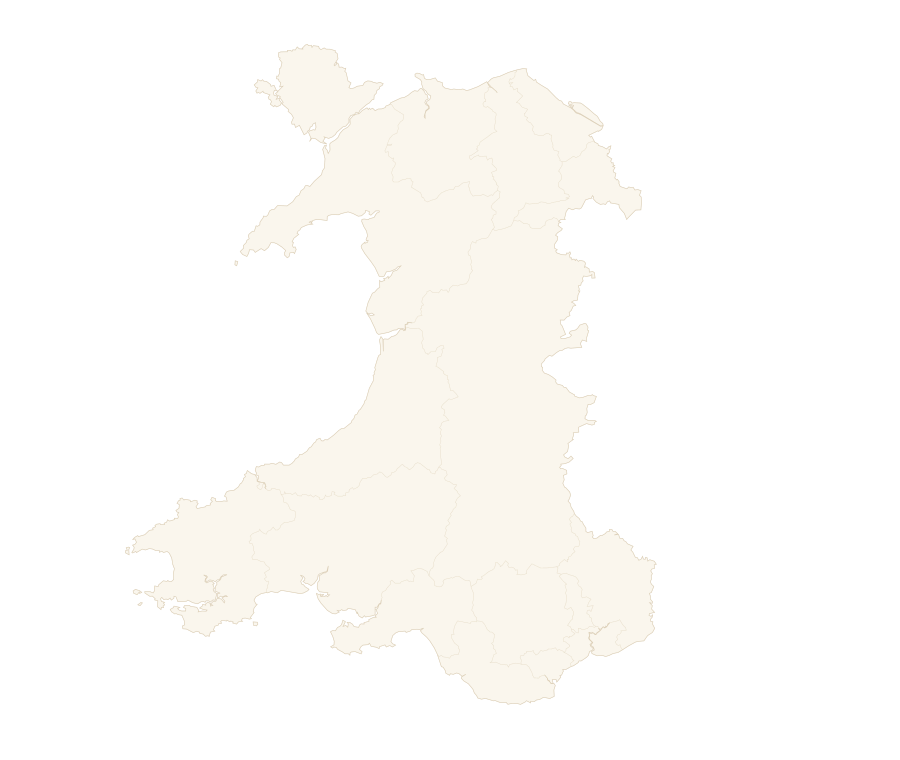
CoreHistoric reach
The seat of Davies
Seat vacantChief
No one leads the Davies community yet. When the movement opens, you can stand for its leadership, or help elect whoever does.
Current mission
No shared goal set yet. Once Davies has leadership, it sets the public focus: a restoration, a gathering, a real-world project that helps its own.
The Davies clan is being rebuilt. Join the waiting list for the movement today, and you help decide who leads it and what it does.
Help rebuild the Davies clan →What does the Davies name mean?
Son of David. The patronymic 'ap Dafydd', son of David, compressed into a single surname under the Tudor administration; the genitive 's' added in the English fashion. David is the patron saint of Wales (Dewi Sant, c.500–589), founder of the monastery at St Davids in Pembrokeshire, and his name has been the most-given male name in Wales for fifteen centuries.
The history of Davies
The saint whose name half a country carries
Davies is ap Dafydd, son of David, worn down into one word and given the English genitive s. Dafydd is the Welsh form of David, and the David is Dewi Sant, c.500-589, founder of the monastery at St Davids in Pembrokeshire and patron saint of Wales. His name has been the most-given male name in Wales for fifteen centuries, which is why a surname built from it ended up on so many people who share no ancestor.
A second account competes with that one and neither is proven: it traces the name to Dyfed, the medieval kingdom covering what is now Carmarthenshire, itself named either for the Irish Déisi dynasty said to have founded it in the third century or for the Demetae, the people the Romans found there. Dafydd and Dyfed both appear in the record from the 12th century.
1536, the year Welsh names stopped moving
Before fixed surnames a Welshman carried his father's name and nothing more, his baptismal name linked by ap or ab (son of), or ferch (daughter of), to his father's. Evan, son of Thomas, was Evan ap Thomas; Evan's son John was John ab Evan; John's son Rees was Rees ap John. The name changed every generation, a description rather than an inheritance. In 1292, 48 per cent of Welsh names were patronymics, over 70 per cent in some parishes.
The strings could run back through grandfathers to perhaps the seventh generation: Llewelyn ap Dafydd ab Ieuan ap Gruffudd ap Meredydd was not an unusual way to be named. Those were a genealogy of the male line carried in the mouth, and the Encyclopaedia of Wales surmises that Welsh law lay behind the habit, since inheritance turned on knowing how a man descended.
Fixed surnames came in from the 15th century onward, and under Henry VIII they became hereditary among the Welsh gentry, spreading slowly to commoners; the fixing is dated by the unification of Wales with England in 1536. Some names kept the ap, reduced and welded to the front: ap Hywel became Powell, ap Rhys became Price, ab Owen became Bowen. Others dropped it and took an s in the English fashion. Dafydd went the second way, and the son of David became, permanently, Davies.
Why two Davieses in one village need not be kin
The stock of Welsh surnames is small for a reason: the variety of baptismal names shrank after the Protestant Reformation, so the pool of fathers' names available to be frozen was already narrow. Evans, Jones, Williams, Davies and Thomas were all inside the top ten surnames recorded in England and Wales in 2000.
The consequence matters more than the ranking. Welsh communities hold many families of one surname who are not related at all, and it cannot be assumed that two people of the same Welsh name, even in the same village, inherited it from a common ancestor. Davies is not one family but thousands, each with a David for a father in the generation the names froze.
The saint's own country, and the spill across the border
The name's centre of gravity is the south-west, Pembrokeshire and Carmarthenshire, the country surrounding St Davids itself, where the cult of the patron saint held it longest. Counts differ on the ranking: Davies is given as the second most common surname in Wales, level with Williams, and as third on other reckonings.
It did not stay inside Wales. Davies is the eighth most common surname in England, thickest in the south-west, especially Cornwall, and in the north-west near the border, where Industrial Revolution migration carried Welsh families to Liverpool and Ashton-in-Makerfield.
A pirate captain, a tramp poet and two writers' rooms
Howell Davis, born around 1690, was a Welsh pirate captain of the Golden Age of Piracy; the story told under this name is Howell Davis on Príncipe, 1719. W. H. Davies, 1871-1940, was born in Newport and wrote 'Leisure' and The Autobiography of a Super-Tramp.
The name has since kept a strong place in the writing trades. Andrew Davies, born 1936, is the screenwriter behind Pride and Prejudice and House of Cards; Russell T Davies, born 1963, is the television writer behind Doctor Who and Queer as Folk. As everywhere else on this page, the shared surname implies no kinship between them.
Croft Castle, bought by the member for Ludlow
The one great house the name held sits over the border in England. Croft Castle had been home to the Croft family since about 1085, when Bernard de Croft, named in Domesday Book, established the estate; Sir John de Croft married Janet, one of Owain Glyndŵr's daughters, after which the family took the Welsh wyvern, a wounded black dragon, as their crest.
In financial trouble after the South Sea Bubble, the Crofts sold in 1746 to Richard Knight, heir to the ironmaster of the Bringewood Ironworks. Croft was later bought by Somerset Davies, Member of Parliament for Ludlow, and stayed in his line as the Kevill-Davies family until 1923, when they sold it back to Katherine, Lady Croft. Family members then raised an endowment, without which the National Trust would not take the house on, and it was bequeathed to the Trust in 1957.
The coalfield that made the name and the coalfields that took it
The population of Wales doubled from 587,000 in 1801 to 1,163,000 in 1851 and reached 2,421,000 by 1911, most of it going into the coal districts. Glamorganshire alone rose from 71,000 in 1801 to 232,000 in 1851 and 1,122,000 in 1911. A name already common in the rural south-west was pulled wholesale into the valleys with the families that went to dig.
Then it left. The 19th-century Welsh industrial diaspora carried the name into the coalfields of Pennsylvania and the iron towns of Ohio, where Davies and Davis chapels are scattered through every county that took Welsh labour. Jackson County in Ohio was called Little Wales and stayed Welsh-speaking for generations.
Among the families that crossed in the colonial period the spelling Davis took hold, and it is now much the commoner form in the United States while Davies stayed standard in Wales; both come out of the same patronymic mechanic. Some 16.3 million people across the countries surveyed for the Welsh Government carry a name of Welsh origin.
Treorchy to Teddington, and the packets that carry the world
Donald Watts Davies was born at 5 Treherbert Street in Treorchy in the Rhondda Valley on 7 June 1924, the son of a colliery clerk who died a few months after his birth. His mother took him and his twin sister to Portsmouth, where he was schooled. He won an exhibition to Imperial College, London in 1942, took a first in physics in 1943, was seconded to the Tube Alloys nuclear programme, and took a second first, in mathematics, in 1947.
That autumn he joined the Mathematics Division of the National Physical Laboratory at Teddington and went onto the team Alan Turing was leading to build the Pilot ACE, which ran its first program in May 1950. Davies stayed at NPL forty-seven years and headed its Computer Science Division from 1966. Through 1965 and into 1966 he set out, in internal papers and lectures, the principle he named packet switching: break a message into short fixed-length blocks, give each a header carrying its destination, let every node forward each packet by the best route then open, and reassemble them at the far end.
He presented the design at the Association for Computing Machinery's first Symposium on Operating System Principles at Gatlinburg, Tennessee in October 1967, where Lawrence Roberts of the US Defense Advanced Research Projects Agency laid out early plans for the ARPANET. The NPL design and Paul Baran's independent earlier work at the RAND Corporation became that network's architectural basis, and Roberts took the NPL packet size and the word packet itself. From January 1970 Davies ran the NPL Local Network, among the first packet-switched networks anywhere; the principle spread through ARPANET and the internet protocols of the 1980s into the fabric every byte of traffic now moves on. He was elected a Fellow of the Royal Society in 1987 and entered the Internet Hall of Fame at its inauguration in 2012.
Champions of the Davies name
The bearers whose lives are inseparable from this surname. Each has their own page, biography, achievements, geography, connection to the family.
Historic Places, Rebuilt
Explore the streets and seats the Davies name knew, rebuilt with AI as they stood in history.
Historic Places, Rebuilt · New
Edward I's walled bastide and mighty castle in North Wales, a generation after the conquest, the banded towers still rising.
Historic Places, Rebuilt · New
Owain Glyndŵr's mountain fortress and court at the high tide of Welsh independence, the English siege lines gathering below.
Historic Places, Rebuilt · New
The grandest castle-palace in Wales at its height, the moated Yellow Tower, fountain courts and long gallery, on the eve of the siege.
Historic Places, Rebuilt · New
The greatest coal port on earth at its peak, the hoists and colliers, the Coal Exchange and the streets of Tiger Bay.
Castles the Davies held
Strongholds this name held for a decade or more, look one up, or rebuild it to explore.
- Croft Castle
Held by Somerset Davies, MP for Ludlow, and his Kevill-Davies descendants until 1923.
The castles of the homeland
The great strongholds of the homeland, look one up, see what it looked like in its prime, and recreate it to explore.
 Caernarfon CastleRestored · prime 1330
 Conwy CastleRuin · prime 1287
 Pembroke CastleRestored · prime 1280
All castles in Wales → · Strongest castles in Wales → · Castles of Europe
Play As Your Clan
Hold a real castle against whatever you choose to send at it, take a ship out in her own service years, or stand at the shoulder of someone the record remembers. The chronicler sets the scene; the deeds are yours.
Notable bearers of the Davies name
- Howell Davis (c.1690–1719), Welsh pirate captain of the Golden Age of Piracy
- W. H. Davies (1871–1940), Newport-born poet of 'Leisure' and the Autobiography of a Super-Tramp
- Andrew Davies (b. 1936), screenwriter (Pride and Prejudice, House of Cards)
- Russell T Davies (b. 1963), television writer (Doctor Who, Queer as Folk)
Stories of Davies
Frequently asked
What does the surname Davies mean?
Where does the Davies family come from?
Where did the Davies family historically hold territory?
Is Davies Welsh or English?
How old is the Davies surname?
What is the Davies family known for?
Is there a Davies family crest or coat of arms?
Who is the most famous Davies?
Who are some famous Davieses?
What stories are told about the Davies family?
What is the story of Howell Davis on Príncipe?
Is Davis the same family as Davies?
Where is the Davies surname found today?
What does the Clan Rising page for the Davies family cover?
Who is the head of the Davies family today?
Neighbouring clans
- JonesSon of John, and roughly one in twenty Welsh-descended people in the world.
- ThomasThe fifth Welsh surname, son of Thomas, on the same Tudor-era road as Jones and Williams.
- ReesFrom Rhys, the name of the most consequential prince of 12th-century Wales.
- RichardsSon of Richard, the -s patronymic that crossed the Marches.