Rees
also Reece, Rhys
From Rhys, the name of the most consequential prince of 12th-century Wales.
- Origin
- Deheubarth, Wales
- Famous bearer
- Rhys ap Gruffydd, the Lord Rhys (1132–1197), King of Deheubarth, host of the first Eisteddfod
- Register
- Welsh family
The Rees arms and country

Coat of armsRees Coat of ArmsUnknown author Unknown author · Public domain

- Coat of arms: Granted to an individual and inherited down that one documented line. These are the arms of particular families of the name, not of everyone who shares the surname.
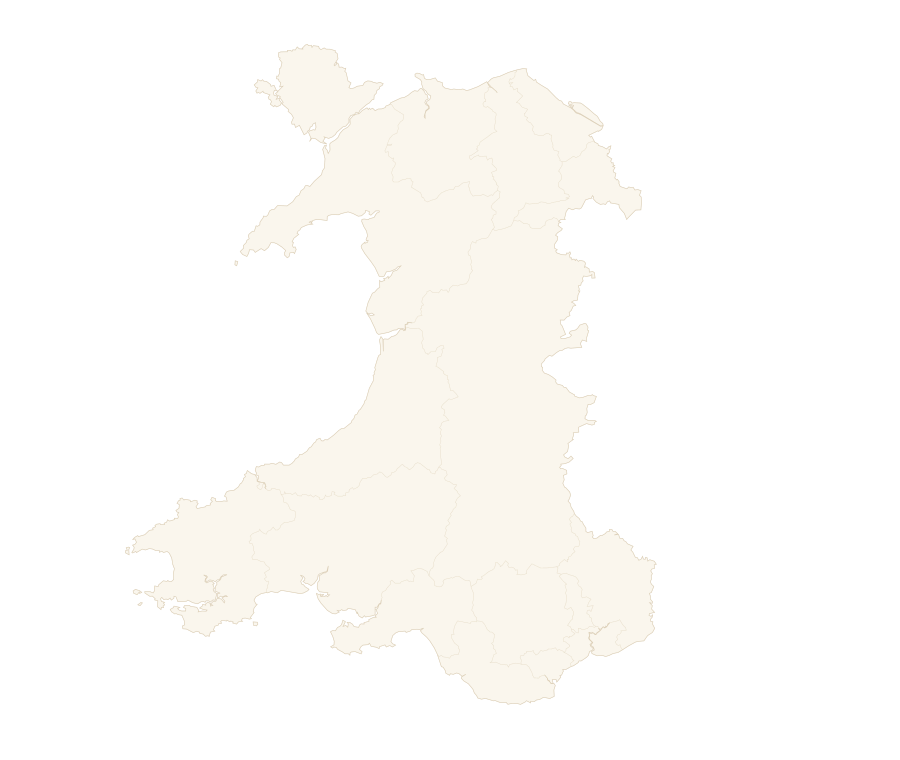
CoreHistoric reach
The seat of Rees
Seat vacantChief
No one leads the Rees community yet. When the movement opens, you can stand for its leadership, or help elect whoever does.
Current mission
No shared goal set yet. Once Rees has leadership, it sets the public focus: a restoration, a gathering, a real-world project that helps its own.
The Rees clan is being rebuilt. Join the waiting list for the movement today, and you help decide who leads it and what it does.
Help rebuild the Rees clan →What does the Rees name mean?
From the Welsh Rhys, an ancient personal name meaning 'ardour' or 'rashness in war'. The patronymic 'ap Rhys' contracted to Price; the unprefixed Rhys, taken hereditarily and anglicised by Tudor scribes, gave Rees and Reece. Both names trace to the same root, and to one historical figure above all others, the Lord Rhys of Deheubarth.
The history of Rees
Ardour, and the law that fixed the name in place
Rhys was a personal name long before it was a surname, carrying the sense of ardour, or rashness in war. Under the Welsh patronymic system it could not settle: a man was his father's son and nothing more. Evan, son of Thomas, was Evan ap Thomas; Evan's son John was John ab Evan; and John's son Rees was Rees ap John. The name changed with every generation. In 1292, 48 per cent of recorded Welsh names were patronymics, over 70 per cent in some parishes, and strings running back through several generations passed without comment: a man carried the genealogy of his male line in his own name.
Fixed surnames came in from the 15th century. They became hereditary among the Welsh gentry in the reign of Henry VIII, under whom Wales was unified with England in 1536, and spread slowly among commoners; border districts and town families dropped patronymics first, while some rural parishes ran the old system on into the early 19th century. Where ap Rhys was kept and contracted it gave Price and Pryce. Where the prefix was simply dropped, the bare Rhys was written down by Tudor scribes as Rees and Reece.
One consequence deserves stating plainly, because it disappoints a lot of family trees. Wales drew on a very small stock of baptismal names, so families sharing a surname are routinely unrelated: two Rees households in one Carmarthenshire village need share no ancestor at all. Density today is heaviest in Carmarthenshire and Ceredigion, the old heartland of the kingdom of Deheubarth and still the core of Welsh-language daily speech.
The Lord Rhys, Dinefwr, and Christmas at Cardigan in 1176
Rhys ap Gruffydd (1132–1197), remembered simply as the Lord Rhys, was the most consequential native ruler of 12th-century Wales and the man the name is bound to. He held Dinefwr Castle and played the politics of the Angevin succession with more skill than any Welsh contemporary. In 1172 Henry II confirmed him as Justiciar of South Wales, an English office acknowledging a Welsh prince's authority in the south.
At Cardigan Castle at Christmas 1176 he hosted the first recorded Eisteddfod, a competitive gathering of bards and musicians summoned from across Wales. The chair for poetry went to a man of Gwynedd and the chair for music to a man of Deheubarth, which suggests how even-handed the host meant the occasion to look. The kingdom did not survive; the gathering did, and it is now the National Eisteddfod of Wales.
Chapel, cyclopaedia and the Rebecca Riots
The name turns up early in the business of print and pulpit. Abraham Rees (1743–1825) was the Welsh compiler of Rees's Cyclopaedia, the reference work that still carries his surname, and a botanist besides. Nonconformist Wales, which made scholars of its ministers, produced Thomas Rees (1777–1864), Unitarian minister, and Thomas Rees (1815–1885), Congregational minister.
Another Thomas Rees took the harder route. Thomas Rees (c. 1806–1876), known as Twm Carnabwth, was a leader of the Rebecca Riots. The same generations threw up John Rees (1857–1949), Welsh musician, Milsom Rees (1866–1952), Welsh surgeon, and later Thomas Ifor Rees (1890–1977), diplomat and translator.
The coalfield, and a colliery boy at the Heart of the Midlands
Industry moved the name east. The population of Wales went from 587,000 in 1801 to 1,163,000 in 1851 and 2,421,000 by 1911, and most of that increase landed in the coal districts: Glamorganshire alone grew from 71,000 in 1801 to 1,122,000 in 1911. Rees families went with the rest, which is why the name's ground now runs through the Valleys, Swansea, the Vale of Glamorgan and Monmouthshire as well as the western counties it started in.
Leighton Maldwyn Rees was born at Ynysybwl in the Cynon Valley on 17 January 1940, the son of a miner, and worked at the Lady Windsor Colliery from the age of fourteen for a decade. He took up darts at fifteen in the village working-men's club, played for the Lady Windsor pub team, and was picked for Wales in 1970. In 1972 he left the colliery for a furniture-salesman's job in Pontypridd that kept his weekends free for exhibition matches, then the main professional income in the game. He took the British Open and the News of the World Individual Championship in 1976, and the Winmau World Masters in 1976 and 1977.
From 3 to 7 February 1978, at the Heart of the Midlands nightclub in Nottingham, the British Darts Organisation staged the first World Professional Darts Championship: five days, sixteen players, six countries. Rees beat Alan Evans 8-6 in the semi-final and the American John Lowe 11 sets to 7 in the final, becoming the first BDO world champion. It went out live on BBC Two to an estimated four and a half million viewers and fixed the tournament at the centre of the British sporting winter for four decades. He won the first WDF World Cup individual title that October, captained Wales to the team title in 1978 and 1979, and died at Pontypridd on 8 June 2003. Wales named its national team trophy after him in 2004.
Reeses in the red jersey
Welsh rugby has fielded the name since the Victorian game. Aneurin Rees (1858–1932) and Conway Rees (1870–1932) were Wales internationals, as was Dan Rees; Idwal Rees (1910–1991) captained Wales; Tommy Rees (1904–1968) played the dual code. Clive Rees, Elgan Rees and Matthew Rees (born 1980) all went from Wales to the British Lions. The surname travelled with the game: Gareth Rees (born 1967) played for Canada, Tom Rees (born 1984) for England.
Beyond rugby, Billy Rees (1924–1996), Ronnie Rees and Jason Rees played football; Dai Rees (1913–1983) was a Welsh golfer; Gavin Rees (born 1980) boxed professionally; Alan Rees (1938–2024) drove in Formula One.
Victoria Cross, flying ace and the Indian Army
Ivor Rees (1893–1967) was a Welsh soldier and a recipient of the Victoria Cross. Lionel Wilmot Brabazon Rees (1884–1955) was a Welsh flying ace of the First World War, in the first generation of men to fight in aircraft at all. Thomas Wynford Rees (1898–1959) served in the British Indian Army, and John David Rees (1854–1922) was a colonial administrator in British India who afterwards sat in Parliament.
An Astronomer Royal and a rocket engineer
Martin Rees, Baron Rees of Ludlow (born 1942), holds the office of Astronomer Royal. Eberhard Rees (1908–1998), carrying the German form of the name, was a rocketry pioneer and the second director of NASA's Marshall Space Flight Center. Dai Rees (1936–2021) was a British biochemist and science administrator, Elmer Rees a British geometer, and Geraint Rees a British neurologist and neuroscientist.
The pattern repeats elsewhere: Brinley Rees (1919–2004), British classicist; John Rawlings Rees (1890–1969), British psychiatrist; Albert E. Rees (1921–1992), American economist and provost of Princeton.
The name in print, and the name overseas
Jean Rhys (1890–1979), the Dominica-born novelist of Welsh-Creole descent who wrote Wide Sargasso Sea, took her literary name from the Rhys patronymic she had inherited, choosing the older spelling. Goronwy Rees (1909–1979) was a Welsh journalist, academic and memoirist, and the last surviving figure of the Cambridge Five circle. Sir Anthony Hopkins carries the name on his mother's line. Roger Rees (1944–2015) and Angharad Rees (1949–2012) acted, and Laurence Rees (born 1957) is a historian and documentary film-maker.
The name left Wales in the same currents as the rest of the country: to Liverpool and the English industrial towns, to the coal towns of Pas-de-Calais, to Y Wladfa in Patagonia, to Jackson County, Ohio, once called Little Wales. In 1819 the ship Albion sailed from Cardigan for New Brunswick with 27 Cardiganshire families aboard, most of them farmers, and around 1.75 million Americans now report Welsh ancestry.
Lloyd Rees (1895–1988) became an Australian landscape painter and Coralie Clarke Rees (1908–1972) an Australian author. Whether the family reached Ohio, New Brunswick or New South Wales, the surname behind it is the one a scribe wrote down in Wales when a man stopped being his father's son and became, permanently, a Rees.
Champions of the Rees name
The bearers whose lives are inseparable from this surname. Each has their own page, biography, achievements, geography, connection to the family.
Historic Places, Rebuilt
Explore the streets and seats the Rees name knew, rebuilt with AI as they stood in history.
The castles of the homeland
The great strongholds of the homeland, look one up, see what it looked like in its prime, and recreate it to explore.
 Caernarfon CastleRestored · prime 1330
 Conwy CastleRuin · prime 1287
 Pembroke CastleRestored · prime 1280
All castles in Wales → · Strongest castles in Wales → · Castles of Europe
Play As Your Clan
Hold a real castle against whatever you choose to send at it, take a ship out in her own service years, or stand at the shoulder of someone the record remembers. The chronicler sets the scene; the deeds are yours.
Notable bearers of the Rees name
- Rhys ap Gruffydd, the Lord Rhys (1132–1197), King of Deheubarth, host of the first Eisteddfod
- Jean Rhys (1890–1979), novelist (Wide Sargasso Sea)
- Goronwy Rees (1909–1979), historian and the last of the Cambridge Five circle
Stories of Rees
Frequently asked
What does the surname Rees mean?
Where does the Rees family come from?
Where did the Rees family historically hold territory?
Is Rees Welsh or English?
How old is the Rees surname?
What is the Rees family known for?
Is there a Rees family crest or coat of arms?
Who is the most famous Rees?
Who are some famous Reeses?
What stories are told about the Rees family?
What is the story of the first Eisteddfod?
Is Reece the same family as Rees?
Is Rhys the same family as Rees?
Where is the Rees surname found today?
What does the Clan Rising page for the Rees family cover?
Who is the head of the Rees family today?
Neighbouring clans
- JonesSon of John, and roughly one in twenty Welsh-descended people in the world.
- DaviesSon of David, born of the patron saint's name and densest in his own corner of Wales.
- EvansSon of John, by the Welsh road, the cousin name of Jones.
- ThomasThe fifth Welsh surname, son of Thomas, on the same Tudor-era road as Jones and Williams.