Price
also Preece, ap Rhys
ap Rhys, the Welsh contraction working on the name of a king.
- Origin
- Morgannwg, Wales
- Famous bearer
- Hugh Price (c.1495–1574), founder of Jesus College, Oxford
- Register
- Welsh family
The Price arms and country

Coat of armsEscutcheon of the Price baronets of Foxley (1828)Borne by the Foxley line, one branch of the name rather than all of it.Charles Matthews · CC BY-SA 4.0 
Coat of armsArmorial Bearings of the PRICE family of Foxley, Yazor, HerefordshireBorne by the Foxley line, one branch of the name rather than all of it.Rs-nourse · CC BY-SA 4.0
.svg)

- Coat of arms: Granted to an individual and inherited down that one documented line. These are the arms of particular families of the name, not of everyone who shares the surname.
CoreHistoric reach
The seat of Price
Seat vacantChief
No one leads the Price community yet. When the movement opens, you can stand for its leadership, or help elect whoever does.
Current mission
No shared goal set yet. Once Price has leadership, it sets the public focus: a restoration, a gathering, a real-world project that helps its own.
The Price clan is being rebuilt. Join the waiting list for the movement today, and you help decide who leads it and what it does.
Help rebuild the Price clan →What does the Price name mean?
ap Rhys, son of Rhys, contracted in spoken Welsh by the same elision that produced Powell (ap Hywel), Pritchard (ap Richard) and Pugh (ap Hugh). The native Welsh name Rhys means 'ardour' or 'rush', the noun used of the charge of a horseman, and was borne by Rhys ap Tewdwr, the eleventh-century King of Deheubarth, and by his great-grandson the Lord Rhys (1132–1197), the most powerful Welsh prince of his age. The patronymic crystallised under Tudor-era surname compression, the older spelling Preece preserving the consonant cluster more honestly than Price does.
The history of Price
The elision that swallowed a king's name
In 1292 forty-eight per cent of recorded Welsh names were patronymics, and in some parishes more than seventy. A man was his father's son and little else: Evan ap Thomas, whose son was John ab Evan, whose son in turn was Rees ap John. The chain could be run back seven generations (Llewelyn ap Dafydd ab Ieuan ap Gruffudd ap Meredydd is a pedigree rather than a name) because Welsh law made it necessary for a man to know exactly how he descended from an ancestor. Price is what was left when that chain was cut and only the last link kept: ap Rhys, worn down in the mouth to one syllable, by the same elision that turned ap Hywel into Powell, ap Richard into Pritchard, ab Owen into Bowen and ap John into Upjohn.
The name at the centre of it was native, not imported. Rhys is the Welsh word for ardour or rush, the noun used of a horseman's charge, and it was borne by Rhys ap Tewdwr, king of Deheubarth, and by his great-grandson the Lord Rhys (1132–1197). Hereditary surnames became the rule among the Welsh gentry in the reign of Henry VIII and spread slowly to commoners after the union of 1536; towns, wealthy families and the anglicised east had let the old system go first, while parts of rural Wales were still naming children the old way in the early nineteenth century. The older spelling Pryce was sounded Preese, and the swap of the y for an i, with the pronunciation that followed it, was an affectation: a Welsh name dressed to pass as an English one. Preece is the honest survival.
Thirty-eight times over, in Radnorshire
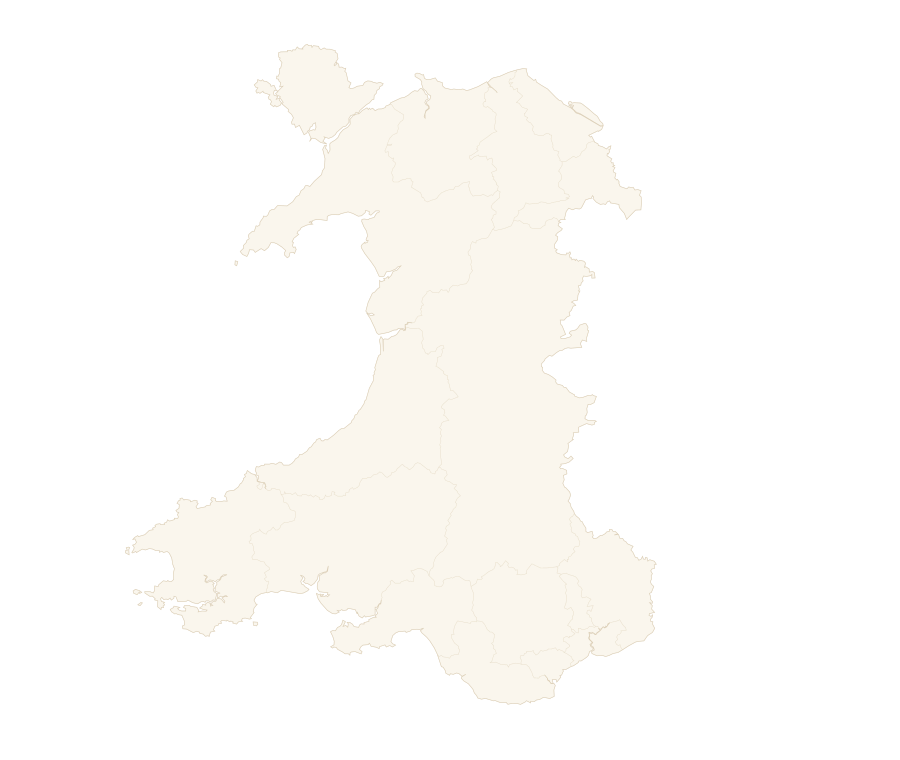
The 1881 census fixes where the name had settled. Radnorshire carried Price at 38.2 times the British average, a concentration no other county approached. Brecknockshire came next, and then Herefordshire, English by administration. Monmouthshire, Flintshire, Shropshire, Denbighshire, Glamorgan, Carmarthenshire and Worcestershire filled out the top ten.
That is a border distribution, running the length of the frontier that Offa's Dyke marked out in the mid-eighth century between Wales and Mercia. It shows a line drawn on administrative maps that never separated the populations either side of it. West of the dyke the name reaches deep into Powys, Carmarthenshire, Ceredigion and Pembrokeshire, where the Landsker line still divides the county's Englishry from its Welshry, and south into Swansea, the Vale of Glamorgan and the Valleys. Two counties in that 1881 top ten, Flintshire and Denbighshire, put Price in the north as well.
The Brecon lawyer who bought Oxford a Welsh college
Hugh Price (c.1495–1574) was born at Brecon, in the county that would return the second-highest density of the surname in Britain three hundred years after his death. He made his career in the law and the church, rising to be Treasurer of St Davids Cathedral, and in 1571 obtained a royal charter from Elizabeth I for a new foundation at Oxford. Six hundred pounds of his own estate went into it. Jesus College was the first Oxford college endowed specifically to take Welsh undergraduates.
The gift reads as practical politics as much as piety. Price made his career inside English institutions in the decades after the union of 1536, in the same years that Welsh gentry were fixing their patronymics into hereditary surnames, and he was buying the next generation of them a door. The affiliation held: four centuries on, the college has kept its Welsh character both in residence and in its principalship. Hugh Price's own name is the whole process in miniature: ap Rhys, contracted to one English-looking syllable, standing on an English royal charter.
The minister who published a dead man's mathematics
Richard Price (1723–1791) was born in Glamorgan and became a Dissenting minister, formed by the nonconformist tradition Wales has long had. He was also a working mathematician, and in 1763 he edited and brought to publication the posthumous paper of Thomas Bayes on inverse probability. That essay is the foundation of modern Bayesian statistics; had Price left it alone, it would have stayed among a dead colleague's papers.
The same arithmetic took him into government finance. Price advised William Pitt the Younger on the redemption of the national debt. A chapel minister from Glamorgan was, in the same working life, putting Bayes into print and telling a British prime minister how to pay off his borrowing.
Old Jewry, November 1789
Price was a political writer as well as a philosopher, and he took the losing side of British opinion twice. In 1776 he published Observations on the Nature of Civil Liberty in support of the American Revolution, against the settled opinion of the government whose subject he was.
Thirteen years later, in November 1789, a single sermon delivered at the Old Jewry set off a pamphlet war. Edmund Burke answered Price with Reflections on the Revolution in France; Thomas Paine answered Burke with Rights of Man. The argument those two books carried on, inherited constitution against natural right, was started by a Welsh Dissenter whose surname was a contraction of ap Rhys.
When Glamorgan filled with a million people
The population of Wales went from 587,000 in 1801 to 1,163,000 in 1851 and 2,421,000 by 1911, and almost the whole increase landed in the coal districts. Glamorgan alone rose from 71,000 in 1801 to 232,000 in 1851 and 1,122,000 in 1911, very nearly sixteen times its size at the start of the century. Falling death rates explain part of that; the rest was migration into Wales, the English most numerous, with considerable numbers of Irish and smaller Italian communities in the south.
The 1881 return catches the surname mid-move. Price was still thickest in the upland counties of Radnorshire and Brecknockshire, but already registering in Monmouthshire and Glamorgan, where the pits were. Today the name's densest ground is the Valleys, the Vale of Glamorgan and Monmouthshire, the industrial south, while Powys, Ceredigion, Carmarthenshire, Pembrokeshire and Swansea hold it as historic country. The centre of gravity moved downhill to the coal, and stayed there.
Cardigan, Patagonia and an American named Price
Welsh emigration was small in proportion to Ireland's (Irish departures for the United States may have run twenty-six times heavier) but it ran in specific, traceable channels. In 1819 the ship Albion sailed from Cardigan for New Brunswick carrying twenty-seven Cardiganshire families, many of them farmers. In 1852 Thomas Benbow Phillips of Tregaron established a settlement of about a hundred Welsh people in Rio Grande do Sul. Both Cardigan and Tregaron sit in Ceredigion, old Price country. Others went to Pennsylvania, to Y Wladfa in Patagonia, to Jackson County in Ohio (known as Little Wales, where the language was widely spoken) and to Malad City in Idaho, a Welsh Mormon settlement that claims a greater proportion of Welsh-descended inhabitants than anywhere outside Wales itself.
The arithmetic of that scattering still shows. Around 1.75 million Americans report Welsh ancestry, and 458,705 Canadians did so in the 2011 census, against 2.9 million people living in Wales. Nearly 35 per cent of the Welsh population carries a family name of Welsh origin, compared with 5.3 per cent in the rest of the United Kingdom, 4.7 per cent in New Zealand, 4.1 per cent in Australia and 3.8 per cent in the United States. One of the Americans carrying it was Vincent Price (1911–1993), the character actor.
Historic Places, Rebuilt
Explore the streets and seats the Price name knew, rebuilt with AI as they stood in history.
The castles of the homeland
The great strongholds of the homeland, look one up, see what it looked like in its prime, and recreate it to explore.
 Caernarfon CastleRestored · prime 1330
 Conwy CastleRuin · prime 1287
 Pembroke CastleRestored · prime 1280
All castles in Wales → · Strongest castles in Wales → · Castles of Europe
Play As Your Clan
Hold a real castle against whatever you choose to send at it, take a ship out in her own service years, or stand at the shoulder of someone the record remembers. The chronicler sets the scene; the deeds are yours.
Notable bearers of the Price name
- Hugh Price (c.1495–1574), founder of Jesus College, Oxford
- Richard Price (1723–1791), philosopher, mathematician and pamphleteer
- Vincent Price (1911–1993), American character actor of Welsh ancestry
Stories of Price
Frequently asked
What does the surname Price mean?
Where does the Price family come from?
Where did the Price family historically hold territory?
Is Price Welsh or English?
How old is the Price surname?
What is the Price family known for?
Is there a Price family crest or coat of arms?
Who is the most famous Price?
Who are some famous Prices?
What stories are told about the Price family?
What is the story of Richard Price at the Old Jewry?
Is Preece the same family as Price?
Is ap Rhys the same family as Price?
Where is the Price surname found today?
What does the Clan Rising page for the Price family cover?
Who is the head of the Price family today?
Neighbouring clans
- JonesSon of John, and roughly one in twenty Welsh-descended people in the world.
- LewisLlywelyn anglicised, a princely name carried into common use across the Marches and the south.
- MorganThe name that named a kingdom, Morgannwg's enduring patronym.
- Powellap Hywel, the contracted patronymic that descends from Hywel Dda, the king who wrote Welsh law.