House of Dinefwr
Royal house of Deheubarth, the Lord Rhys.
- Origin
- Deheubarth, Wales
- Famous bearer
- Rhys ap Gruffydd ('the Lord Rhys', c.1132-1197), Prince of Deheubarth
- Register
- Princely house
Ranked of all time
The 10 Most Powerful Welsh Houses of All Time
Where the Dinefwr name comes from
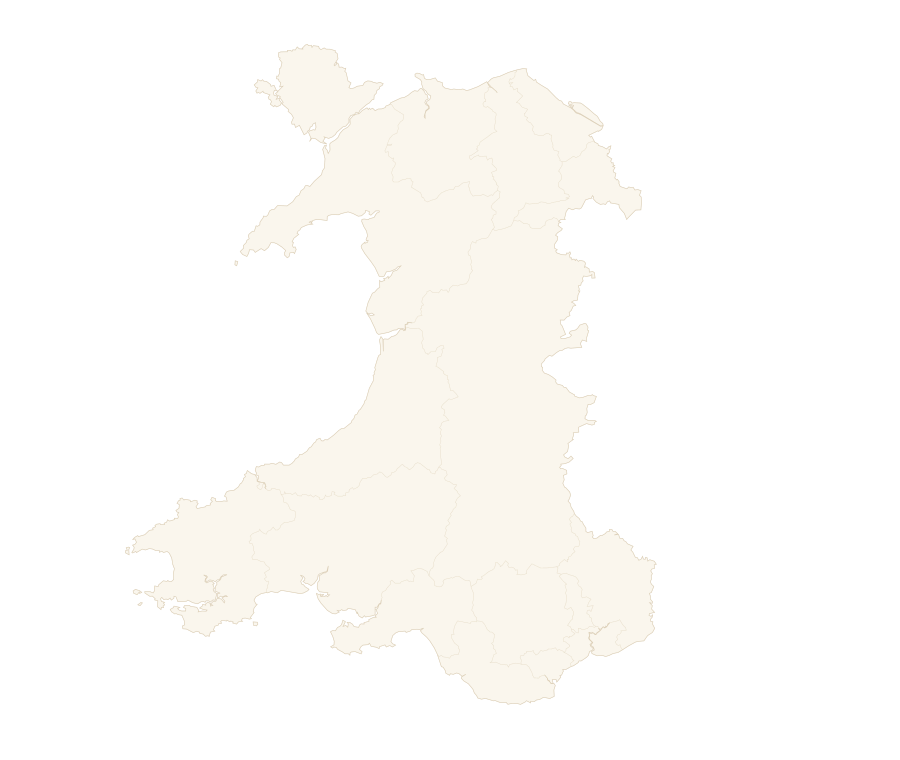
CoreHistoric reach
The seat of House of Dinefwr
Seat vacantChief
No one leads the House of Dinefwr community yet. When the movement opens, you can stand for its leadership, or help elect whoever does.
Current mission
No shared goal set yet. Once House of Dinefwr has leadership, it sets the public focus: a restoration, a gathering, a real-world project that helps its own.
The Dinefwr clan is being rebuilt. Join the waiting list for the movement today, and you help decide who leads it and what it does.
Help rebuild the Dinefwr clan →What does the Dinefwr name mean?
From Dinefwr, the rock fortress above the Tywi valley in modern Carmarthenshire, the royal seat of the kingdom of Deheubarth. As with Aberffraw and Mathrafal, the dynasty took its name from the place its kings ruled from. The senior line traces its descent to Hywel Dda, the 10th-century king who codified Welsh law.
The history of House of Dinefwr
The rock above the Tywi
The castle stands on a ridge on the northern bank of the river Towy outside Llandeilo, with a drop of a hundred feet to the water below, and it was held as a princely seat from the 9th century. The dynasty that ruled Deheubarth, the southern Welsh kingdom, took its name from that rock.
Deheubarth covered roughly what is now Pembrokeshire, Carmarthenshire, Ceredigion and Brecknock, the wealthiest and most agriculturally productive of the Welsh territories and the hardest for its neighbours to leave alone. Dinefwr stayed the seat of the senior line through the medieval centuries and, under an anglicised spelling, into the modern peerage.
Cadell ap Rhodri looks south
The line begins with a younger son who had nothing to inherit. When Rhodri Mawr died, Gwynedd passed to his eldest son, Anarawd. His second son, Cadell ap Rhodri, looked outside Gwynedd's borders instead. King of Seisyllwg and nephew of Gwgon, king of Ceredigion, he had taken the kingdom of Dyfed by the late 9th century, conquering it with his son. The family is called the Cadelling after him.
Hywel, Rhodri's grandson, finished the work. Under Hywel Dda the Cadelling united Dyfed and Seisyllwg into the single kingdom of Deheubarth in the early 10th century, and Dinefwr became the fortress it was ruled from. He was its first ruler and afterwards king of most of Wales.
Hywel Dda, and the law he had written down
Hywel submitted to Edward the Elder, king of the Anglo-Saxons, and supported Edward's successor Aethelstan, the first king of England, in his invasion of Scotland. He took the title King of the Britons and late in life made the pilgrimage to Rome. His legacy was the law: he gathered expert lawyers and priests from across the whole country under his leadership and had the native law of Wales codified into the corpus known ever since as the Laws of Hywel Dda.
His descendants held the title and fought to keep it. Owain ap Hywel, king of South Wales, attacked Morgannwg with his sons and paid tribute to Edgar the Peaceful. Maredudd ab Owain, King of the Britons, appears in the Chronicle of the Princes struggling repeatedly with Viking invasions of Wales, and raided Mercia himself.
Rhys ap Tewdwr, Nest, and the Norman century
The Norman conquest reached Deheubarth as a negotiation before it arrived as a war. Rhys ap Tewdwr, king in southern Wales, made an agreement with William the Conqueror for his kingdom. He was later forced to flee to Ireland, and came back with a fleet to attack the royal house of Mathrafal.
Nest ferch Rhys was raised at the court of William Rufus and married Gerald of Windsor, constable of Pembroke Castle and founder of the House of Fitzgerald. Gruffydd ap Rhys, prince of Deheubarth, took the harder road: he fought the Normans through the civil war of Stephen of Blois and the Empress Matilda, and refused to do homage to Stephen in London.
Gruffydd's sons carried it on. Anarawd ap Gruffydd joined the war of Owain Gwynedd and his brother Cadwaladr, and attacked Cardigan Castle with a Viking fleet. Cadell ap Gruffydd took Llansteffan and Carmarthen castles, was set upon and injured by the Normans while out hunting, and left Wales on pilgrimage to Rome. His half-brother Maredudd, who had fought beside him in Ceredigion, became king in his place, and died in 1155.
The Lord Rhys, 1155 to 1197
Rhys ap Gruffydd was born at Dinefwr around 1132, fourth and youngest son of Gruffydd ap Rhys and of Gwenllian ferch Gruffydd ap Cynan of the Aberffraw line. His father died in 1137, when Rhys was five, and his elder brothers fought through the disputed succession of the 1140s. He came in as sole and undisputed ruler on Maredudd's death in 1155, and held Deheubarth for forty-two years, the longest tenure of any medieval Welsh ruler.
He won Ceredigion back from the Normans in 1158 and the lower Tywi in 1162, and built the alliance with Owain Gwynedd that produced the joint Welsh victory over Henry II at Crogen in 1165. Carreg Cennen is his. After that failed expedition Henry wanted a settled peace, and at the Council of Gloucester in March 1175 recognised Rhys as Princeps Sudwallie, Prince of South Wales, and as Justiciar of South Wales.
The peace did not outlive Henry. Rhys fought his son Richard the Lionheart too, attacking the Norman lordship and taking many of its castles, and through the 1190s carried the steadily more unequal pressure of the Marcher advance. He founded the Cistercian abbeys of Strata Florida in 1184 and Talley in 1185, and died at Dinefwr on the twenty-eighth of April 1197. His effigy at St Davids Cathedral is one of the finest pieces of late twelfth-century Welsh sculpture to survive.
Christmas 1176 at Cardigan
At Christmas 1176, in his rebuilt great hall at Cardigan Castle on the Teifi estuary, Rhys held the festival remembered ever since as the first eisteddfod. Brut y Tywysogion records that before the feast he had proclamation made throughout all Britain, and to many other countries, inviting all the bards and minstrels to it, and gave them chairs and gifts according to their condition.
Two competitions were held, one for poetry and one for instrumental music. The poets of Gwynedd took the first, the musicians of South Wales the second. The National Eisteddfod of Wales, revived in 1860 and held every year since, traces its descent directly to that Christmas feast, so a prince of Dinefwr founded the institution Welsh cultural life is organised around.
What Rhys's children did with the inheritance
His daughters carried the line into other houses. Gwenllian married the seneschal Ednyfed Fychan, who fought the army of Ranulph de Blondeville, Earl of Chester; through her the Dinefwr line is ancestral to Sir Owen Tudor and the Tudor dynasty, and beyond them to the houses of Stuart and Windsor. Angharad married William FitzMartin, lord of Cemais, whose castle her father took and handed to his own son.
On Rhys's death the kingdom was divided among his sons and the castle passed to Rhys Gryg. The earliest parts of the building standing today, the cylindrical keep linked by high curtain walls to rectangular towers, are thought to date from his time. He fought Baron Falkes de Breaute, and his wife was a sister of Gilbert de Clare, Earl of Gloucester, a signatory of Magna Carta.
The rest of the inheritance was traded back and forth with the crown. Gruffydd ap Rhys II captured Cilgerran Castle and came to terms with King John. Maelgwn ap Rhys took Cardigan Castle and sold it to John, then seized Cilgerran and lost it to William Marshal, Earl of Pembroke. Llywelyn had Dinefwr itself restored, and held it until his death in 1240.
Dryslwyn, Dynevor, and the rock today
The last generations show how far the ground had shifted. Rhys Mechyll married Matilda de Braose, and his only heiress married into the House of Talbot and took the arms of the House of Dinefwr with her. Rhys ap Maredudd was granted lands by Edward Longshanks and lived at Dryslwyn Castle; he rebelled, was executed for treason at York, and his son was shut up in Bristol Castle.
Towards the end of the 15th century Sir Rhys ap Thomas held Dinefwr and rebuilt on a large scale. In 1531 his grandson, another Rhys ap Gruffydd, was executed for treason and the castle confiscated by the crown, though the family were later able to recover it.
From the early modern period the family anglicised the patronymic and became the Rice family of Newton, and from 1780 sat in the Lords as Barons Dynevor, the Welsh place name in its anglicised spelling. George Rice-Trevor, 4th Baron Dynevor (1795-1869), sat as a Conservative MP. Hugo Rhys, Baron Dynevor, holds the family seat at Dinefwr Park today.
The castle is a Grade I listed ruin, managed by Cadw inside the National Trust's Dinefwr Park. A narrow spiral staircase still climbs to a high tower with views over the deer park and the Towy valley, which is why the kings of Deheubarth put their hall on that rock.
Champions of the Dinefwr name
The bearers whose lives are inseparable from this surname. Each has their own page, biography, achievements, geography, connection to the family.
Castles the Dinefwr held
Strongholds this name held for a decade or more, look one up, or rebuild it to explore.
- Dinefwr Castle
Chief seat of the royal Dinefwr dynasty of Deheubarth, from the age of Hywel Dda.
Castles that share the Dinefwr name
The same name on the map, look one up, see what it looked like in its prime, and recreate it to explore.

All castles in Wales → · Strongest castles in Wales → · Castles of Europe
Play As Your Clan
Hold a real castle against whatever you choose to send at it, take a ship out in her own service years, or stand at the shoulder of someone the record remembers. The chronicler sets the scene; the deeds are yours.
Notable bearers of the Dinefwr name
- Rhys ap Gruffydd ('the Lord Rhys', c.1132-1197), Prince of Deheubarth
- George Rice-Trevor, 4th Baron Dynevor (1795-1869), Conservative MP
- Hugo Rhys, Baron Dynevor, current head of the Dinefwr line
Frequently asked
What does the surname Dinefwr mean?
Where does the Dinefwr family come from?
Where did the Dinefwr family historically hold territory?
Is Dinefwr Welsh or English?
How old is the Dinefwr surname?
What is the Dinefwr family known for?
Is there a Dinefwr family crest or coat of arms?
Who is the most famous Dinefwr?
Who are some famous Dinefwrs?
Where is the Dinefwr surname found today?
What does the Clan Rising page for the Dinefwr family cover?
Who is the head of the Dinefwr family today?
Neighbouring clans
- JonesSon of John, and roughly one in twenty Welsh-descended people in the world.
- DaviesSon of David, born of the patron saint's name and densest in his own corner of Wales.
- ThomasThe fifth Welsh surname, son of Thomas, on the same Tudor-era road as Jones and Williams.
- ReesFrom Rhys, the name of the most consequential prince of 12th-century Wales.