Vaughan
also Fychan
Fychan, the younger, the descriptive surname that marks a son.
- Origin
- Powys, Wales
- Motto
- Non revertar inultus
- Famous bearer
- Sir Roger Vaughan of Tretower (d. 1469), killed at Edgecote
- Register
- Welsh family
Ranked of all time
The 10 Most Powerful Welsh Houses of All Time
The Vaughan arms and country

Coat of armsVaughan armsWikimandia · CC BY-SA 4.0

- Coat of arms: Granted to an individual and inherited down that one documented line. These are the arms of particular families of the name, not of everyone who shares the surname.
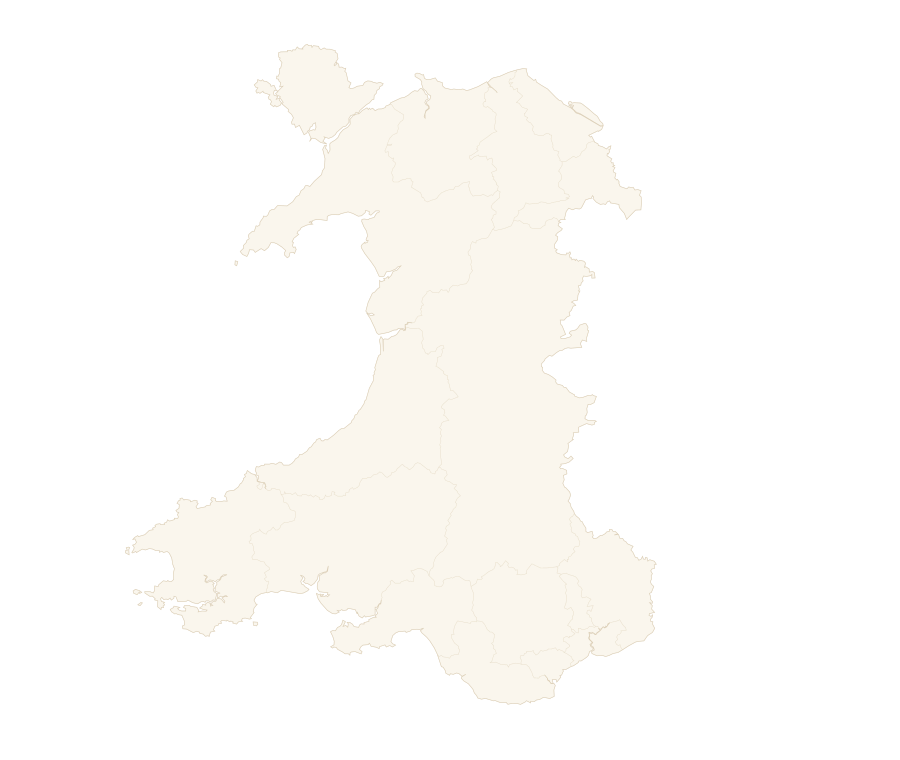
CoreHistoric reach
The seat of Vaughan
Seat vacantChief
No one leads the Vaughan community yet. When the movement opens, you can stand for its leadership, or help elect whoever does.
Current mission
No shared goal set yet. Once Vaughan has leadership, it sets the public focus: a restoration, a gathering, a real-world project that helps its own.
The Vaughan clan is being rebuilt. Join the waiting list for the movement today, and you help decide who leads it and what it does.
Help rebuild the Vaughan clan →Motto
Non revertar inultus
“I shall not return unavenged”
What does the Vaughan name mean?
From the Welsh 'fychan', younger, smaller, a descriptive byname distinguishing a son who shared a forename with a more prominent kinsman. Fychan was rewritten as Vaughan by Tudor administrators whose English orthography had no glyph for the soft Welsh 'f', and whose policy, after the Acts of Union of 1536, was to compress Welsh patronymic naming into fixed English-style surnames in any case. The name parallels the Scottish 'Beg' (small) and the Irish 'Óg' (young) as a generation-marker frozen into a surname.
The history of Vaughan
Fychan: the younger of two men with the same name
Vaughan is the English spelling of the Welsh fychan, the soft-mutated form of bychan, little or younger. It was never a surname to begin with, but a working label, hung on a man to tell him from someone standing next to him: the second Rhys in a household, the smaller of two cousins. The name only makes sense as one half of a pair. Behind every Vaughan alive today is an argument about which of two men you meant.
It is a descriptive byname, not a trade or a patronymic. Welsh produced a set of them that froze into surnames together: Lloyd from llwyd, grey; Goch, red; Gwyn, white; Crych, curly. Vaughan is the age-marker in that set, and the one that travelled furthest: the same work Young did in England, Òg in Gaelic Scotland and Óg in Ireland.
From ap Thomas to Vaughan: how the name froze
Before fixed surnames, Wales ran on patronymics. Evan son of Thomas was Evan ap Thomas, his son John was John ab Evan, John's son Rees was Rees ap John: the name changed every generation on purpose. In 1292, 48 per cent of recorded Welsh names were patronymics, over 70 per cent in some parishes, and where lineage mattered the chain got longer: Llewelyn ap Dafydd ab Ieuan ap Gruffudd ap Meredydd was an unremarkable way to be named, a spoken pedigree kept because Welsh law required a man to know his own descent. A system like that leaves a village full of men sharing two or three baptismal names, and Fychan was one of the ordinary repairs.
That law decayed through the later Middle Ages and the patronymics went with it. Fixed surnames were adopted in Wales from the 15th century onwards; under Henry VIII they became hereditary among the gentry and spread only slowly to everyone else, with the union of Wales and England in 1536 as the administrative hinge. Some names kept the ap in reduced form: Powell from ap Hywel, Price from ap Rhys, Bowen from ab Owen. Fychan went a third way: the byname itself became the surname, and English clerks with no letter for the soft Welsh f wrote what they heard.
One consequence deserves saying plainly. Welsh surnames come from so small a stock that communities are full of families sharing a surname without sharing a line. Several unconnected kindreds took Fychan for the same obvious reason at the same time, so two Vaughans in one village cannot be assumed to share an ancestor. The name is genuinely yours; the pedigree behind it is a separate question, worth researching rather than assuming.
Tretower, and the half-brothers of Gwladus the Star
One kindred carried the name into the front rank of Welsh politics. Sir Roger Vaughan of Tretower was the son of Gwladus ferch Dafydd Gam, called Gwladus the Star, and through her the half-brother of William Herbert, Earl of Pembroke. The two houses rose together out of the Welsh march in the middle of the 15th century (Raglan and Tretower, Hergest and Pembroke) as the new Yorkist captains of a country that had been Owain Glyndŵr's within living memory. Edward IV gave them Wales in all but name, and gave Herbert the wardship of the boy Henry Tudor.
Vaughan stood at his half-brother's right hand at Mortimer's Cross in 1461, and by tradition it was he who took the captured Owen Tudor to the block at Hereford afterwards. He received Tretower from Herbert around 1450, and the family held the fortified manor at the foot of the Black Mountains until 1783. Its stone ranges, gatehouse and courtyard are largely Vaughan work, and the Great Hall still stands.
Edgecote, 1469: the day Wales was widowed
On 26 July 1469, at Edgecote Moor in Northamptonshire, the Welsh-speaking Yorkist army of Herbert and Vaughan (about ten thousand men) was caught in the early morning by a flank attack from Warwick's lieutenant Sir Geoffrey Gate. Lord Stafford of Devon's English archers, expected on the right, had gone south in the night after a quarrel. The line broke after Pembroke fell. About two thousand Welshmen died on the field, principally of the Herbert and Vaughan affinities; Sir Roger Vaughan was killed in the press, and Herbert and his brother Sir Richard were beheaded the next morning at Northampton, without trial.
Guto'r Glyn wrote the elegy within the year. Marwnad William Herbert called Edgecote y dydd y gweddwyd Cymru, the day Wales was widowed, and the phrase has held for five and a half centuries: a generation of Welsh landed leadership was eliminated in one morning. Redress came sixteen years later at Bosworth in 1485, when another Welsh army crossed the marches behind Henry Tudor, the boy warded at Raglan in 1469, kin to the Vaughans through Gwladus the Star. Roger Vaughan's grave-slab, the effigy in plate with the Vaughan arms cut on the breastplate, lies in Bredwardine church in Herefordshire.
The keepers of the Red Book of Hergest
The Vaughans of Hergest, on the Herefordshire side of the border, hold a different claim on Welsh memory. They were the keepers of Llyfr Coch Hergest, the Red Book of Hergest, written between 1375 and 1425 and the greatest manuscript anthology of medieval Welsh prose and poetry: the Mabinogion, Brut y Tywysogion, and much of the Cynfeirdd, the earliest Welsh poets.
Almost everything a reader knows as Welsh legend comes down through books like this one, and books survive because somebody pays to keep them. The Hergest line patronised Welsh-language writing in exactly the period when patronage was thinning everywhere else. The Red Book is now in the Bodleian Library at Oxford; a family of the name Vaughan kept it alive long enough to get there.
Trawscoed, Golden Grove and the long gentry line
Vaughan branches emerged across Wales from the 13th century, traditionally claiming descent from the royal house of Powys, a tradition, not a charter. The two leading lines were the Vaughans of Trawscoed in Ceredigion, who became Earls of Lisburne, and the Vaughans of Golden Grove in Carmarthenshire, who became Earls of Carbery. The 2nd Earl of Carbery governed the principality as Lord President of Wales and the Marches from Ludlow Castle under Charles II; Trawscoed produced Sir John Vaughan, Lord Chief Justice of the Common Pleas from 1668 to 1674. The Earldom of Lisburne continues today.
The property record runs the length of the march. Carreg Cennen passed to the Vaughans after the Yorkists slighted it in 1462; a Vaughan manor house stood at Dunraven on the Glamorgan coast by the 16th century, recorded by John Leland, and went to the Wyndhams in 1642; Roger Vaughan bought Kinnersley in Herefordshire in 1588. The spread is the point: a web of cadet branches holding mid-Wales and the border.
Henry Vaughan the Silurist, and where the name went
The name's finest hour was not military. Henry Vaughan was born on 17 April 1621 at Newton-by-Usk in Llansantffraed, Brecknockshire, son of a small Welsh-speaking laird descended from the Vaughans of Tretower. He went up to Jesus College, Oxford, in 1638, took no degree when the Civil War broke out in 1642, served briefly as a Royalist soldier, and lost his elder brother William to wounds at Rowton Heath in 1645, the bereavement that turned him inward. From about 1648 he practised as a country physician in the upper Usk valley for forty-seven years, to his death.
Silex Scintillans, the Flashing Flint, appeared in 1650 and enlarged in 1655. The Retreat, The World, The Night and They Are All Gone into the World of Light sit in every modern anthology of 17th-century English verse, and Wordsworth's Intimations of Immortality of 1804 descends directly from The Retreat. He signed himself Silurist, the Welshman of the country of the ancient Silures, and died at Llansantffraed on 23 April 1695, buried under a Latin epitaph he wrote himself.
Carry the name abroad and you carry a Welsh one. An analysis commissioned by the Welsh Government found 16.3 million people bearing a name of Welsh origin: 3.8 per cent of the United States, 4.1 per cent of Australia, 4.7 per cent of New Zealand, against nearly 35 per cent of Wales itself. Vaughan began as a word meaning the younger, said about one man to tell him from another. It has ended on a grave-slab at Bredwardine, on a manuscript in the Bodleian, and on a book of poems still in print three centuries on.
Champions of the Vaughan name
The bearers whose lives are inseparable from this surname. Each has their own page, biography, achievements, geography, connection to the family.
Historic Places, Rebuilt
Explore the streets and seats the Vaughan name knew, rebuilt with AI as they stood in history.
Castles the Vaughan held
Strongholds this name held for a decade or more, look one up, or rebuild it to explore.
- Carreg Cennen Castle
Ownership of the castle passed in its later history to the Vaughan family.
- Dunraven Castle
The Vaughans' manor house stood on the site by the 16th century; sold to the Wyndhams in 1642.
- Tretower Court
Held by the Vaughans from about 1450, when Sir Roger Vaughan received the property from his half-brother Sir William Herbert, until the family sold it in 1783.
- Kinnersley Castle
Bought by Roger Vaughan in 1588 and renovated under the Vaughans; his son John later sold it to Francis Smallman.
The castles of the homeland
The great strongholds of the homeland, look one up, see what it looked like in its prime, and recreate it to explore.
 Caernarfon CastleRestored · prime 1330
 Conwy CastleRuin · prime 1287
 Pembroke CastleRestored · prime 1280
All castles in Wales → · Strongest castles in Wales → · Castles of Europe
Play As Your Clan
Hold a real castle against whatever you choose to send at it, take a ship out in her own service years, or stand at the shoulder of someone the record remembers. The chronicler sets the scene; the deeds are yours.
Notable bearers of the Vaughan name
- Sir Roger Vaughan of Tretower (d. 1469), killed at Edgecote
- Henry Vaughan (1621–1695), Welsh metaphysical poet
- The Vaughans of Hergest, keepers of the Red Book of Hergest
Stories of Vaughan
Frequently asked
What does the surname Vaughan mean?
Where does the Vaughan family come from?
Where did the Vaughan family historically hold territory?
Is Vaughan Welsh or English?
How old is the Vaughan surname?
What is the Vaughan family known for?
What is the Vaughan motto?
What does "Non revertar inultus" mean in English?
Is there a Vaughan family crest or coat of arms?
Who is the most famous Vaughan?
Who are some famous Vaughans?
What stories are told about the Vaughan family?
What is the story of Roger Vaughan dies at Edgecote?
Is Fychan the same family as Vaughan?
Where is the Vaughan surname found today?
What does the Clan Rising page for the Vaughan family cover?
Who is the head of the Vaughan family today?
Neighbouring clans
- EvansSon of John, by the Welsh road, the cousin name of Jones.
- LewisLlywelyn anglicised, a princely name carried into common use across the Marches and the south.
- OwenThe princely name, Owain in Welsh, the surname of the last revolt and the first Tudor.
- LloydLlwyd, the grey one, the great descriptive surname of the central Welsh ridge.