Wales · Partial ruin
Beaumaris Castle
Castell Biwmares
Beaumaris Castle is a late 13th–early 14th century concentric castle on Anglesey, Wales, begun under Edward I and designed by James of St George. It consists of an outer moated ward with multiple towers and gatehouses surrounding a larger inner ward intended to contain domestic ranges; the site later fell into ruin and is now a maintained historic monument and tourist attraction.
First raised
1295
Its prime
1330
Today
Partial ruin
Ranked among Europe’s castles
As it stood in 1330
What Beaumaris Castle looked like in its prime.
Beaumaris is a near-rectangular concentric fortress of pale grey local stone set inside a water-filled moat. An outer ward of continuous curtain wall is punctuated by twelve round towers and two outer gatehouses; an inner ward with higher walls contains six massive towers and two large D-shaped gatehouses. The centre is a broad, grassy inner bailey where ranges of domestic buildings stood. The plan is highly symmetrical and the moat is directly adjacent to the southern gate.
Its story
The story of Beaumaris Castle.
From the Statute of Rhuddlan to Beaumaris, 1284–1295
Edward I invaded North Wales in 1282 and decided to colonise it permanently. The Statute of Rhuddlan of 3 March 1284 carved three shires out of the north-west (Caernarfon, Merioneth and Anglesey), each governed from a new town beneath a new castle. Anglesey's was probably planned near Llanfaes, the wealthiest and most populous borough in Wales and a port on the preferred route to Ireland. The cost of the castles already rising at Caernarfon, Harlech and Conwy postponed the plan.
A rebellion revived it. Madog ap Llywelyn rose against English rule in 1294, and among the casualties was Roger de Pulesdon, sheriff of Anglesey. With the island reoccupied in April 1295, Edward revived the shelved scheme. The new site, a mile from Llanfaes, was called Beaumaris, “fair marsh”, from the Norman-French Beau Mareys; the Welsh population of Llanfaes was moved some twelve miles south-west to a new settlement named Newborough, clearing the ground for an English town under a new castle.
Master James of St George and the Leather Tokens
Work began in the summer of 1295 under Master James of St George, the king's master of works in Wales, for whom Beaumaris was now the main charge. The pipe rolls record that first summer in detail: an average of 1,800 workmen, 450 stonemasons and 375 quarriers on site, at around £270 a week in wages. The project fell into arrears so fast that officials issued leather tokens instead of coin, and the centre of the castle filled with huts to house the workforce through the winter.
The following spring James spelled out the costs to his employers. He had needed, and would go on needing, “400 masons, both cutters and layers, together with 2,000 less skilled workmen, 100 carts, 60 wagons and 30 boats bringing stone and sea coal; 200 quarrymen; 30 smiths”. The men's pay, he added, “has been and still is very much in arrears, and we are having the greatest difficulty in keeping them because they have simply nothing to live on.”
£15,000 Spent, the Walls Still Short
Building slowed through 1296 as debts mounted and stopped entirely by 1300, about £11,000 in, Edward's new wars in Scotland having taken his attention and money. The inner walls and towers stood at a fraction of their proper height, and the north and north-west sides had no outer defences. A feared Scottish invasion brought the masons back in 1306, first under James and then, after his death in 1309, under Master Nicolas de Derneford. Work halted for good in 1330, still short of the intended height, with £15,000 spent. A royal survey in 1343 reckoned at least £684 more was needed to finish it; the money was never invested.
The outer gate was set out of line with the inner, so an intruder who forced the first had to cross open ground on a predictable rightward path under fire. Arnold Taylor called Beaumaris Britain's “most perfect example of symmetrical concentric planning”, and for many years it was thought the pinnacle of military engineering in Edward I's reign, a reading historians now dispute, holding it as much a royal palace and symbol of English power as a fortification.
Taken by Glyndŵr's Rebels, 1403
A revolt against English rule broke out in North Wales in 1400 under Owain Glyndŵr. Rebels besieged and took Beaumaris in 1403; royal forces retook it in 1405. Neglect did the rest: by 1534, when Roland de Velville was constable, rain leaked into most of the rooms, and a report of 1539 counted an arsenal of eight or ten small guns and forty bows, which the new constable Richard Bulkeley thought quite inadequate against a Scottish attack. By 1609 Beaumaris was classed as “utterlie decayed”.
Surrendered Twice for Charles I, 1646 and 1648
War made the decayed castle useful again: it controlled part of the route between Charles I's Irish bases and his English operations. Thomas Bulkeley, whose family had managed the castle for centuries, held it for the king and may have spent around £3,000 on its defences. With the royal armies beaten, Colonel Richard Bulkeley surrendered in June 1646; Anglesey revolted again in 1648 and royalists briefly reoccupied the castle, giving it up a second time that October.
Parliament, fearing a royalist invasion from Scotland, spared Beaumaris the slighting inflicted elsewhere and garrisoned it under Colonel John Jones at £1,703 a year. When Charles II restored the Bulkeleys as constables in 1660 it appears to have been stripped of its lead and roofs. Thomas Bulkeley, 7th Viscount Bulkeley, bought the ruin from the Crown in 1807 for £735 and folded it into the park at Baron Hill. In 1925 it went into the care of the Commissioners of Works, who dug out the moat and repaired the stonework.
Step inside
9 places to explore in 1330.
The record describes 9 distinct spots at Beaumaris Castle, including 1 interior: domestic ranges (inner ward, interior remains). Create your own photoreal reconstruction and explore every one, more scenes means more rooms, more angles, and more of the place to stand in.
Build Your Own Castle
Recreate Beaumaris Castle with AI to explore it.
The artist rebuilds it as it stood in 1330, a photoreal reconstruction that belongs to you alone. Pay with coins, no subscription needed.
Recreate this castle →Defend this castle →Whose castle
Clans who held Beaumaris Castle.
The families that held Beaumaris Castle for a decade or more across its history, follow a name to its clan.
Bulkeley
Held for the Crown by the Bulkeley family, hereditary constables; bought outright by the 7th Viscount Bulkeley in 1807.
From the archive
Beaumaris Castle on paper: the measured plan and period views.
The survey plan and photographs below are the ground truth this page's reconstructions are checked against, drawn and photographed while the castle was still a working garrison. Every image is public-domain or openly licensed, with its source named.

Beaumaris Bay, Beaumaris Castle, Wales LOC 3751652297
ca. 1890-1900 · Photochrom Prints Collection (via Wikimedia Commons)
Public domain
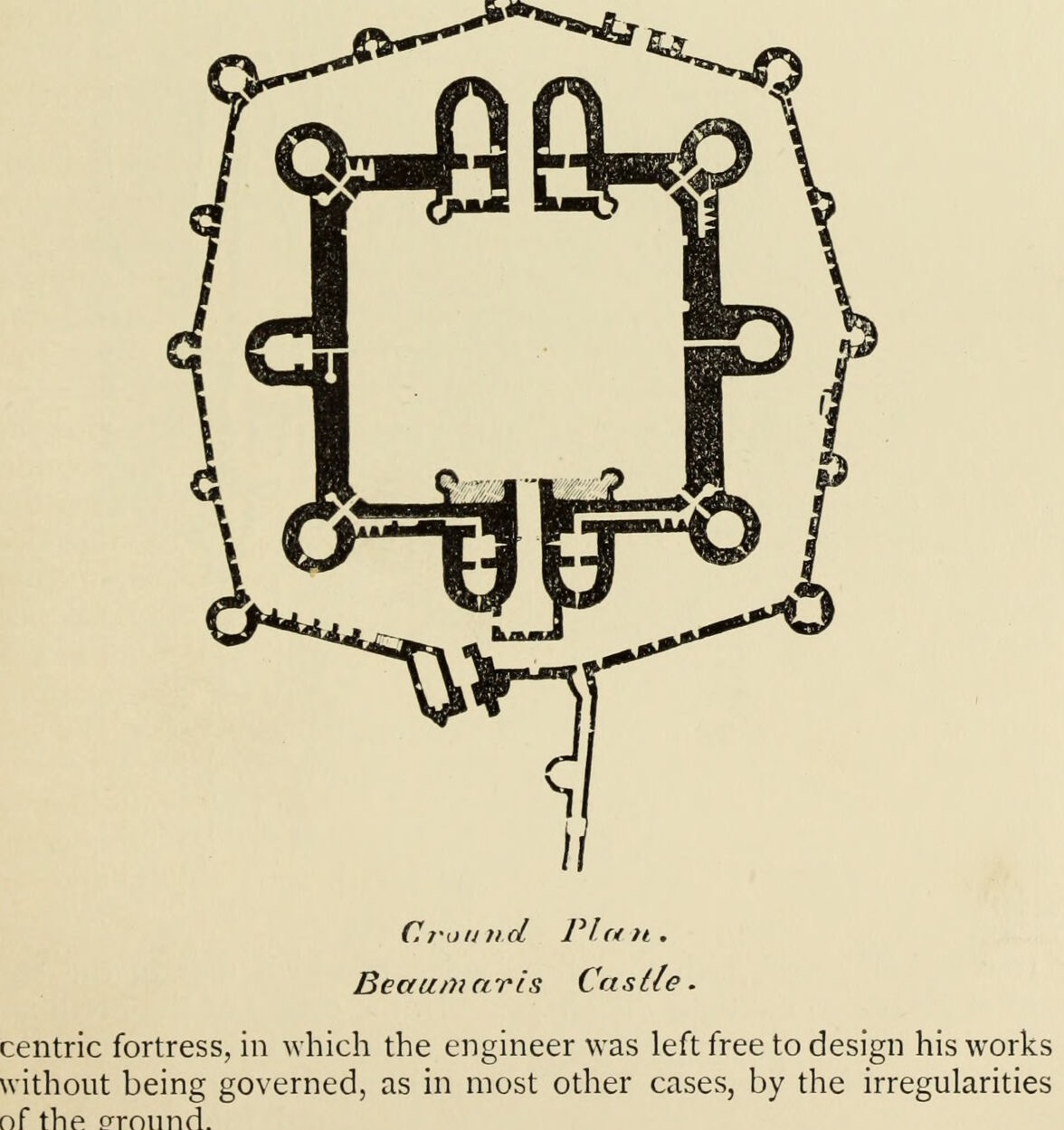
Ground Plan. Beaumaris Castle.
1884 · G. T. Clark, Mediaeval Military Architecture, vol. 1 (1884)
Public domain
Nearby