Farrell
also O'Farrell, Ó Fearghail
Lords of Annaly, and the family that gave Longford town its name.
- Origin
- Leinster, Ireland
- Motto
- Cú re cú agus duine re duine
- Famous bearer
- Colin Farrell (b. 1976), actor
- Register
- Irish family
Where the Farrell name comes from
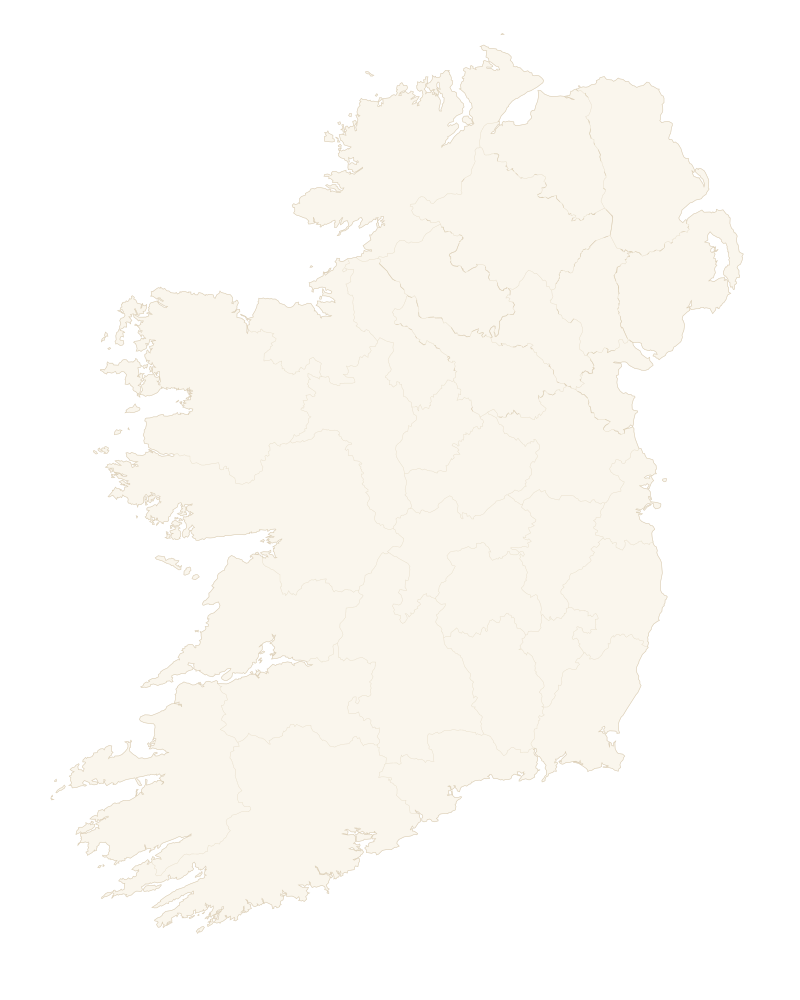
CoreHistoric reach
The seat of Farrell
Seat vacantChief
No one leads the Farrell community yet. When the movement opens, you can stand for its leadership, or help elect whoever does.
Current mission
No shared goal set yet. Once Farrell has leadership, it sets the public focus: a restoration, a gathering, a real-world project that helps its own.
The Farrell clan is being rebuilt. Join the waiting list for the movement today, and you help decide who leads it and what it does.
Help rebuild the Farrell clan →Motto
Cú re cú agus duine re duine
“Hound to hound and man to man”
What does the Farrell name mean?
From Ó Fearghail, descendant of Fearghal ('man of valour'). The Ó Fearghail of Annaly (Anghaile) were the chief sept of County Longford from the 13th century to the Tudor confiscation, with their seat at Longphort Uí Fhearghaill, the 'longphort' or fortified residence that gave the modern county town and county its name. Annaly remained a Gaelic lordship under the Ó Fearghail until the dissolution of the lordship by Sir Henry Sidney in 1565 and the Plantation of Longford under James I in 1620.
The history of Farrell
The longphort that gave a county its name
Farrell is the anglicised Ó Fearghail, descendant of Fearghal, a personal name meaning man of valour. Fearghal was a great-grandson of Angaile, a tenth-century king of Fortúatha who conquered the midland country that has carried his name ever since as Annaly. The ancestor from whom the family claims its descent, Fearghail of Conmaicne, was killed at the Battle of Clontarf in 1014, by which time Angaile had already established control of the territory. Genealogists group them with the Conmaicne Rein, whose other chiefly houses were the MacRannalls, O'Cornyns, O'Moledys and O'Quins.
The chief sat at Longphort Uí Fhearghail, the fortified residence whose name the town and the county of Longford still carry, with a second seat at Moatfarrell, Móta Uí Fhearghail, in eastern Annaly between Ballinalee and Edgeworthstown. The family fought under a motto that set out the terms plainly: Cú re cú agus duine re duine, hound to hound and man to man. From the early eleventh century until the confiscations of James I, Annaly was theirs to rule as a principality, and the six centuries of Ó Fearghail history that follow are the history of holding it.
Depredations, aggressions and slaughters
Rule was disrupted by repeated English invasions through the twelfth and thirteenth centuries, and the annals record the family answering in kind. In 1262 the English of Meath deposed Giolla na Naomh Ó Fearghail, who then committed, in the annalists' own list, "many evils, depredations, aggressions, spoliations, and slaughters" to re-assert his lordship of Annaly. The lordship was recovered; the method was noted.
In 1316 the Ó Fearghail fought at the Second Battle of Athenry in support of Edward the Bruce's Irish campaign, and four of them died at the hands of the victorious English. In 1323 a large English army under Lord Bermingham came against them and was repulsed and slain at the command of Donnell Ó Fearghail. In 1329 the sons of John Ó Fearghail, acting with a party of the Meath English, lured the Earl of Breifne to a house at Fore and murdered him there, a reminder that the border with Meath ran through alliances as well as land.
Seven of the name in the see of Ardagh
In fourteenth- and fifteenth-century Ireland ecclesiastical office was frequently entrusted as a hereditary holding, and the diocese of Ardagh became as much an Ó Fearghail possession as the longphort. Eóghan Ó Fearghail, Owen O'Ferral in the English records, held the see from 1343 to 1367, and Cairbre Ó Fearghail from 1373 to 1378.
Then the family took the bishopric for most of the fifteenth century in turn: Conchobhar from 1416 to 1423, Risdeárd from 1425 to 1444, Donnchadh from 1467 to 1469, Seaán from 1469 to 1479, and Uilliam Ó Fearghail from 1482 to 1516. Seven named men: the church in Annaly staffed from the same kin as the lordship, and the two surviving the same wars.
Ormond bought off, and the field at Knockdoe
The fifteenth-century chiefs handled the crown's men with money as readily as with weapons. In 1452 the Ó Fearghail chief clashed with the Earl of Ormond, Lord Lieutenant of Ireland, over the imprisonment of Lord Bermingham's son by the O'Reillys of East Breifne; Ó Fearghail bought Ormond off, and the Lord Lieutenant rode away to pursue O'Reilly instead. Feuding with the same neighbours turned bloody in 1471 at Clankee, where the O'Reilly commander was killed and the Ó Fearghail chief was taken prisoner.
Not every loss came in battle. In 1464 John and Redmond Ó Fearghail of the Annaly lords died of bubonic plague along with members of their families, and in 1475 a number of the name were banished to the English of Meath for killing one of their own kin. In 1504 the chief joined the Lord Deputy Gearóid FitzGerald, with most other Irish chiefs, in the very large Anglo-Gaelic army that marched on Munster and beat the O'Briens at Knockdoe, one of the largest battles ever witnessed in Ireland.
Delvin's grant, Sidney's shire, and the deposition of 1618
The undoing began with a stroke of a pen rather than a siege. In 1552 Edward VI granted much of the lands of Annaly to Baron Delvin, the Holy Island and the Ó Fearghail estates among them, and the principality never recovered the ground. From 1565 the Annaly chiefs clashed repeatedly with the new Lord Deputy, Sir Henry Sidney, whose plan was to shire the country into an English county with sheriffs in place of chiefs.
In 1618 the Ó Fearghail of Longford were finally deposed as Princes of Annaly by James I. The Annals of the Four Masters put it without consolation: "They were deprived of their estates without any compensation whatsoever, or any means of subsistence assigned them." With the tribal Gaelic order gone, many of the family stayed on the same fields as tenants of English and Scottish landlords.
The first record of the name written in English belongs to this moment of collapse. It was made in 1620 by Father Richard O'Farrell, a priest of Annaly in County Longford, who joined the Irish Catholic Confederacy and went on to witness and write about the wars of the Continent.
The Longford Column at Benburb, and Cromwell before Waterford
Dispossessed men took their trade abroad. A number of O'Farrells served in an Irish regiment of the Spanish army during the Eighty Years' War, and by the rebellion of 1641 many had come home to fight with the Irish Catholic movement of Confederate Ireland. In 1646 General Richard O'Farrell, newly arrived from that Spanish service, led the Longford Column, an O'Farrell force within the Irish Confederate Army, at the Battle of Benburb under Owen Roe O'Neill, whose deputy he was; the Covenanters were decisively beaten in a large-scale pitched battle.
In 1649 he was at the First Siege of Waterford, defending the city against Oliver Cromwell and coming off the winner through siege-warfare experience earned in the Low Countries with the Spanish and French armies. The same year in Wexford, Captain Daniel O'Farrell recaptured Enniscorthy Castle from the New Model Army. The run ended in 1652 at Galway, where Richard O'Farrell stood with Thomas Preston, 1st Viscount Tara, and the English Parliamentarians took the town.
Wild Geese: a road into Brussels, a regiment to Tangier
What remained of the family went where soldiers were paid. In 1657 O'Farrells in French service held an access route to Brussels during the Franco-Spanish War, and at the behest of the exiled Charles II they switched sides, standing aside so the Spanish could pass along the road and strike Brussels from Flanders. In 1662, on the orders of the restored king, the family was commissioned to Tangier in North Africa: 381 O'Farrells made up the bulk of the Irish contingent, half of the whole Tangier Regiment, and sailed for Africa together.
Others chose the other side. Francis Fergus O'Farrell, born in County Longford in 1650, moved to the Netherlands, married a local girl and raised six children there before serving in the army of William of Orange, seeing action in England and Ireland for the Protestant cause. Ceadagh O'Farrell of Annaly was killed at the Battle of the Boyne in 1691, and his three sons fled to the French brigades, some of them settling in Picardy.
The family's own record-keeping outlasted its lands. In 1709 Roger O'Ferrall compiled Linea Antiqua, a genealogical and historical account of the Irish nation gathered from the pedigrees of the Gaels; it was later transcribed by Sir William Betham, copied by John O'Hart into his Irish Pedigrees, and is held today by the Genealogical Office at the National Library of Ireland. In 1751 the marriage of Richard O'Ferrall, who held the title Prince of Annaly, to Laetitia O'More founded the House of More O'Ferrall, which carries the title still.
The Wallasey boy who wrote the empire down
James Gordon Farrell was born at Wallasey on Merseyside on 25 January 1935, second son of an Anglo-Irish accountant of County Galway descent working for the Liverpool branch of Shell-Mex. The household kept both its Liverpool-English and west-Irish identities and moved back to Dublin in 1936; he was schooled in Dublin and at English schools, finishing at Rossall School in Lancashire. He went up to Brasenose College, Oxford in 1956 to read modern languages, contracted poliomyelitis in his first year and carried the resulting muscular weakness in the upper body for the rest of his life. He took his degree in 1960 and at twenty-six moved to Paris, writing on a typewriter with English teaching on the side.
A Harkness Fellowship to Yale in 1968 bought him the year in which he began the Empire trilogy. Troubles (1970), the Big House novel set at the fictional Majestic Hotel on the Wexford coast across the war of 1919 to 1921, won the Geoffrey Faber Memorial Prize and was awarded the Lost Booker in 2010. The Siege of Krishnapur took the Booker Prize in 1973, and The Singapore Grip completed the sequence in 1978. He had moved to a coastal house at Bantry in west Cork in 1977 and begun a fourth novel, The Hill Station, when he died at Bantry on 11 August 1979, forty-four years old; the unfinished book was published from his manuscript and notebooks in 1981.
Coaches, cardinals and architects of the name
Andy Farrell (b. 1975), the English league-then-union player turned manager, took Ireland to the Grand Slam in 2023, the Six Nations title in 2023 and again in 2024, and the British and Irish Lions tour of 2025; Owen Farrell plays rugby union for Saracens and England, and Dessie Farrell came up as an Irish footballer. Charles Farrell (1900–1990) was the American actor who partnered Janet Gaynor in early Hollywood.
The name also runs through building and design: Sir Thomas Farrell the Irish sculptor, William Farrell the Irish architect who died in 1851, Yvonne Farrell the Irish architect, and Sir Terry Farrell (1938–2025), the British architect and urban designer. Suzanne Farrell danced as an American ballerina and Eileen Farrell sang as an American soprano. John Farrell (1826–1865) was the Irish soldier awarded the Victoria Cross, Thomas Francis Farrell (1891–1967) an American general, and Kevin Farrell (b. 1947) an American cardinal, the descendants of a Longford lordship that lost its lands in 1618 and kept its name.
Champions of the Farrell name
The bearers whose lives are inseparable from this surname. Each has their own page, biography, achievements, geography, connection to the family.
The castles of the homeland
The great strongholds of the homeland, look one up, see what it looked like in its prime, and recreate it to explore.
 Ashford Castle, County MayoRestored · prime 1880
 Manderley CastleRestored · prime 1840
 Dublin CastleRestored · prime 1790
All castles in Ireland → · Strongest castles in Ireland → · Castles of Europe
Play As Your Clan
Hold a real castle against whatever you choose to send at it, take a ship out in her own service years, or stand at the shoulder of someone the record remembers. The chronicler sets the scene; the deeds are yours.
Notable bearers of the Farrell name
- Colin Farrell (b. 1976), actor
- Andy Farrell (b. 1975), Ireland rugby head coach; Grand Slam 2023, Six Nations 2023 and 2024, British and Irish Lions tour 2025
- James T. Farrell (1904–1979), Chicago novelist (Studs Lonigan)
- James A. Farrell (1862–1943), president of US Steel 1911–1932
- Charles Farrell (1900–1990), American actor, partner of Janet Gaynor in early Hollywood